Quick Take
- Narration: Lawrence Bransby narrates his own diary, and the self-narration is the right call, his South African voice and obvious lived familiarity with every detail gives the account an intimacy that no professional narrator could replicate.
- Themes: Father-son adventure and relationship, improvised travel through political instability, the motorcycle as philosophical companion
- Mood: Warm, gritty, and frequently funny, an old-fashioned adventure diary with genuine heart.
- Verdict: An unpretentious and thoroughly absorbing travel memoir that earns its place among the best of the adventure motorcycle genre, made better by Bransby’s own voice carrying every mile.
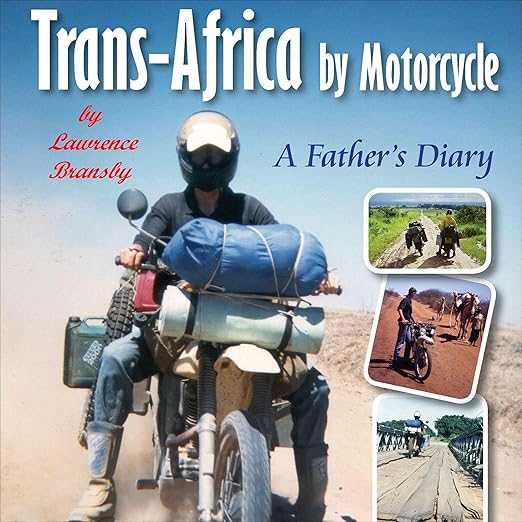
I have a weakness for adventure travel memoirs that describe journeys no sensible planning committee would approve. The best ones share a specific quality: they are not written for an audience that needs to be impressed. Lawrence Bransby’s account of taking his seventeen-year-old son Gareth across Africa on a pair of aging XT500 motorcycles, with very little money and three Michelin maps that cover the entire continent, belongs firmly in this category. I listened to it during a long drive through the desert, which felt appropriately thematic, and I arrived at my destination feeling slightly spoiled by my comfortable vehicle.
The premise is exactly what it sounds like. In an era when celebrity motorcycle expeditions come equipped with support 4x4s, spare parts vehicles, and camera crews, Bransby and his son set off from their home in Natal, South Africa with the bare minimum. The plan was to travel north then west through Zaire, the Central African Republic, Nigeria, and Niger, and then across the Sahara through Algeria. The plan did not survive contact with reality: wars in Sudan and Zaire, and murders of Europeans in Algeria, forced a continuous rerouting east until father and son found themselves on the Red Sea coast of Eritrea, with war-torn Sudan blocking west and Egypt’s closed border blocking north.
Our Take on Trans-Africa by Motorcycle
What makes this memoir worth your attention is not the adventure itself, though the adventure is genuinely impressive, but the relationship at its center. Bransby is honest about the asymmetry of traveling with a seventeen-year-old: Gareth is old enough to be a real partner in the logistical challenges, young enough that his father is still responsible for decisions whose consequences he cannot fully calculate. The diary format captures this in real time rather than retrospectively, which means the anxiety and the miscalculation are not smoothed over with the knowledge of how things turned out.
The political geography the Bransbys navigate is another of the book’s unexpectedly interesting dimensions. They pass through countries whose current conditions are very different from those of the early 1990s when the journey took place, and Bransby’s diary-in-progress observations about borders, officials, hospitality, and danger have the texture of someone learning a continent by crossing it rather than someone with a political thesis to advance. His portraits of the people they meet, from customs officials to local hosts to other travelers encountered in unlikely circumstances, have a specificity that comes from having actually been there.
One reviewer noted some discomfort with the religious dimension of the book, which runs as a thread through Bransby’s self-reflection. This is honest feedback for secular readers: Bransby is a believing Christian and this shapes how he interprets the journey’s providential close calls. It does not overwhelm the adventure narrative, but it is present, and readers who prefer their travel writing without theological commentary should know in advance.
Why Listen to Trans-Africa by Motorcycle
Bransby’s self-narration is the audiobook’s anchor. His South African accent and unhurried delivery suit the diary format perfectly, and the sense that you are hearing a man recount an experience he actually had is exactly what this kind of first-person adventure memoir needs. One reviewer described feeling saddle sore as though they had been with Bransby day by day, which is high praise for a memoir’s ability to place the listener in the experience.
At just under seven hours, the runtime is modest for a four-month journey across a continent, which means the editing is ruthless. Bransby includes what is interesting and omits what is merely sequential, which is a harder skill to execute than it sounds in a diary-based memoir.
What to Watch For in Trans-Africa by Motorcycle
The section covering Eritrea and the Red Sea coast, where the original plan had definitively collapsed and the Bransbys were genuinely uncertain about how to proceed, is the memoir’s most compelling stretch. The enforced creativity of that situation, finding a boat to Egypt via Saudi Arabia, dealing with borders that should not have admitted them and officials who might not have been bribable, produces the kind of travel writing that reads like improvised fiction because the circumstances were improvised in real time.
Also worth attention is the postscript dimension of the story: twenty-five years later, father and son still ride together, with subsequent journeys through Russia, Morocco, and Central Asia. The original African trip is not just an adventure the book documents; it established a way of being in relationship that continued across decades. That longevity gives the memoir a retrospective weight that a purely chronological account would not have.
Who Should Listen to Trans-Africa by Motorcycle
Adventure motorcyclists will find this essential reading in the genre’s tradition. Travel memoir readers who enjoy overland adventure accounts, whether on motorbikes or by other means, will find the narrative approach accessible and the detail rewarding. The book works equally well for armchair travelers who respond to the what-if quality of genuinely improvised journeys. Listeners who want polished literary travel writing in the style of William Least Heat-Moon or Colin Thubron should adjust their expectations: Bransby is a diary-keeper and an adventurer, not a literary stylist, and the book’s considerable charm comes precisely from that directness.
Frequently Asked Questions
Do you need to be a motorcyclist to enjoy this memoir?
No, though motorcycle enthusiasts will find additional pleasure in the technical details of keeping aging XT500s running across some of the continent’s most difficult terrain. Bransby writes about the bikes as characters in their own right, but non-riders will follow the broader adventure narrative without difficulty.
When did this journey take place, and how does the African political landscape described compare to today?
The journey took place in the early 1990s. Many of the political conditions Bransby describes, wars in Sudan and Zaire, closed borders, instability in Algeria, have since changed significantly, though others have not. The memoir reads partly as a historical document of a specific moment in African political geography.
How does Bransby’s religious perspective affect the narrative for secular readers?
It is a genuine thread in the memoir’s reflective passages and in how Bransby interprets close calls and providential assistance. It does not dominate the adventure narrative but it is consistently present. One reviewer flagged this as an irritant; most others barely mention it. Readers who strongly prefer secular travel writing should know in advance.
Is there a sequel, and does this book work without it?
Bransby has written about subsequent journeys including trips through Russia, Morocco, and Central Asia, and at least one reviewer mentions having downloaded the next adventure before finishing this one. The African memoir works completely as a standalone with its own beginning, middle, and end.