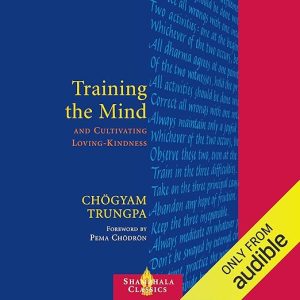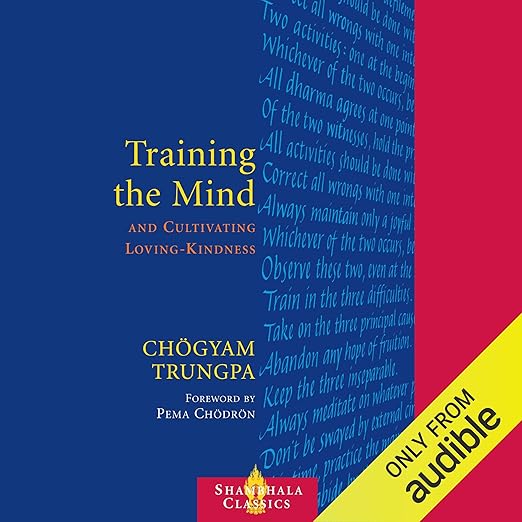
- Narration: Roger Clark reads Trungpa's commentary with measured clarity, treating the slogans as instructions rather than decoration, exactly the right approach for this material.
- Themes: Lojong mind training, ego dissolution, compassion as daily practice
- Mood: Austere and demanding, quietly transformative
- Verdict: Among the most direct and practically useful Buddhist texts available in audio, provided you are ready to be told uncomfortable things about yourself with no softening.
I came to Training the Mind during a stretch of weeks when I was reading a great deal of Buddhist philosophy but finding most of it too abstract to land anywhere useful. Books that circle around the concept of compassion without ever telling you what to do with your hands on a Tuesday morning. Chögyam Trungpa's commentary on the 59 lojong slogans is a different kind of thing entirely. The synopsis itself carries a warning that using this book could be hazardous to your ego, and that warning is not rhetorical decoration. Trungpa means it.
The lojong slogans originated with the Indian master Atisha in the eleventh century and have been used in Tibetan Buddhist practice for eight hundred years as a tool for what is called mind training, the systematic dismantling of habitual self-cherishing in favor of genuine openness toward others. Trungpa's commentary on all 59, delivered originally as teachings and here transcribed and edited for reading, is among the most direct and least sentimental treatments of this material in the English language. Pema Chödrön, who contributes a new foreword to this edition, studied directly with Trungpa, and her own work in books like When Things Fall Apart grows directly from this root.
The Review
What strikes me most about Trungpa's approach is his refusal to make this material feel safe. Slogans like "Be grateful to everyone" or "Always maintain only a joyful mind" could easily be reduced to affirmations, bumper stickers, the kind of chirpy positive-thinking content that fills half the self-help shelf. Trungpa won't let that happen. His commentary repeatedly insists that these instructions are literal and that they apply to your worst-case scenarios, not the pleasant ones. One longtime reader described the experience as getting kicked in the face, in terms of the book's powerful call to wake up, and I understand exactly what they meant.
Multiple reviewers with experience across many lojong texts, including Jamgon Kongtrul's classic formulation, rate this as the best available for its combination of thoroughness and directness. That endorsement carries weight. The 59 slogans cover an enormous range of territory, from how to work with difficulty and pain to how to behave at the moment of death, and Trungpa's commentary doesn't skip the hard ones.
Why Listen to Training the Mind
There is a genuine question about whether a text like this belongs in audio format at all. These are instructions designed to be returned to repeatedly, to be memorized and applied moment by moment in ordinary life. You won't absorb everything in a single five-hour listen, and the format doesn't encourage the kind of stopping and sitting with individual slogans that the practice is built around. That said, Roger Clark's narration is an asset here. He reads Trungpa's commentary with a quality of attention that matches the material, unhurried, precise, without the performance quality that can make spiritual audiobooks feel staged. You get the sense that the reader has spent time with this text rather than encountering it fresh in the recording booth.
At five hours and twenty-four minutes, the audiobook is dense rather than long. The slogans themselves are brief; Trungpa's commentary on each ranges from a few sentences to several pages. The accumulative effect by the end is considerable, but the individual units are digestible in shorter listening sessions, which makes this one of the more sensible formats for the material.
The Caveats
This is not an introductory text, despite sometimes being recommended as one. You will get more from it if you have some existing familiarity with basic Buddhist concepts, particularly the Mahayana framing of bodhichitta, the awakened heart or awakened mind that lojong practice is meant to cultivate. Trungpa doesn't pause to define these terms at length, and he doesn't soften his instructions for readers who might find them confrontational. One reader who had not previously encountered Buddhist practice described the experience as highly rewarding precisely because there is no doctrine in the conventional sense, nothing required to believe, only practices to try. That is accurate and worth holding onto if you come from outside Buddhist tradition.
The genre tag here is history, which feels genuinely misplaced; this is a practical manual for meditation and ethical development, not a historical survey. Don't let the metadata mislead you.
Who Should Pick Up Training the Mind
Anyone who has found other Buddhist introductions too theoretical and wants something with immediate daily application will find this invaluable. It works whether or not you identify as Buddhist, because the instructions are behavioral rather than doctrinal. Skip it if you are looking for comfort or for a gentle entry into mindfulness culture; this book will not flatter you or tell you that you are already doing fine.
Frequently Asked Questions
Do you need to be Buddhist to get something from this audiobook?
No. Multiple reviewers with no Buddhist background found the practices immediately applicable to daily life. The instructions are behavioral rather than doctrinal, nothing requires belief, only practice.
Is this a good introduction to lojong practice, or is prior knowledge required?
Some familiarity with basic Mahayana Buddhist concepts will help you get more from Trungpa's commentary. It is not written as a primer and doesn't pause to define foundational terms. That said, curious readers without background have found their way in.
How does Roger Clark's narration handle Trungpa's direct, sometimes blunt style?
Clark reads with measured calm and precision that suits the material well. He treats the slogans as instructions rather than literary passages, which is exactly the right interpretive choice for a practice manual.
Can this audiobook replace reading the physical book, or is this a format that limits the text?
The lojong slogans are designed to be memorized and returned to daily, which audio makes harder. The audiobook works well as an introduction or refresher, but serious practitioners will want a physical copy alongside it for reference and repetition.