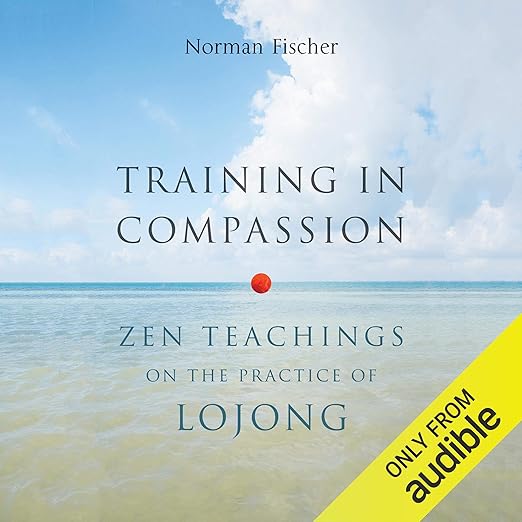
Quick Take
- Narration: Norman Fischer reading his own work creates an immediate contemplative quality that a different narrator could not replicate. His Zen teacher’s cadence gives the slogans genuine weight.
- Themes: Mind training across traditions, radical generosity as daily practice, the gap between knowing and living
- Mood: Calm and quietly transformative, best absorbed in small pieces over time
- Verdict: One of the clearest and most usable commentaries on the lojong slogans available in audio, with cross-tradition framing that makes it accessible well beyond Buddhist practitioners.
I came to Training in Compassion through a long and roundabout path. I had been reading Pema Chodron for years without ever going further into the lojong tradition she drew from. The slogans themselves, those compressed instructions for mind training that look deceptively simple, had been sitting in my reading notes for months with a vague intention to follow the thread. Norman Fischer’s commentary arrived at the right moment, during a period when I needed practical instruction more than theoretical framework, and what I found was considerably more useful than I expected from a six-hour audiobook on a millennium-old practice.
What distinguishes this book from other lojong commentaries I have since found is precisely what one reviewer identifies: Fischer approaches these Tibetan Buddhist teachings from a Zen perspective, and that cross-traditional lens does something genuinely valuable. It reveals the slogans as pointing toward principles that are not doctrinally specific. You do not need to be Buddhist to use these practices. Fischer is explicit about this, and his commitment to making lojong accessible to anyone interested in living more generously and attentively is not a watering-down of the tradition but an honest expansion of it. Pema Chodron’s influence in bringing lojong to Western non-Buddhist audiences is the acknowledged starting point; Fischer carries that work further by showing how the slogans resonate across multiple contemplative traditions simultaneously.
What the Slogans Actually Ask of You
Lojong practice centers on short, pithy statements designed to be carried through daily life. Things like exchanging yourself for others or meditating on whatever provokes resentment. These are not affirmations. They are instructions for interrupting habitual mental patterns, and the interruptions they propose are often uncomfortable. Fischer’s commentary earns its high reputation because he does not soften this. He explains what each slogan is asking without making it sound easier than it is, while also conveying genuine encouragement that the practice is achievable within an ordinary life rather than requiring retreat conditions or advanced meditation skill.
One reviewer notes this was the first of five books they read on lojong, which suggests the book does its pedagogical work well: it opens a door rather than closing a subject. Another reviewer, returning to the book a second time, notes it is only the second book they have ever read twice. That quality of re-usability is significant for a practice text. Fischer has written something that rewards return visits because the practice itself requires them. The slogans you needed most on first reading will not be the same ones you need six months later.
Fischer Reading Fischer
The decision to have Fischer narrate his own work is the right one for reasons specific to this material. Fischer is a long-practicing Zen teacher with decades of teaching experience, and the way he reads his commentary reflects that background. There is no urgency in his delivery, no performance of profundity. The pauses feel earned rather than scripted. The humor, which appears regularly and is one of the book’s real pleasures, lands naturally rather than being set up by inflection. One reviewer describes the book as full of wisdom and humor that they will return to again and again, noting that Fischer’s voice comes through loud and clear whether or not you have heard him teach. That observation captures something important: a teaching voice is a specific thing, different from a narrator voice, and when the two coincide the audio format acquires a quality closer to sitting with a teacher than reading a book.
For Practitioners and for Everyone Else
The interesting positioning of this book, which Fischer is deliberate about, is that it sits at the intersection of a specific Buddhist practice and a universal human project. One reviewer makes the point that too many Western Buddhist practitioners approach the dharma without examining moral foundation, and that Fischer’s Zen-inflected lojong commentary helps address that gap. Another reviewer, coming at the text from a more evaluative angle, appreciates how Fischer’s explanation of the seven-point mind training technique presents the lojong in a way that is both sequential and easy to understand, inspiring continued study. Both responses point to the same quality: a book that takes its subject seriously enough to be genuinely useful to people at very different stages of engagement with contemplative practice, without ever talking down to either group.
Who Should Listen and Who Should Skip
This book works for anyone interested in practical ethics, mind training, or contemplative practice regardless of religious background. It is particularly valuable for people who have been drawn to Pema Chodron’s work and want to go deeper into the lojong source material. The free audiobook format suits the material well: six hours of content you can absorb in segments, returning to specific slogans as your practice or your circumstances require. It is not the right entry point for someone wanting a narrative introduction to Buddhism broadly, nor for someone looking for quick self-help results. The practice requires patience, and the book makes no apologies for that honest requirement.
Frequently Asked Questions
Do I need any prior knowledge of Buddhism to benefit from this audiobook?
No. Fischer explicitly frames the lojong slogans as useful to anyone, including people with no interest in Buddhism or meditation practice. The commentary draws on Zen, Tibetan Buddhism, and broader spiritual traditions in ways that are accessible without doctrinal background.
How does Fischer’s commentary compare to Pema Chodron’s work on lojong?
Chodron is the teacher most responsible for bringing lojong to Western audiences and is mentioned directly as a key influence. Fischer’s approach is complementary: he applies a Zen lens to the Tibetan tradition, which one reviewer describes as cutting to the chase with a flavor that makes the slogans easy to carry for daily practice. Both are recommended; neither replaces the other.
Is this audiobook designed for sequential listening or can individual slogans be approached selectively?
Fischer structures the slogans in a sequential progression that builds on itself, so first-time listeners benefit from going in order. Return listeners, and several reviewers describe this as a book worth revisiting multiple times, can navigate more selectively according to what is currently relevant in their practice or their life circumstances.
How does Fischer handle the humor in the material, and does it undercut the contemplative seriousness?
The humor is one of the book’s strengths and does not undercut the material. Fischer uses it to deflate the self-importance that can accumulate around spiritual practice, which is itself consistent with the lojong spirit. Reviewers consistently mention the combination of wisdom and humor as a defining quality of both the book and the narration.