Quick Take
- Narration: Mike Sullivan handles the immense scope of Quigley’s prose with steady authority, a marathon performance that maintains comprehension across 77 hours without descending into monotony.
- Themes: global power structures, financial history, the transition from European dominance to Cold War multipolarity
- Mood: Dense, demanding, and intellectually galvanizing for the right reader
- Verdict: One of the most ambitious works of 20th-century historical analysis finally available in full, unabridged audio, essential for serious students of global history, genuinely punishing for casual listeners.
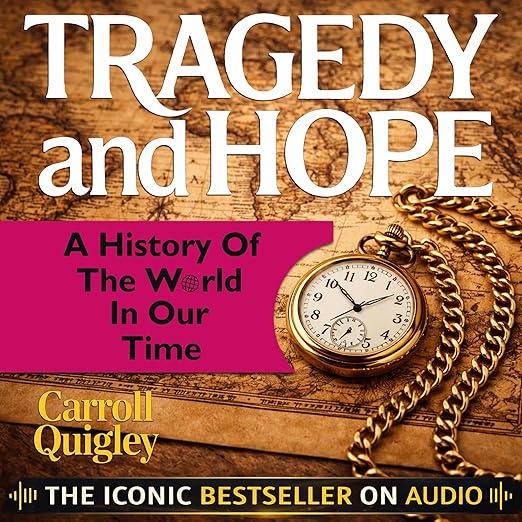
Seventy-seven hours. I want to start there, because that number is not incidental to the experience of this audiobook, it is the experience. Carroll Quigley’s Tragedy and Hope is one of those books that exists at the outer edge of what the format can contain. At roughly three full days of listening time, it requires a different kind of commitment than most audiobooks, and it will reward or defeat you based almost entirely on whether you arrive with the patience and intellectual appetite the text demands.
I have spent time with this book in its print form over the years, it has a particular reputation in history and political science circles as a document that rewards sustained engagement but resists casual reading. The unabridged and uncensored audio edition published in early 2026 by Dauphin Studios is the first time I have spent time with it as a listening experience, and that changes things. Quigley’s prose, which can feel dense and cumulative on the page, has a different quality when spoken, it builds momentum in a way that the eye tends to interrupt by re-reading sentences.
Our Take on Tragedy and Hope
The book covers the period from 1895 to 1950, examining the transition from a world dominated by European powers to the post-war configuration of three blocs. That description undersells the scope: Quigley is operating simultaneously as a diplomatic historian, an economic historian, a historian of science and technology, and a cultural analyst. He wants to show not just what happened but how the financial patterns of the pre-1914 West shaped the conditions for everything that followed, the two world wars, the Depression, the redrawing of the global map.
The book is “unabridged and uncensored,” which the publisher emphasizes for a reason. Quigley’s analysis of the influence of financial institutions and networks on governmental decision-making in the West has made the book a touchstone for readers ranging from conventional academic historians to those with more conspiratorial orientations. The text itself is more careful and empirically grounded than its reputation in some circles suggests, Quigley writes as an interpretive historian who wants to show complexity, not as a polemicist. The challenge for any reader is holding that complexity steady across 77 hours without either dismissing the financial analysis or over-reading it into something simpler than Quigley intends.
Why Listen to Tragedy and Hope
Mike Sullivan’s narration is the core practical asset of this edition. A book of this length and density requires a narrator who can sustain authority and clarity across an extraordinary runtime without fatiguing the listener. Sullivan manages this through a combination of measured pacing and tonal consistency, he does not perform the text in a theatrical sense, but he reads it with evident comprehension, which matters enormously for complex historical prose. Quigley’s sentences are long and subordinate-clause-heavy; a narrator who rushes or loses their place syntactically would make the book unusable. Sullivan does not.
The reception among readers who have engaged with the book seriously is genuinely strong. Reviewers describe it as changing their understanding of the 20th century, providing a framework for events that previously seemed disconnected, and illuminating the relationship between financial structures and political outcomes with unprecedented clarity. These are not casual endorsements, this is a book people come back to and recommend with genuine conviction.
What to Watch For in Tragedy and Hope
The 77-hour runtime is not an obstacle to be overcome but a commitment to be evaluated honestly. Quigley does not offer a streamlined argument with a handful of key insights, he builds a world-historical picture through accumulation, and the picture only coheres at significant length. Readers who want the gist will find summaries elsewhere. Readers who want the analysis itself need to accept that the analysis is inseparable from its scope.
The book was written in 1966 and reflects both the strengths and the limits of mid-century academic historiography. Quigley’s treatment of non-Western actors in global history is shaped by the analytical frameworks of his era, which means some readers will encounter assumptions and framings that sit uneasily with more recent historiography. This does not diminish the book’s value, but it means reading it as a document of its time as well as a source of historical insight.
Who Should Listen to Tragedy and Hope
This is the audiobook for listeners who have wanted to engage with Quigley’s full argument for years but found the physical or digital text too demanding to sustain. It is also well-suited to people with long commutes, running or exercise routines, or any lifestyle that accommodates extended audio engagement. At 77 hours, it can function as a kind of background education over several weeks rather than a concentrated sit-down read.
Casual history listeners who want engaging narrative history, the kind that reads like a well-structured documentary, will find this book punishing. It is analytical rather than narrative, structural rather than biographical, and demanding throughout. Come prepared or come to something else.
Frequently Asked Questions
Is the 77-hour runtime of Tragedy and Hope justified, or could the argument have been made in a shorter book?
Quigley’s argument is precisely as long as it is because his method is cumulative, he builds a world-historical picture through the sustained examination of interconnected events, financial systems, and cultural shifts. Summarizing the argument loses the argument. Whether that commitment is justified depends entirely on your interest level and patience for large-scale interpretive history.
What does it mean that this edition is described as ‘unabridged and uncensored’?
Tragedy and Hope has a complicated publication history, earlier print editions were allegedly suppressed or altered, and the book has been associated with various readings of Western power structures. The uncensored description signals that this edition presents Quigley’s full text without editorial abridgement. The analysis of financial networks and their influence on government is intact and given Quigley’s own framing rather than a simplified version.
How does Mike Sullivan handle the complexity of Quigley’s prose over 77 hours of narration?
Sullivan maintains consistent authority and clarity across the full runtime without the monotony that can set in with very long nonfiction narrations. His pacing gives Quigley’s long, complex sentences the space they need to be parsed by the listener. For a book this dense, the narration quality is a critical practical consideration, and Sullivan’s performance holds up.
Is Tragedy and Hope relevant to understanding contemporary global politics, given that it was written in 1966?
The book covers 1895 to 1950, so it is not directly about contemporary events. Its value for contemporary readers lies in the analytical framework Quigley develops for understanding how financial structures, international institutions, and great-power competition interact, frameworks that have ongoing explanatory power. Readers should also approach it as a product of 1960s academic historiography, which has both strengths and blind spots by current standards.