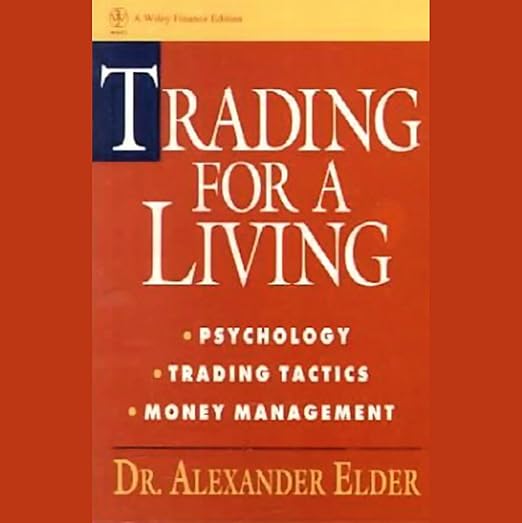
I first heard about Alexander Elder's Trading for a Living from a trader I knew who had been in equity markets for fifteen years. He described it as the book that changed how he understood why he kept making the same losing decisions despite knowing better. That description stuck with me, and when I finally sat down with the audiobook, I understood what he meant almost immediately. Elder is a psychiatrist as well as a trader, and that combination produces a book that is fundamentally about psychology first, methodology second, and market mechanics third. This is not the order most trading books choose. It is, Elder argues, the correct order. And the argument holds.
Our Take on Trading for a Living
Elder's framework, which he calls the Three M's: Mind, Method, and Money, is the spine of the whole book, and the sequence matters. He spends the opening sections on individual psychology, on what distinguishes consistently profitable traders from the majority who treat the market as a source of emotion rather than income. His comparison of compulsive losing traders to alcoholics is one of the more provocative formulations in trading literature, and it lands harder in audio than it might on the page because you cannot skim past it.
Traders who cash out profitable positions early to cover losing ones, who double down after losses instead of cutting them, are exhibiting a pattern Elder reads as closer to addiction than to rational decision-making. One reviewer who described himself as having averaged twenty percent annual returns praised the book for articulating what he had learned through experience but never fully understood analytically. Another noted that you need some market experience before the psychological patterns Elder describes become recognizable from your own history. Both observations are accurate. This book is most valuable to traders who have already lost money in identifiable patterns and are trying to understand the mechanism rather than just the symptom.
Why Listen to Trading for a Living
The methodology sections cover classical charting, support and resistance levels, volume and open interest, and Elder's own Triple Screen trading system. These are presented clearly enough for the audio format, though listeners who want to apply the technical elements will want the print edition available alongside for the visual components that charts and indicators naturally require. Richard Davison's narration handles the specialized vocabulary without stumbling, which is a genuine skill, but there is a ceiling on how much charting knowledge transfers through audio description alone.
Elder is appropriately skeptical of trading systems sold as keys to the market, which gives the book an intellectual honesty that distinguishes it from much of the trading literature it sits alongside. The systems he describes are tools for thinking rather than algorithms to follow blindly. One reviewer noted that anyone who sells you a system is selling you fool's gold, and Elder makes that point with enough specificity and evidence that it is difficult to dismiss.
What to Watch For in Trading for a Living
The chapter on psychological indicators and contrary opinion theory is one of the most unusual sections in any trading book I have encountered. Elder argues that the majority of market participants, operating from emotion rather than analysis, are a more reliable contrarian signal than their individual positions suggest. When the crowd is maximally optimistic, it has likely already acted on that optimism, leaving the market vulnerable to the opposite move. Understanding how to read crowd psychology as a contrarian signal is an edge that requires no specific technical tool, just the discipline to act against the feeling of the moment.
This section alone justifies the book's enduring reputation. It is the kind of insight that is easy to understand in the abstract and extremely difficult to execute in practice, and Elder does not pretend otherwise. His honesty about the gap between knowing and doing is one of the qualities that has kept the book in continuous print for decades.
It is also worth noting what Elder's book does not do that many trading books attempt: it does not promise a system that will generate consistent profits if applied correctly. The disclaimer runs throughout the text. Elder is relentlessly honest about the fact that even a correct framework applied with discipline will produce losses, and that the measure of a successful trader is not the elimination of losing trades but the management of their size and frequency relative to winning ones. This is psychologically harder to accept than a formula, but it is also true in a way that formulas are not, and Elder's willingness to say so is one of the qualities that has kept this book in active circulation for three decades.
The sections on mass psychology and market indicators are among the more unusual elements of the book and reward the most careful listening. Elder argues that understanding what the crowd is doing and why, not to join it but to identify the moments when it has overextended, is a more durable edge than any technical signal. This is the kind of insight that experienced traders recognize immediately and beginners tend to undervalue until they have been burned by it firsthand.
Who Should Listen to Trading for a Living
Traders who have spent at least some time in live markets and are ready to examine the behavioral patterns behind their losses will find this genuinely useful. The psychiatric framework Elder brings to trading psychology is not found in most other books in the genre, and it makes the diagnosis of losing behavior feel clinically accurate rather than motivationally vague.
Complete beginners will absorb the broad principles but will not have the experiential reference points to fully recognize what Elder is describing. The book is honest about this: it is written for people who need a framework for what they are already experiencing, not a primer for people who have not yet begun. For the right listener at the right stage, it remains one of the most psychologically sophisticated books in the field.
Is this audiobook suitable for someone who has never traded before?
Elder's framework is accessible enough that a complete beginner will understand the concepts. But the psychological diagnosis of losing behavior is most powerful when you have already experienced the patterns he describes. Beginners may find the book more useful after they have spent some time in live markets.
Does the audio format work well for a book that covers technical analysis and charting?
With limitations. Davison's narration handles the terminology well, but chart-based concepts naturally resist audio description. Listeners serious about applying Elder's technical methodology will want the print edition alongside the audio, particularly for the Triple Screen system and classical charting sections.
What does Alexander Elder's background as a psychiatrist add to a trading book?
Considerably more than you might expect. His clinical experience shapes how he diagnoses the behavioral patterns behind consistent losing, specifically the parallel he draws between compulsive trading and addiction. The psychological framework he brings is the most distinctive element of the book and the reason it has remained in print for decades.