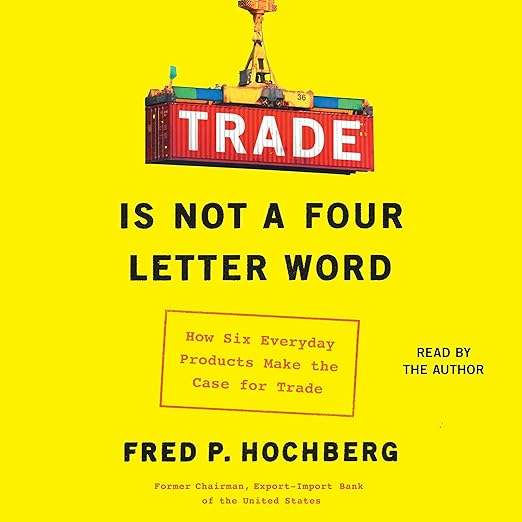
Quick Take
- Narration: Hochberg narrating his own book brings insider authority and a conversational warmth that no hired voice actor could replicate.
- Themes: Globalization’s human costs and benefits, political mythology around trade, how everyday products reveal economic interdependence
- Mood: Engaged and measured, like a long dinner conversation with someone who has actually done the thing they are describing
- Verdict: One of the most accessible economics audiobooks published in the last decade, and one of the rare policy books that is genuinely fun to listen to.
I put Trade Is Not a Four-Letter Word on during a long drive through upstate New York, somewhere between two small towns that had both seen better economic decades, and I spent the next hour genuinely reconsidering assumptions I hadn’t examined in years. Fred Hochberg was the chairman of the Export-Import Bank under two administrations. He has sat in the rooms where trade policy gets made and has watched the same arguments cycle through both parties like weather patterns. He writes about all of this from that position of genuine experience, which is what separates this from the economics books written by people who have mostly read other economics books.
The organizing framework is six everyday products: a taco salad, a Honda Odyssey, a banana, an iPhone, a college degree, and an HBO series called Game of Thrones. Hochberg uses each to pull back the curtain on how trade actually works in practice rather than in theory. The Game of Thrones example is the most surprising and ends up being one of the most convincing arguments for the complexity of export economics that I’ve encountered in popular nonfiction.
Our Take on Trade Is Not a Four-Letter Word
What Hochberg does better than most policy writers is refuse to flatten his argument into ideology. He served under a Democratic administration and holds broadly pro-trade positions, but he earns those positions through argument rather than assumption, and he’s honest about where free trade has failed specific communities. One reviewer called the book measured and noted it doesn’t fit neatly into one lane or another. That observation holds. The chapter on tariffs as a cause of the Civil War is the kind of historical detour that most trade books would cut in editing and Hochberg correctly kept. The section on NAFTA’s populist mythology is similarly willing to follow the evidence wherever it leads. Reviewer Gabriel specifically recommended it as a book worth sending to relatives who believe in free trade but struggle to articulate why. That use case is accurate.
Why Listen to Trade Is Not a Four-Letter Word
Hochberg’s self-narration is the right choice for this material. He delivers policy argument with the tone of a knowledgeable friend rather than a lecturer, and the slight informality of his delivery does a lot of work in keeping dense economic content accessible. The Wall Street Journal called it a sprightly and clear-eyed testimonial to the value of globalization, which is not language you often see applied to trade policy books, but it earns it. The nearly nine-hour runtime is efficient: Hochberg does not pad, and he trusts his anecdotes to do the explanatory work without requiring extensive setup. This is what good narrative nonfiction audio sounds like when the author is also the narrator and knows exactly how each sentence should be delivered.
What to Watch For in Trade Is Not a Four-Letter Word
This book was published in 2020 and makes specific references to the Trump trade policy era that now feel like recent history rather than current events. The core arguments about how trade works and why it matters remain durable, but some of the political commentary has dated in ways that may distract listeners who remember the period clearly. One reviewer with an MBA noted they felt like a fly on the wall getting a rare view into someone who had a front row seat as a doer, not just an observer. That framing is useful: this is a memoir of trade policy as much as it is a primer on it, and the two modes reinforce each other throughout.
Who Should Listen to Trade Is Not a Four-Letter Word
This is well matched for anyone who wants to understand globalization without wading through academic economics. It rewards people across the political spectrum who are willing to follow an argument rather than just have their existing views confirmed. If you’ve found yourself unable to explain why trade wars are complicated when someone at a dinner table insists they’re simple, this book provides the vocabulary and the specific examples needed to do that. Skip it if you want ideological ammunition rather than genuine economic education. Hochberg is too interested in accuracy to be useful for that purpose.
Frequently Asked Questions
Do you need any economics background to follow Hochberg’s arguments?
None at all. The six-product framework is specifically designed to make trade concepts concrete and immediate. Listeners with no economics background consistently report finding the book accessible.
How does the book handle the argument that trade has harmed American manufacturing workers?
Hochberg addresses this directly and with more nuance than either side of the political debate typically allows. He acknowledges real harm to specific communities while arguing that trade policy is not the primary cause and that protectionism would not reverse those losses.
Does Hochberg’s pro-trade position mean the book ignores the legitimate criticisms of globalization?
No. Multiple reviewers who describe themselves as skeptical of free trade found the arguments worth engaging with. The book takes the counterarguments seriously rather than dismissing them.
Is the Game of Thrones chapter actually about the television series, and does it work as an economic case study?
Yes, it’s genuinely about the HBO series and the economics of film and television exports. It works better than it has any right to, and ends up being one of the more memorable chapters in the book.