In Brief
- Performance: George Backman is credited for a very long book dense with Chinese place names, where consistent pronunciation is the thing that lets a listener follow a route.
- What it covers: The First Patriarch of Zen, Chan Buddhism inside Chinese political history, modern China on the ground, pilgrimage and demolition.
- Feel: Curious, digressive, occasionally weary.
- Our call: Rewarding if you want China through a Zen lens, frustrating if you came for a life of Bodhidharma.
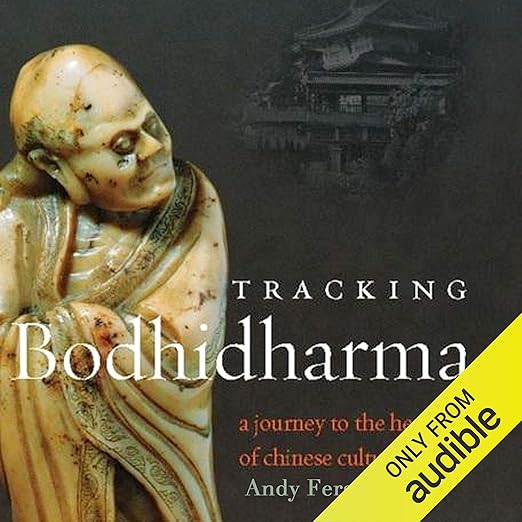
Reaching the next site takes up a great deal of this book, which is worth knowing before committing sixteen hours to the audiobook. Andy Ferguson travels across present-day China retracing the route of the figure Zen calls its First Patriarch, who carried the tradition out of South India in 500 CE, and the tension running through this page is whether the road holds up as well as the history does.
Ferguson's real argument is political rather than devotional. Placing Zen inside China's political landscape lets the description present it as a counterpoint to other Buddhist sects, as a catalyst behind some of the most revolutionary moments in Chinese history, and as the older spiritual core of a country now defined by how fast it is changing. That framing is what separates the book from a pilgrimage memoir: the places he goes to are political as well as sacred, and the description is explicit that this history matters to a country changing faster than anywhere on earth.
Ikkyu Jones, who arrived already knowing Ferguson's earlier work on Zen, describes what the new book added: "a wry sense of humor, often directed at himself, and a keen sense of historical narrative". The same notice makes the structural point clearly, that underneath the travelogue and the comic anecdotes about contemporary China, Ferguson "manages to uncover a fascinating relationship" involving ancient Chan Buddhism. The jokes are load-bearing rather than decorative; they are how the historical argument gets carried.
Thirty-six people have rated this and five have written, and for once the writers are the harsh ones. Their scores run 5, 4, 5, 1 and 3, averaging 3.6 against a listed 4.1, which means the thirty-one who rated without explaining themselves must sit somewhere around 4.1 to 4.2. The readers who liked it least are the ones who bothered to say why. That reverses the usual relationship on a book page, and it is worth reading the criticisms with that in mind.
Why Listen to Tracking Bodhidharma
SeaSea's response identifies the book's most unusual property, which is that it works for two audiences who rarely buy the same title. Because it is a travel book, that reviewer notes, it becomes "interesting to both general readers and people familiar with Zen or Chinese history", and it goes on to reveal material about Zen history "that modern day Zen practitioners will no doubt find very surprising". On the speculative passages, the same notice is careful: "the speculation is based on meaningful evidence".
What that dual reach buys you is context a purely doctrinal account leaves out entirely. Ferguson is interested in Zen as something that happened to a country rather than only to individuals, which turns a set of familiar teaching stories back into events with consequences for other people. Anyone who has read Zen only as philosophy will find the ground shifting underneath it, and anyone who has traveled in China will recognize the specific comedy of trying to find something ancient in a construction site.
Pronunciation is the production question on a book like this, and it is not a trivial one. Chinese place names and transliterated Buddhist terms arrive by the hundred with no romanization in front of the listener, and the sources cannot even agree among themselves: the publisher writes Chan while one reviewer writes Ch'an. A reader has to settle each of them and then stay consistent for the whole distance, because a listener who cannot recognize a place the second time it appears has lost the route. Consistency is the thing to sample for rather than tone.
What to Watch For in Tracking Bodhidharma
Pacing is where this book divides its readers, and two of them land on the same complaint. Vlad's four-star response compresses the whole shape into a sentence, "Kinda road movie plus historical overview plus detective story", then adds the verdict that matters at this length: interesting and informative, "though sometimes monotonous". The three-star notice from toronto goes further, praising the opening as a glimpse of contemporary China from an experienced tour guide before conceding that "after a while it becomes one bus ride and one lost ruin after another".
Metadata is quietly making that problem worse. One reviewer quotes the full title as Tracking Bodhidharma: A Journey to the Heart of Chinese Culture, and the subtitle is exactly the warning a buyer needs, since it announces a book about a culture rather than about a man. The listing displays the short title alone. The description also calls the author Andrew Ferguson while the byline reads Andy. Neither slip is dramatic, and together they set up the single worst experience anyone has reported here.
That experience belongs to Jonathan Westbrook, the one-star response, and it is entirely an expectation mismatch: "I was hoping for more of a history of the man or an understanding of the philosophy", followed by the concession "Good story but not what I thought it would be". A biography of Bodhidharma this is not, and the description is honest that his life has been magnified into legend with the history long since turned to myth. Anyone buying it as a life of the First Patriarch will finish disappointed by design.
Who Should Listen to Tracking Bodhidharma
Travel readers who want a destination they cannot easily visit, and Zen practitioners curious about where the tradition physically comes from, are the two groups this serves best. It also suits anyone interested in modern China as a subject in its own right, since a good deal of the book is simply what it is like to move around the country asking awkward questions about the past in places that would rather discuss the future.
Impatient listeners should think hard about the runtime. Sixteen hours and sixteen minutes is a substantial commitment for a book whose own supporters concede that the middle stretch repeats itself, and the repetition is structural rather than accidental, since the journey really did consist of one bus and one ruin after another. Anyone who needs narrative momentum rather than accumulation will feel the length in the second half.
Taken as a whole, this is a book I would recommend with the subtitle attached and the runtime stated up front, which is more or less what the listing fails to do. Nobody on the page has written a word about the recording itself, and two of the five responses predate this edition entirely, so the pacing complaints belong to the book rather than to the reading. Know that you are buying a journey rather than a biography and the length makes a good deal more sense.