Quick Take
- Narration: Craig Childs reading his own work is essential, his voice carries the reverence and intimacy these desert landscapes demand in a way no other narrator could replicate.
- Themes: Deep time and human impermanence, the language of ancient image-making, the ethics of witnessing
- Mood: Contemplative and quietly numinous, best experienced slowly
- Verdict: A rare audiobook that genuinely rewards unhurried listening, Childs at his most meditative, writing about marks that have outlasted entire civilizations.
I finished Tracing Time on a Sunday evening in November, sitting in a dark kitchen after the rest of the house had gone quiet. I had been listening in fragments over several days, a chapter on a walk, two chapters before bed, and by the end I found I had been thinking about it in between sessions in the way you think about a conversation that mattered. There is a particular kind of writing that stays with you not because of plot or argument but because it changes the frequency at which you are attending to the world. Craig Childs’s prose does that.
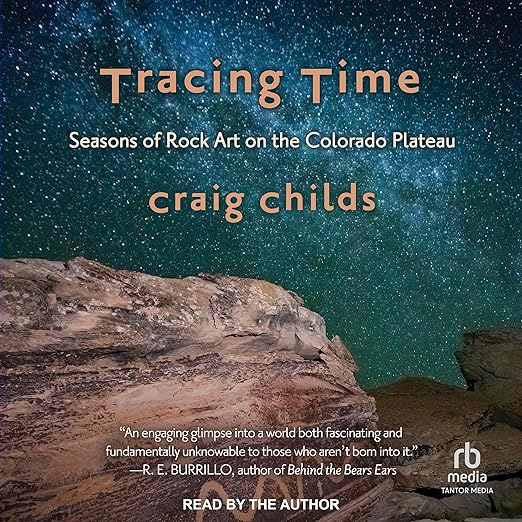
Tracing Time is about rock art on the Colorado Plateau: the bighorn sheep, the spirals, the human figures with upraised arms that have been pecked into stone across the desert Southwest over thousands of years. It is not, crucially, a guidebook or a scholarly catalog. It is something stranger and more personal, a witness account from one of the most attentive observers of the American West currently writing. Childs approaches these marks not as puzzles to be solved but as presences to be sat with, and that distinction shapes everything about how the book is structured and heard.
The Ethics of Looking at Ancient Marks
One of the most striking things about Tracing Time is how seriously Childs takes the question of what it means to encounter rock art at all. He is not just describing images; he is interrogating the relationship between a contemporary observer and marks made by people whose entire world of meaning is inaccessible to us. The blurb quote from R. E. Burrillo, ‘an engaging glimpse into a world both fascinating and fundamentally unknowable to those who aren’t born into it’, captures something real about the book’s central tension. Childs does not pretend to decode what he sees. He witnesses it, and he writes about the experience of witnessing with a precision and humility that is itself a kind of argument about how we should approach the deep past.
The pandemic shadow that one reviewer mentions is present but not heavy-handed. Childs wrote during a period of heightened awareness of human fragility and collective uncertainty, and those conditions have left traces in the prose, a particular attentiveness to what persists, what is lost, and what we leave behind. It gives the book a slightly more detached quality than some of his other work, which some readers have noted. I found it appropriate to the subject matter rather than a flaw: there is something right about approaching marks that have survived ten thousand years with a certain quietness.
What the Prose Actually Does
Reviewers who call Childs’s writing poetic are not being hyperbolic. His sentences work with sound and rhythm in ways that are unusual in nature writing, and the effect in audio format is amplified. He writes about ‘tiny spirals in stone, human figures with upraised arms shifting with the desert light, each one a portal to the open mouth of time’, and read aloud in his own voice, that sentence lands differently than it does on a page. The prose has a quality that I can only describe as spatial: it creates the feeling of physical presence in a landscape, which is precisely what rock art demands of its audience.
The structure of the book follows a seasonal organization, which allows Childs to move through different sites and different qualities of desert light without forcing a linear argument. This works extremely well in audio. Each chapter functions as a kind of essay in the classic sense, a movement through an idea rather than a march toward a conclusion. Some listeners expecting a more conventional informational arc may find this disorienting initially, but the form is entirely deliberate and pays off across the full runtime.
Childs Reading Childs
The narration question is easily answered: Craig Childs reading his own work is not just adequate, it is the only version that makes full sense for this book. His voice has the quality of someone who has spent years in these landscapes, unhurried, attentive, occasionally breaking into the kind of wonder that cannot be performed. There are moments in the reading where the silence around a sentence feels as meaningful as the sentence itself. At seven and a half hours, the audio version is immersive in a way that the print edition, however beautiful, cannot quite replicate.
A listener who came to this having read The Secret Knowledge of Water observed that this confirms Childs as a writer of literary, poetic masterpieces about the Southwest. That is not an overstatement. Within the nature writing tradition, Childs occupies a particular position alongside writers like Barry Lopez and Terry Tempest Williams, writers for whom the physical landscape is also a philosophical and spiritual territory, and who approach it with corresponding seriousness. Tracing Time belongs in that company.
Listeners Who Will Treasure This and Those Who Will Struggle
This audiobook will resonate most deeply with listeners who are already drawn to contemplative nonfiction, who have some familiarity with the desert Southwest, or who have an interest in archaeology and indigenous cultural history approached from a literary rather than academic angle. Those seeking a conventional informational guide to Colorado Plateau rock art, sites, dates, cultural attributions, visiting recommendations, will find Childs’s approach frustratingly oblique. He is not writing that book. What he is writing is something rarer: a sustained meditation on human time, image-making, and the experience of encountering marks that were made for purposes we cannot fully know. For the right listener, Tracing Time is the kind of audiobook you return to.
Frequently Asked Questions
Is Tracing Time suitable for listeners with no prior knowledge of Colorado Plateau archaeology?
Yes, though Childs’s goal is not to educate systematically. He provides enough context to orient listeners new to the subject, but his primary interest is the experiential and philosophical dimensions of encountering rock art rather than comprehensive archaeological explanation. New listeners may want to pair it with a more conventional introduction to Ancestral Puebloan culture.
How does this audiobook compare to Craig Childs’s other work, particularly The Secret Knowledge of Water?
Reviewers who know his earlier work describe Tracing Time as slightly more detached in tone, which some attribute to the pandemic context in which it was written. The prose quality and the immersive approach to landscape are consistent with his previous books, but this one is quieter and more inward in its movement.
Does the author-narrated format add anything specific to the listening experience?
Significantly. Childs reads with the kind of earned unhurriedness that comes from genuine familiarity with the landscapes he describes. His silences, pacing, and the occasional shift in vocal register when describing something that clearly moved him all add dimensions that a professional narrator working from the text alone could not replicate.
Is this a book about visiting rock art sites, or is it more of a meditation?
Firmly the latter. Childs does not provide site locations or visiting guidance, in part out of respect for the protection of vulnerable archaeological resources. The book is about the experience of witnessing and the questions that witnessing raises, not about directing listeners to specific places.