Quick Take
- Narration: Tom Taylorson’s grounded, earnest delivery suits Perkins’s first-person confessional style – he conveys the author’s moral reckoning without melodrama.
- Themes: Economic colonialism, shamanic transformation, the Life Economy versus Death Economy
- Mood: Urgent and searching, personal memoir braided with political and ecological alarm
- Verdict: Perkins at his most explicitly personal and programmatic – a book that functions as both confession and call to action, strongest when the memoir and the argument are running together.
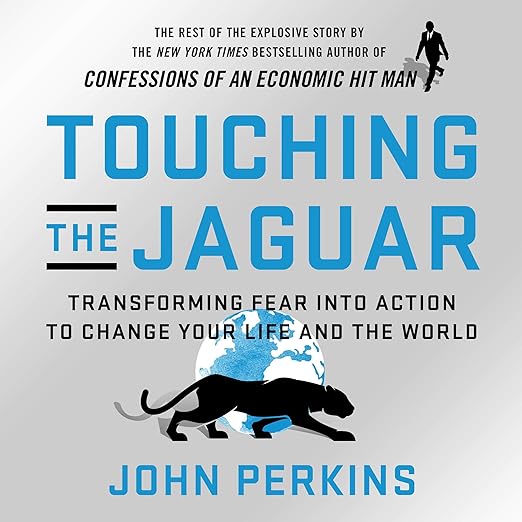
John Perkins is known for Confessions of an Economic Hit Man, which described his role in convincing developing nations to take on debt they could never repay through massive infrastructure projects that served American corporate and geopolitical interests. Touching the Jaguar is not a sequel in the conventional sense – it is something stranger and more personal: a book about what happened to Perkins after he made those confessions, what he found when he returned to the Amazon, and what an encounter with an uncontacted tribe’s response to invasion taught him about transformation and choice. I came to it expecting the political economy framework of the first book and got something considerably more hybrid.
The title metaphor comes from an indigenous Amazon tribe that “touched its jaguar” – meaning it confronted its existential threat directly, uniting with historical enemies to defend its territory against oil and mining companies. Perkins uses this as both literal event (he witnessed it) and conceptual frame: that we are all, individually and collectively, facing a jaguar of one kind or another, and that the choice to touch it rather than flee is the organizing principle of meaningful transformation. This is the kind of metaphorical scaffolding that either clicks or doesn’t, and for readers whose relationship to the Earth Economy framing is skeptical, the structure may feel like it’s doing more work than the evidence supports. For readers already inclined toward that framework, it will feel clarifying.
Our Take on Touching the Jaguar
What Perkins does best in this book is use his own biography as something more than autobiography. His movement from Peace Corps volunteer to economic hit man to Amazon witness to activist is presented not as a hero’s journey but as a cautionary account of how well-meaning people participate in harmful systems because the systems’ logic is internally coherent until you see the consequences at close range. His arrival at the realization that the “best model for economic development” he learned in business school was “a new form of colonialism” is not presented as a eureka moment – it is rendered as a gradual, uncomfortable accumulation of evidence he had initially been trained to ignore.
The Death Economy and Life Economy framework, which Perkins uses throughout to describe the current global system of resource extraction versus a hypothetical system of regeneration and circulation, is explicitly programmatic in a way that some listeners will find motivating and others will find simplistic. Elizabeth’s review, describing the book as giving new perspective on “the entire world” and being impossible to put down, reflects genuine engagement with this framework. Stephanie’s review calls it “empowering, disturbing, moving” – all three words simultaneously, which accurately reflects the tonal complexity of a book that moves between genuine hope and genuine alarm within single chapters.
Why Listen to Touching the Jaguar
Tom Taylorson’s narration is well-calibrated for material that is simultaneously personal and polemical. Perkins’s writing style is confessional and direct, and Taylorson honors that register without pushing it into rhetorical territory the text doesn’t quite occupy. The seven-hour runtime is appropriate for a book that is expansive in its claims but built around a single sustained argument – it is long enough to develop the ideas without outstaying its welcome.
The audio format works particularly well for the Amazon sections, which are rendered with enough environmental specificity that listening while commuting provides a grounding contrast to urban or suburban noise. April Kelly’s review, written from the perspective of a conservation biologist and expedition leader who found herself connecting deeply to the jungle narratives, suggests that those with firsthand experience of remote ecosystems will find extra resonance in those passages.
What to Watch For in Touching the Jaguar
The book’s shamanic transformation sections, in which Perkins describes ceremonies and spiritual experiences in the Amazon that converted him from EHM to activist, require a certain openness from the listener. Readers skeptical of shamanism as a knowledge system, or of the claim that such experiences can constitute genuine political conversion, will find these passages the least persuasive in the book. Perkins does not hedge or contextualize them – he presents the experiences as formative and the claims they generated as real. Whether that reads as authentic witness or as credulous mysticism depends largely on what the listener brings to it.
The strategic section, in which Perkins outlines what each person can do to help shift from Death Economy to Life Economy, is the most explicitly prescriptive portion of the book and the most debatable. Broad calls to change perceptions and make different choices are genuinely motivating for some readers and frustratingly vague for others expecting policy specificity.
Who Should Listen to Touching the Jaguar
This audiobook is for readers who engaged with Confessions of an Economic Hit Man and want to follow Perkins’s evolution; for listeners interested in the intersection of indigenous wisdom traditions and environmental activism; and for anyone whose relationship to economic globalization has shifted toward alarm and who wants both an account of how we got here and a framework for responding. Those looking for conventional policy analysis or academic economic critique will find the register too personal and too spiritually inflected. Readers who want Perkins as memoirist-activist rather than Perkins as economist will find this the more fully realized version of the book he has been trying to write since his first confession.
Frequently Asked Questions
Do I need to read Confessions of an Economic Hit Man before Touching the Jaguar?
Not strictly, but the prior book provides essential context for Perkins’s EHM work and the moral weight he’s carrying into this one. Touching the Jaguar assumes familiarity with his economic hit man history and moves quickly into what came after – new readers may want to start with Confessions first.
How much of the audiobook is focused on the Amazon and indigenous communities versus the economic framework?
The book is genuinely hybrid – the Amazon memoir portions and the Death Economy/Life Economy framework are intertwined rather than segregated. Roughly half the runtime involves direct narrative (Peace Corps, Amazon experiences, the uncontacted tribe) and half involves Perkins’s broader argument about economic systems and personal transformation.
How does Tom Taylorson’s narration handle the shamanic ceremony descriptions?
Taylorson maintains a grounded, even-keeled delivery for those passages rather than dramatizing them. This serves the material well – the ceremonies are presented as real rather than theatrical, and an understated narration prevents them from feeling like performance.
Is the Life Economy framework Perkins proposes developed in actionable detail?
Perkins offers a directional framework – emphasizing green technology, regenerative practices, and shifting personal consumption patterns – but does not provide granular policy prescriptions. Readers wanting detailed economic or policy analysis will find the framework suggestive rather than specific. Its primary function is motivational and conceptual rather than technical.