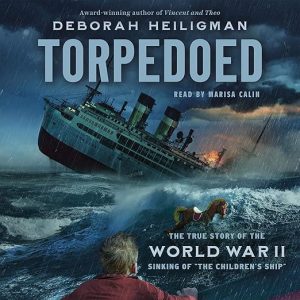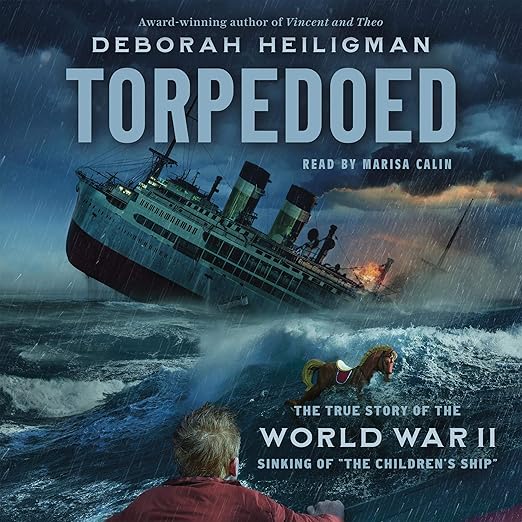
Quick Take
- Narration: Marisa Calin’s measured, emotionally restrained delivery honors the gravity of the subject without performing grief on behalf of the listener.
- Themes: Wartime civilian sacrifice, human resilience, the moral weight of bureaucratic decisions in wartime
- Mood: Tense and quietly devastating, like reading a dispatch that keeps getting worse
- Verdict: Deborah Heiligman’s account of the SS City of Benares sinking is meticulous, humane journalism that earns its emotional impact entirely through documented fact.
I was about halfway through my evening run when the Benares went under, and I stopped moving completely. Not because the prose is dramatic in a manufactured way, but because Heiligman had spent so many pages making me understand exactly who was on that ship: the names, the ages, the specific letters home, the particular reasons each family had sent their child across an ocean that was supposed to be safer than a bombed English city. When the torpedo hit, I already knew all of them. That is the technique, and it is devastating.
Torpedoed tells the true story of the SS City of Benares, a passenger liner that departed England in September 1940 carrying ninety children through the British government’s Children’s Overseas Reception Board program. CORB evacuated poor children to Canada when wealthy families were already making private arrangements. The convoy lost its naval escort at what seemed like a safe distance from German submarine range. A U-boat found them anyway. What followed, as Heiligman puts it, revealed everything human beings are capable of, worst and best, in a compressed and terrible sequence of hours.
The CORB Program and Its Hidden Stakes
The book’s first substantial achievement is explaining the Children’s Overseas Reception Board with enough specificity that the class dimension of wartime evacuation becomes visible and impossible to ignore. Wealthy British families had been sending children abroad privately since the Blitz began. CORB was the government’s answer to the question of what happened to the children whose parents could not pay, and the program’s genesis carries its own complicated moral history. Heiligman does not moralize about this; she documents it. But she documents it carefully enough that the reader understands exactly what was at stake in the decision to send those ninety children on the Benares.
This is where Heiligman’s journalism background shows most clearly. She is not content with the broad historical fact; she wants the specific mechanism, the specific person who signed the authorization, the specific communications that preceded the convoy’s departure. That granularity is what transforms the sinking from a statistic into something that carries personal weight.
Marisa Calin and the Problem of Narrating Atrocity
The hardest thing to get right when narrating a book like this is tone. Over-emoting makes the narrator the subject, which is wrong. Underdoing it creates emotional distance that makes the deaths feel abstract, which is also wrong. Calin finds a third approach: she reads with the clear, slightly formal cadence of someone delivering testimony rather than performing story. It is not flat; there is genuine inflection and variation. But the emotional reserve is consistent, and it serves the material precisely because Heiligman’s approach is itself documentary rather than sentimental.
One reviewer writes that books rarely move them, and this one did. That response is testimony to the combination of Heiligman’s research and Calin’s restraint. The emotion in this book belongs to the events and the people, not to the narration, and that is a choice that demands discipline from a narrator working with material this heavy.
What Follows the Sinking
Heiligman’s promise that the story includes both the worst and best of what people are capable of is fully kept in the book’s second half. The survival stories are extraordinary in ways that exceed what a novelist would risk inventing. The duration of survival in the North Atlantic, the coincidences of rescue, the individual decisions made by crew members and passengers that determined who lived, are documented with the same factual specificity as the events leading to the sinking. Heiligman does not sentimentalize the survival; she lets the facts carry the weight.
The book’s target audience, grades 5 through 9 as recommended by a teacher reviewer, is accurately calibrated. The subject matter is genuinely dark, and children in this range are old enough to carry that weight if the adults around them create space to discuss it. For younger readers, the material warrants a preview conversation about war and loss before listening.
Who Should Listen, Who Should Skip
Ideal for: students and adults interested in World War II civilian history, teachers looking for a rigorously researched narrative text in the 5th through 9th grade range, and listeners who respond to journalism-style nonfiction that earns its emotional impact through documented fact rather than editorial sentiment.
Worth a content conversation for: younger listeners. The sinking itself, the deaths of children, and the aftermath are not softened, and a child under 10 would benefit from an adult present who can contextualize the events and respond to questions.
Frequently Asked Questions
What was the CORB program, and why is it central to understanding the Benares story?
The Children’s Overseas Reception Board was a British government initiative that evacuated working-class children to Canada and other Commonwealth countries during the Blitz, providing an option that wealthy families had already accessed privately. The Benares was carrying 90 CORB children when it was torpedoed. Heiligman’s attention to the program’s class dimension makes the sinking’s stakes visible in ways a purely military history would miss.
How much of the book focuses on survival and aftermath versus the sinking itself?
Heiligman spends significant time on the post-sinking survival stories, which are extraordinary in documented fact. The book follows specific individuals through the rescue period and tracks their later lives, meaning roughly half the runtime is dedicated to what happened after the torpedo hit. The survival accounts are as carefully researched as the lead-up.
Is Torpedoed appropriate for a 10-year-old listener, or does the subject matter require an older reader?
Teacher reviewers recommend it for grades 5 through 9, which puts the lower boundary around age 10 to 11. The deaths of children are documented honestly and not softened. For a 10-year-old, parental or teacher accompaniment is advisable so there is space to discuss the events. The writing handles the darkness with restraint rather than graphic detail, but the subject is genuinely heavy.
Does Heiligman cover the German submarine side of the engagement, or is the focus entirely on the Benares passengers?
The focus is on the Benares passengers and crew. Heiligman covers the operational context of German submarine warfare to explain why the convoy was vulnerable, but she does not humanize the U-boat crew in the way she humanizes the ship’s passengers. The book is explicitly the story of the victims and survivors, not a balanced account of both sides.