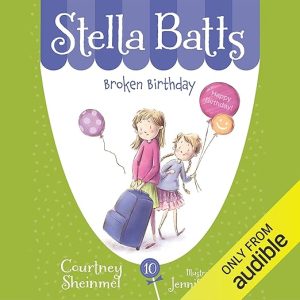
Stella's ninth birthday was supposed to mean Pennsylvania, Willa, and a weekend sleepover with her best friend. Broken Birthday, the tenth book in Courtney Sheinmel's Stella Batts series and an audiobook narrated by Cassandra Lee Morris, opens with a disaster before the flight even boards: a broken leg leaves Stella stranded in a hospital room in Somers, California, with an unfamiliar roommate and no birthday plans intact. Sheinmel takes that premise and does something more interesting than a simple recovery arc. She examines what it means to salvage something meaningful from a day that has already been publicly defined as ruined.
This installment runs one hour and forty-nine minutes. For context, Stella has been nine years old across multiple books in the series, and Sheinmel keeps her emotional world consistently calibrated to that age even as the series has grown long enough to attract readers who started it in first grade and are now in upper elementary school. That consistency, thematic and tonal, is one of the series' real achievements and the reason loyal listeners return with each new entry.
Enforced Stillness a Broken Leg Requires
The hospital setting gives Sheinmel a structural constraint that she uses well. Stella cannot go anywhere, cannot make plans, cannot fix the situation through effort or ingenuity. The broken leg forces her into a kind of enforced stillness that children's books rarely impose on their protagonists, and the book's quiet power comes from watching Stella figure out what she can do with that stillness. The stranger who shares her hospital room is a carefully drawn character, someone whose own circumstances give Stella an outside perspective she would not have had if the birthday had gone as planned.
One parent reviewer described the series as instrumental in getting their daughter to read for pleasure, noting authentic portrayals of friendships and elementary school life, and praising Sheinmel's handling of Stella's genuine unhappiness. That observation about unhappiness is key: Sheinmel does not flatten the disappointment of the broken birthday into a lesson-delivery mechanism. Stella is genuinely sad, and the book holds space for that sadness before it begins to find what is still possible inside the hospital room walls. The resolution is earned rather than cheerful by fiat.
Morris's Decade of Familiarity Pays Off
Morris's decade of familiarity with Stella's voice pays dividends in the tenth installment. The early chapters, where Stella is confronting the full scope of the disaster and trying to hold herself together, require a narrator who can convey suppressed distress without tipping into melodrama. Morris has that skill, and it is more refined here than it would be in earlier installments. Young listeners who have followed the series from the beginning will notice, even if they cannot articulate it, that this performance has a depth of understanding for who Stella is that comes only from sustained engagement with a character over time.
The ninety-minute-plus runtime is slightly longer than other installments in the series, and Sheinmel uses the additional time not for more plot but for more emotional development. The conversations in the hospital room, between Stella and the strangers who share her space, are more extended than the series' typical short-scene pacing, and in audio those conversations benefit from Morris's ability to differentiate characters cleanly without ever stepping outside Stella's child perspective.
A Birthday That Cannot Be Fully Fixed
The Willa subplot that runs through the series gets a significant emotional beat here. Having Stella miss the birthday trip specifically planned around finally seeing Willa again gives the friendship thread a poignancy that earlier books could not have achieved. Listeners who have followed Stella from book one, or even from Hair Today, Gone Tomorrow where Willa's move was first announced, will feel the accumulated weight of that friendship's difficulty in a way that first-time readers will not. This is one of those installments that rewards the loyal listener.
The book is honest about the fact that a broken birthday cannot be fully fixed. Stella does not wake up with the birthday she had planned, and Sheinmel resists the impulse to provide a compensatory celebration so complete that the loss is retroactively negated. What Stella gets is something more modest and real: a new story to tell about the birthday that went wrong, and a few unexpected connections she would not have made otherwise. That is a more sophisticated resolution than most children's books in this category attempt, and it is one reason the series continues to be compared to Judy Blume in its willingness to give children the honest version of things.
Starting Earlier Makes This Hit Harder
Children aged seven to ten who have read earlier Stella Batts books will find Broken Birthday a rewarding and emotionally resonant addition to a series they already love. Parents looking for audiobooks that handle disappointment, unexpected kindness, and resilience with honesty and warmth will find this installment well-calibrated for those conversations. Cassandra Lee Morris's narration makes it ideal for bedtime, car trips, and any setting where you want a story that settles rather than agitates.
New listeners to the series can follow Broken Birthday's plot without prior context, but they will miss much of the accumulated emotional investment in Stella and Willa's friendship. Starting earlier in the series will make this tenth book hit considerably harder when the moment arrives. Sheinmel has built a world worth entering at the beginning, and the emotional architecture she constructs across ten books is what makes the simple premise of a ruined birthday feel genuinely moving by the time it arrives.
- Narration: Cassandra Lee Morris brings her established feel for Stella's voice into this tenth installment with confident warmth, making the hospital setting feel emotionally contained rather than alarming for young listeners.
- Themes: plans gone wrong, unexpected kindness from strangers, resilience and reframing disappointment
- Mood: Quietly moving and hopeful, with the particular bittersweet quality of a birthday that refuses to stay ruined
- Verdict: Broken Birthday shows Sheinmel at the height of her emotional precision with Stella, making the tenth book feel like an earned chapter rather than a diluted one.
Before You Listen
Can Broken Birthday be listened to as a standalone audiobook, or is reading the first nine books important?
The plot is self-contained and can be followed without prior context. But the emotional weight of the birthday-trip disappointment and the Willa subplot is significantly greater for listeners who know the full arc of their friendship from earlier in the series. The tenth book rewards the loyal reader in ways a new listener will not fully access.
Is the hospital setting in this audiobook too frightening or intense for sensitive young listeners?
No. Sheinmel handles the hospital setting with the same emotional honesty she applies throughout the series, but without any medical drama or scary content. The broken leg is a plot mechanism for enforced stillness, not a medical thriller. The tone remains warm and ultimately hopeful throughout.
How does the Broken Birthday audiobook handle themes of disappointment for young listeners?
With unusual honesty and without a forced fix. Stella's birthday plans genuinely fall apart and the book does not manufacture a replacement celebration so perfect it erases the loss. What she gains is real but modest, which is the kind of truthfulness about disappointment that makes this series trusted by parents and children alike.
Is the Broken Birthday audiobook too long for young listeners at nearly two hours?
The hour-and-forty-nine-minute runtime is at the longer end for this series but still well within a single-session listen for most six-to-ten-year-olds who are fans. The extended scenes in the hospital room are slower in pacing, which suits bedtime listening particularly well.