Quick Take
- Narration: Tom Weiss brings a warm, unhurried quality to Burgess’s chapters that suits the book’s deliberate pace, reading with the steadiness of someone who trusts the material rather than pushing it.
- Themes: Natural curiosity and discovery, the lives of creatures at the edge of land and sea, gentle learning through story
- Mood: Calm and exploratory, unhurried in the best sense, designed for the pace of a tide
- Verdict: A beautifully paced introduction to seashore ecology that wears its educational purpose lightly, best suited to families who appreciate the older tradition of nature storytelling.
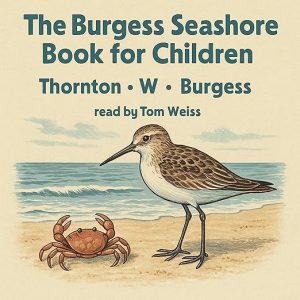
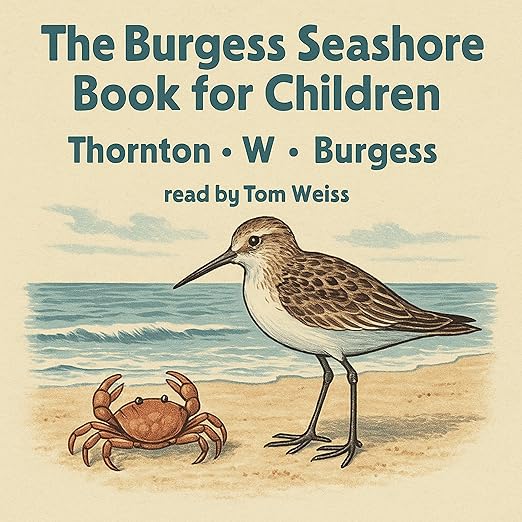
There is a particular kind of children’s book that has almost disappeared from publishing lists, and The Burgess Seashore Book for Children belongs to that tradition. Thornton W. Burgess wrote nature stories for children in the early twentieth century with a specific method: real animals, real places, real biological behavior, wrapped in the gentle fiction of familiar characters like Reddy Fox and Jimmy Skunk discovering these things for the first time. The educational content was never hidden, but it was never foregrounded so aggressively that it overwhelmed the story.
I finished the first few chapters of this audiobook on a quiet afternoon and found myself thinking about tide pool ecology in a way I had not since childhood. That is a genuinely uncommon response for me to an audiobook listed primarily for younger audiences, and it says something about what Burgess achieved with his method: the curiosity he cultivates in his animal characters transfers to the reader through a kind of sympathetic engagement that more overtly informational formats rarely produce.
Reddy Fox Meets the Tide Pool
Burgess’s narrative device of sending familiar inland animals to discover unfamiliar coastal environments is particularly well suited to audio. When Reddy Fox and Jimmy Skunk leave the Green Forest and encounter the seashore, their confusion and wonder create a natural frame for introducing information. They do not know what a hermit crab is, so when they find out, the listener finds out alongside them without the experience feeling like a lesson. The questions are asked by characters the young listener already trusts, which makes the answers feel like shared discovery.
Tom Weiss narrates with a register that honors this approach. He does not read at the pace of performance but at the pace of storytelling, which is slower and more considered, with space for the details of a sandpiper’s hunting behavior or the mechanics of a clam’s shell to land and settle. Reviewers who appreciated Burgess for family reading aloud will find that the audiobook preserves the read-aloud quality that makes Burgess particularly effective for multi-age listening.
What Contemporary Nature Content Does Not Do
One reviewer describes this as not a boring textbook and frames it explicitly against what passes for nature education in most children’s media: fast-cut documentary footage, information delivered at a pace that does not allow for processing, engagement through spectacle rather than attention. Burgess’s method is the opposite. The chapters stand on their own and can be returned to individually. The pace is unhurried enough that a child who has recently been to the beach will make connections in real time to what they saw, while a child who has never seen a tide pool will build a picture gradually rather than being overwhelmed.
A reviewer who bought the book before a beach vacation describes it as a successful pre-trip preparation tool, noting that children ranging from 2.5 to 13 years old all engaged with the material, with the oldest particularly drawn in. That range is a useful data point: Burgess writes at a level that young children can follow and that older children will find more interesting than they expect.
The Question of Age and Contemporary Relevance
The Burgess Seashore Book for Children was written in 1929, and that age is both a limitation and part of its value. The prose style is gentler and more formal than most contemporary children’s content, which makes it an acquired taste for children raised on faster-paced media. But the biology is sound, the coastal ecosystems Burgess describes remain recognizable, and the fundamentals of how tide pools work have not changed because the book is old.
Parents who value unhurried, screen-free content and who want to build in their children a disposition toward attentive observation of the natural world will find Burgess a reliable ally. This is storytelling that specifically invites the listener to slow down, which is a function that very little contemporary children’s media attempts.
Who Should Listen / Who Should Pass
This is best suited for families who appreciate the older tradition of nature storytelling, for children aged 6 to 12, and for anyone preparing for a coastal visit who wants to arrive with more curiosity than they left home with. It is not the right choice for children who need plot-driven narrative tension or who find gentle pacing frustrating.
For bedtime listening or quiet afternoon time, the unhurried stand-alone chapters are ideal. For a long car journey where sustained engagement is essential, pairing it with something more plot-driven will balance the experience well.
Frequently Asked Questions
Does The Burgess Seashore Book for Children require prior coastal experience to enjoy, or does it work for inland families?
It works equally well for both. For coastal families, it adds language and knowledge to experiences children have already had. For inland families, it builds a picture of an unfamiliar world through characters the child can follow. Burgess was writing for a general audience and assumed no prior seashore experience.
Is this audiobook suitable as bedtime listening, or is the content too stimulating?
It is one of the better choices for bedtime listening precisely because of its unhurried pace and self-contained chapters. The gentle narrative rhythm and the absence of dramatic tension make it genuinely conducive to winding down. Individual chapters run to a length appropriate for pre-sleep listening without leaving children in the middle of an unresolved situation.
How does Tom Weiss’s narration handle the older prose style of a 1929 text?
Weiss reads with warmth that modernizes the tone without distorting the period flavor of Burgess’s language. He does not try to artificially accelerate the pacing, which is the right choice: the slower prose style of the original is part of what makes the audiobook feel calm and unhurried. The result is accessible to contemporary young listeners without being anachronistic.
Are Reddy Fox and Jimmy Skunk the main characters throughout, or do other Burgess animals appear?
Reddy Fox and Jimmy Skunk serve as the discovery frame for the seashore, but Burgess introduces the coastal animals they encounter as full characters in their own right. The seashore creatures, shorebirds, crabs, fish, mollusks, are the real subjects of the book, with the familiar Green Forest animals providing the point-of-view perspective through which young listeners enter an unfamiliar world.