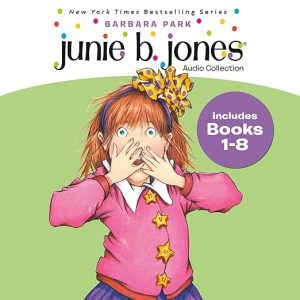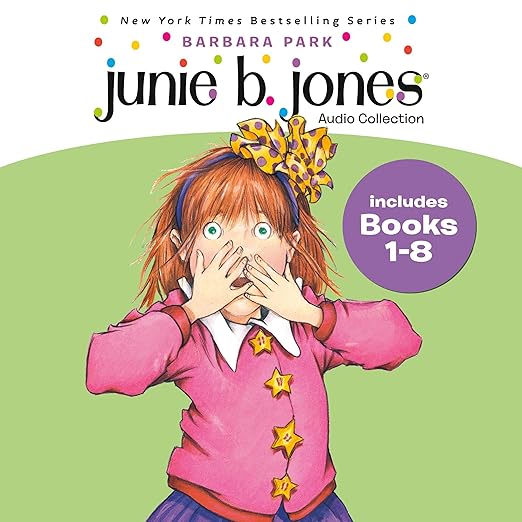
How much Junie B. Jones fits inside five hours and fifty-three minutes? Eight books, according to this collection, which works out at roughly forty-four minutes each and tells you nearly everything about the shape of the series. Barbara Park wrote them short, funny and self-contained, and this audiobook runs the first eight in order, from the kindergarten bus that starts the whole thing to the monster under the bed that closes it.
Delivered as Mistakes, Which Is Harder Than It Sounds
The April 2021 five-star entry pays the compliment that counts most in children's audio: the reader's voice sounds like what you would expect Junie B. to sound like. That account describes two daughters, aged six and two and a half, listening together in their room while the parent catches themselves giggling from somewhere down the hall. Which is the real test for a collection like this one. Children will replay anything they find funny, and the adults in the house have to survive the repetition.
Junie B. tells her own stories, and her grammar is the entire engine of the books. The titles carry it before a single word is read aloud: the Stupid Smelly Bus, the Yucky Blucky Fruitcake, That Meanie Jim's Birthday. The comedy sits in the gap between what she reports and what a grown-up would have seen happen. On a page, a child watches those mistakes on the paper. In audio they have to be delivered as mistakes, which is harder than it sounds and the reason this series depends so heavily on its reader.
Eight Anxieties in the Order They Arrive
Eight books turns out to be a well-chosen span, a genuine arc rather than an arbitrary block. Book one is the first day of kindergarten and the terror of the bus. Book two brings a baby brother. After that: a big mouth landing her in hot water, a secret she has to keep, a school carnival, the birthday party she is the only one in her class not invited to, a first crush, and finally the question of whether monsters are real. Starting school to negotiating friendship, in the order the anxieties actually arrive.
Five Responses That Predate This Recording
May 2013 brought a five-star response from a high school English teacher, self-described as an avid reader, who admitted to having no idea where to begin with early literacy. The recommendation came from a kindergarten teacher in the family, aimed at a four-year-old judged ready for chapter books, and the outcome was a child who would sit and listen with rapt attention. That is a specific and useful data point, because it identifies what this collection is actually for: the bridge between picture books and chapter books.
Roughly forty-four minutes a book is close to ideal for the age group. Long enough to count as a proper story, short enough to finish before attention gives out, and self-contained enough that a parent can offer one as a whole thing rather than a chapter of something enormous. Bedtimes, school runs and rainy afternoons all absorb a single Junie B. comfortably, and for a five-year-old, finishing is a large part of the pleasure.
All five written responses predate the recording being sold. The dates run 2008, 2012, 2013, 2021 and January 2025, while this collection was released in November 2025, and several of the older ones are plainly describing a boxed set of discs. What they establish is that the material and the credited reader have a long history with families, which counts for a good deal on a page carrying only five written entries.
An Endorsement Misspelled as Pikey
Filed in March 2008 by a family in Australia who had to buy the set while traveling in the States, the oldest response on the page names Lana Quintal outright and says the books are read so, so well. It then supplies the only real complaint in the record: stories split across two discs, so somebody has to get up and swap them partway through. That is a physical-media problem this download edition does not have, which makes it a rare caveat solved by the format rather than caused by it.
Some of the promotional copy on this listing belongs to a different product entirely. Eighty million copies sold, a number one bestselling chapter book series, and a cover endorsement from the author of Dog Man whose surname appears in the blurb as Pikey. Those are print credentials pasted onto an audio page. The same description also loses its formatting partway down, running items four and five of the book list together into a single unbroken line.
Metadata carries one flag worth raising. This is filed under growing up and facts of life, a tag that will put it in front of parents hunting for something considerably more earnest than a school carnival and a monster under the bed. Nothing here is educational in the curricular sense. What the books teach is social: how a big mouth lands you in trouble, what it feels like to be the one child not invited, and how to decide whether the thing under the bed is real.
A Granddaughter Who Loves Being Read To
Households with a four-to-seven-year-old are the core audience, and one February 2012 response widens that in a way worth quoting. It describes a five-year-old granddaughter with cerebral palsy who cannot play the way other children do and who loves being read to, lying and listening every night before lights out while her mother tends to a one-year-old. Audio does something for that household a book held on a lap cannot, and the family kept reading to her as well.
Classrooms and long car journeys make up the second use. Eight self-contained stories, each about the length of a school run, is a genuinely practical resource for a teacher or a parent who needs a dependable forty minutes. Adults who grew up with these will find the relisten holds up better than most nostalgia, largely because the jokes were never aimed exclusively at the children in the room.
Skip it if your child has already moved on to longer chapter books, because the register here is firmly early elementary and a confident reader will find it babyish. Pass as well if you want the later titles, since the collection stops at book eight of a series that runs a great deal further. Parents looking for the moment a child works out that stories can be funny, and that listening counts as reading, will find eight of those moments here in the right order.
Is this Junie B. Jones audiobook collection a download or a set of CDs?
This listing is the digital edition, released in November 2025. Part of the review pool clearly belongs to an older physical set, and one entry from January 2025 concerns delivery rather than content, praising quick service and a product as advertised. If you want discs specifically, check what you are ordering, because the two products share a review pool.
Who reads the audiobook, and is it one voice throughout?
Lana Quintal is the only reader credited, so all eight books arrive in a single voice rather than from a rotating cast. Since this edition went on sale in November 2025, the sample is your most direct evidence of how it sounds, and it is worth playing specifically to hear how the child's voice is handled.