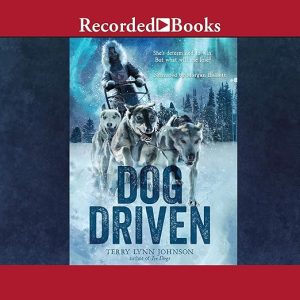
Sled dogs give a novelist an unusual engine, and this audiobook runs on eight of them, one harness line and a teenager who cannot reliably see the trail ahead. Terry Lynn Johnson sends McKenna Barney into a three-day commemorative mail run through the Canadian wilderness while she hides how far her eyesight has already gone. Morgan Hallett reads the four hours and forty-eight minutes, Recorded Books released it in December 2019, and one hundred and ninety-two ratings have accumulated since with remarkably little written under them.
Winning Would Put Both Sisters on Display
McKenna has spent a year pulling away from people, which is what hiding a condition does. She enters the race at her little sister's request, not from ambition, and the stakes the copy sets are public rather than personal: winning would put both sisters' condition in front of a national audience. Against that sit three days of shifting lake ice, sudden owl attacks, snow squalls, bitterly cold nights and competitors drawn from across the globe. It is a survival plot with a moral obligation bolted to the front of it.
Strangers Spell the Diagnosis Two Different Ways
The description never names the condition. It says her disease and her sister's, and stops. Two readers fill the gap and disagree on the spelling while doing it: a four-star response posted five days before the recording existed calls it Starsgardt Disease and supplies the younger sister's name, Emma, noting the same disorder has already taken most of Emma's sight; Amy Dominy's five-star account writes Stargardts and puts McKenna at fourteen. Buyers are getting the central medical fact of the book from strangers, spelled two ways, because the publisher would not print it.
Counting is the other oddity. That counter supports only five written responses, roughly one note per thirty-eight votes, and all five were filed between 2019 and 2021. Nothing on the page speaks for the years since. For a middle-grade title still being bought steadily enough to hold that average, the written record is both thin and old, which makes the few detailed responses carry more weight than they should have to.
Three Racers All Believed They Had to Win
Race structure does most of the narrative work, and it does it well. A route, a clock, checkpoints and rivals give a novel about concealment somewhere to go every chapter, and the three-day frame keeps the pressure rising without requiring a villain. Johnson has built the kind of plot where the weather is the antagonist and the deadline is real, which is the oldest reliable engine in wilderness fiction and still the best one for young listeners.
Joy's five-star response identifies the sharpest thing in the book, which is not the peril. Only one musher can win, that response notes, yet three of them believed they had to, and the novel takes each of those claims seriously rather than sorting them into heroes and obstacles. Giving genuine weight to competing personalities is unusual at this reading level. That response also credits the book with teaching a great deal about sled dogging along the way, which the material carries lightly.
Then the disability thread, handled better than the category usually manages. A sport in which the animals out front read the trail is a shrewd place to put a girl losing her sight, and the copy is blunt that she does not know whether she can even see well enough to run it. The book is about the cost of concealment as much as the cost of the disease, and the sister who asked her to enter is the one person who already knows.
Nobody Mentions Hallett or the Performance
Nobody has said anything about the reading. Four and three-quarter hours are carried by a single young first-person voice, and not one response on this page mentions Morgan Hallett or how the performance handles the race. On a book that lives or dies on whether a fourteen-year-old sounds fourteen, that is the largest unknown a buyer faces, and the page offers nothing to close it.
Holly B. in NC's five-star note is the warmest thing on the listing and it describes a printed copy, bought for a son through a monthly subscription book box for children, then finished over two nights at bedtime. That is a strong recommendation for the novel and no information about this release. It also tells you the intended reader is younger than the protagonist, which fits how the book actually behaves.
Shelving is odd. This sits in children's audiobooks under a tag reading Geography and Cultures, which suggests a travel primer rather than a survival novel with a degenerative illness in it. The copy leans on comparisons instead, offering the author's earlier Ice Dogs and pitching the book at readers of Gary Paulsen, both of which describe the shelf far better than the tag does. Anyone browsing by category will meet this book by accident or not at all.
One Frustration Sits With the Listing Itself
Confident middle-grade listeners and the adults reading alongside them are the natural fit, particularly households where somebody is managing a diagnosis and would like to hear it treated as an obstacle rather than a tragedy. Dog people of any age will get an unexpected amount of technical pleasure from the racing itself.
Less suited to very young listeners, since the animals are in genuine danger and the cold is written to be frightening. Teenagers well past the age of the protagonist may also find the emotional register a little tidy, and anyone wanting a detailed portrait of living with sight loss should know the disease works here mainly as the engine of a secret.
Four and three-quarter hours is the right size for this story, and the race carries it cleanly from the first checkpoint to the last. My one real frustration sits with the listing rather than the book: a novel this specific about a real condition deserves a description willing to name it, instead of leaving two strangers to spell it out differently in the reviews.
Questions Listeners Ask
How old should a listener be for this audiobook?
Confident middle-grade and up. The protagonist is described by one reader as fourteen, and the copy promises shifting lake ice, owl attacks, snow squalls and bitterly cold nights across a three-day race. Younger children who love dogs may still want it, but the peril is real and the animals are not safe throughout.
Is this audiobook connected to Ice Dogs?
Only by authorship. The description introduces this as coming from the author of Ice Dogs, and the record shows an empty series field, so nothing links the two stories. Read it as a recommendation for readers who liked the earlier book rather than as a continuation of it.
What is the mail run race the story is built around?
A commemorative event through the Canadian wilderness, retracing a historical mail route, run over three days against an international field. It supplies the deadline, the geography and the field of rivals, and the commemorative framing is why a teenager can enter at all.