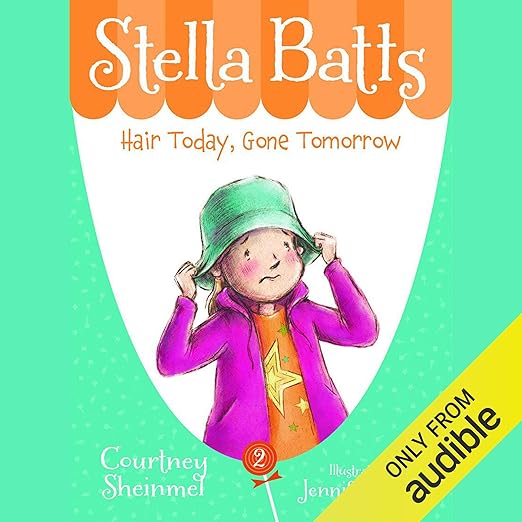
Quick Take
- Narration: Cassandra Morris sustains Stella’s eight-year-old perspective with the same reliable warmth she brings to the whole series, handling the magic-gum premise with deadpan sincerity that younger listeners find wholly convincing.
- Themes: Bad luck and persistence, the particular grief of a best friend moving away, finding belief when things go wrong
- Mood: Cozy and bittersweet, with just enough comedic disaster to keep the emotional weight from becoming too heavy
- Verdict: The second Stella Batts book is a confident early entry that introduces the candy-store world and handles a genuinely difficult emotional situation, a best friend’s move, with honest feeling.
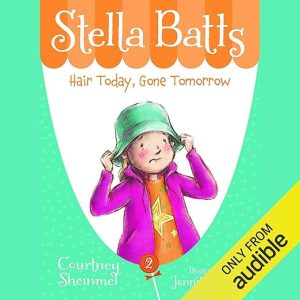
I came to the Stella Batts series by way of a parent at a school event who told me their daughter had asked to stay up past bedtime to hear one more chapter. That is a specific kind of praise I trust. Hair Today, Gone Tomorrow, the second book in Courtney Sheinmel’s series, lands that quality: it has enough genuine emotional incident to justify staying up, and enough warmth to make putting it down feel like a reasonable option too.
The premise runs two parallel threads: Stella chewing magical glow-in-the-dark gum from her parents’ candy store, falling asleep with it in her hair, and waking to a drastic haircut; and Willa, her best friend, announcing she is moving across the country. The gum subplot is funny. The Willa subplot is not. Sheinmel does not resolve the sadness of losing a close friend by installing a convenient replacement. She lets Stella sit with the loss while still finding a path forward, which is the right call and rarer than it should be in early-reader fiction.
Magic Gum and the Mechanics of Bad Luck
The magical glow-in-the-dark gum is a beautifully calibrated device. Stella’s younger sister blows bubbles and makes wishes that come true; Stella cannot even blow one. The asymmetry is funny and then increasingly frustrating in the way that things become when you are eight and the universe seems to be making a specific point at your expense. The haircut that results from falling asleep with the gum in her hair is played with exactly the right comic register. It is humiliating but not cruel. It is the kind of disaster that becomes a story you tell about yourself later.
The Harder Thread: Willa Moves Away
The Willa plotline is where the book does its more serious work. Best-friend departures are a standard elementary-school-fiction subject, but Sheinmel handles it with enough specificity that it does not feel like a lesson module. Stella does not perform resilience; she finds it gradually, and the process is uneven and honest. One parent reviewer noted that her first-grade daughter and she read this together and enjoyed getting to know Stella through Sheinmel’s literary voice. That phrase, “literary voice,” is apt: Sheinmel writes from inside the character’s consciousness in a way that respects young readers’ emotional complexity.
Cassandra Morris in the Early Series Register
At book two, Cassandra Morris is still establishing her Stella voice rather than inhabiting it with nine installments of accumulated familiarity. The performance is warm and consistent, capturing the first-person earnestness that makes Stella work as a protagonist. Morris handles the tonal shift between the gum comedy and the Willa grief with appropriate variation, keeping neither element from crowding out the other. At one hour and thirty minutes, the audio is brief enough for bedtime use and substantial enough to feel like a real story rather than a warm-up exercise.
Who Should Listen, Who Should Skip
This is for girls aged six to nine and for parents who want to read alongside them. Multiple reviewers mention the parent-child co-listening pleasure specifically, and the series earns that quality by writing situations recognizable from real life at that age. The Judy Blume comparison one reviewer makes is appropriate: Sheinmel writes for children the way Blume did, with respect for the actual emotional landscape of being young. Anyone who wants to know the candy-store world should start with book one and move immediately to this one. The magic-gum premise makes it one of the more appealing early entries in the series.
Frequently Asked Questions
Is Hair Today, Gone Tomorrow a good starting point for the Stella Batts series, or should we begin with book one?
Starting with book one is preferable, both because the series introduces the candy-store world and Stella’s friendships more fully, and because the books are brief enough that reading them in sequence is easy. That said, book two is accessible enough that newcomers will not be lost.
How does the book handle Willa moving away? Is it handled sensitively for younger listeners?
Yes. Sheinmel treats the situation with genuine feeling rather than a quick fix. Stella is sad, the loss is real, and the path forward is gradual rather than artificially swift. Parents who want to use it as a conversation-starter about friends moving away will find it very useful.
At 90 minutes, is this long enough to feel satisfying as an audiobook?
For the target age range and the format, ninety minutes is well-proportioned. The story reaches a complete emotional arc without padding. Multiple parents mention using it as a bedtime series with one or two chapters per evening, which the length supports naturally.
Is this appropriate for boys as well as girls, or is it specifically written for a female audience?
The series centers on a girl protagonist and has been most popular with girls in the six-to-nine range. One reviewer mentions their son enjoying it and comparing it to Judy Blume, which suggests broader appeal is possible. The candy-store setting and first-person voice are universal; the social dynamics are most directly relevant to the primary audience.