- Performance: Lorelei King is the definitive voice of Stephanie Plum and has been for the full series - her comedic timing on the ensemble cast, from Grandma Mazur to Randy Briggs, is the primary reason long-term fans prefer the audio editions to print.
- What it covers: comedic crime, romantic triangle dynamics, small-city chaos
- Feel: Fast, funny, and unabashedly escapist
- Our call: If you are already twenty books into this series, Lorelei King narrating Stephanie Plum through a Trenton full of feral Chihuahuas and competing assassins is exactly what you came back for.
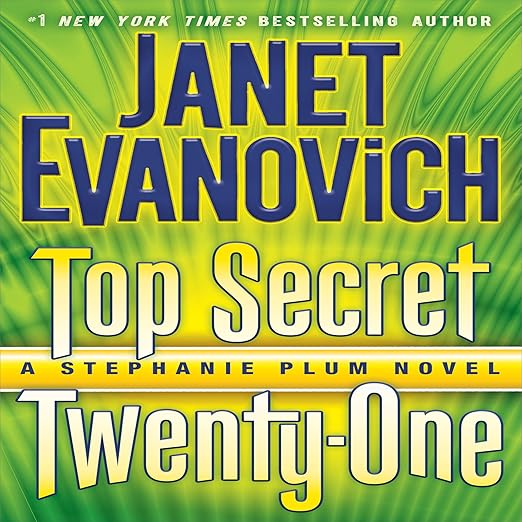
Stephanie Plum has been driving into things, burning down apartments, and failing upward in Trenton, New Jersey for twenty novels before Top Secret Twenty-One opens. Janet Evanovich's series is the rare long-running crime comedy that has found its audience and kept them - not by reinventing itself, but by refining its formula with enough new wrinkles per installment to justify the return. This audiobook, the twenty-first in the series narrated by Lorelei King, tracks bounty hunter Stephanie through the search for a bail-skipping used-car dealer named Jimmy Poletti, the increasingly fraught task of protecting a genuinely irritating informant named Randy Briggs, and the revelation that Ranger - the series' most enigmatic recurring figure - has been targeted by a professional assassination plot whose origins trace back to a carefully concealed past. Grandma Mazur's bucket list, building toward an item the title declines to disclose, provides the comedic spine running underneath all of it.
How Top Secret Twenty-One Holds Up
Evanovich's skill at this stage of the series is in layering. The Poletti plot is the nominal spine - dead ends, dead bodies, Stephanie's usual combination of persistence and near-disaster - but the Ranger backstory is where Book 21 reaches for something slightly more substantial. Ranger is the series' most carefully withheld character, a man whose past Stephanie has been piecing together across twenty books without ever quite getting the full picture. This installment extends that backstory in ways that longtime fans will find satisfying, revealing just enough without resolving the essential mystery of who Ranger is and what his specific history with government and private security actually entailed. The balance between information and withholding is managed with the practiced ease of a writer who knows exactly how much her audience can bear without either frustration or satiation.
The Grandma Mazur material operates as pure comedic relief, but Evanovich has always understood that Mazur's function is not simply to make readers laugh. She is also the character who does things Stephanie cannot do, who goes places Stephanie will not go, and whose absolute disregard for propriety and consequence creates plot openings that the more cautious protagonist would never engineer. In Book 21, the bucket list gives the novel a secondary structure that tracks alongside the main plot, building toward a final item that the synopsis keeps secret - and that delivers in the Mazur tradition of spectacular, cheerful absurdity.
Why Top Secret Twenty-One Works as an Audiobook
Lorelei King's narration is the series' most reliable constant. She has been performing these characters for the full run, and by Book 21 she inhabits them with a specificity that no re-casting could replicate. Her Grandma Mazur is pitch-perfect - the voice of someone who has absolutely no awareness that what she is saying should not be said, delivered with the innocence that makes the character work rather than becoming tiresome. Her Randy Briggs captures the precise blend of obnoxiousness and vulnerability that makes him one of the series' more interesting recurring figures. And her Stephanie has the quality that all good series narrators develop over time: she sounds like she remembers the previous twenty books, which makes the running character dynamics feel continuous rather than freshly assembled for each installment.
The audiobook runs six hours and 13 minutes, which is consistent with the series' approach to pacing: these are not long books, and they move. For listeners who want a crime comedy that does not ask for sustained attention or emotional investment across a complicated plot, the brevity is a feature rather than a limitation. One reviewer described it as a mindless read with evident affection, and that description is accurate in the sense that the book asks for enjoyment rather than analysis. The mystery, the romance, and the comedy are all competently executed at exactly the pitch that the series audience expects and returns for.
Weak Spots in Top Secret Twenty-One
New listeners should not start here. Twenty books of accumulated character history and running jokes are genuinely load-bearing in Book 21. The romantic triangle between Stephanie, Morelli, and Ranger - which has been Evanovich's primary structural engine since Book 1 - requires familiarity to appreciate, because the specific dynamics at play in this installment are variations on a long-established pattern rather than fresh developments. The plot also references previous Poletti-adjacent material that functions as callback rather than introduction. The series is available from Book 1 with Lorelei King narrating, and starting there is unambiguously the right approach for any new listener.
Longtime series readers who have occasionally found the later installments formulaic will not find that criticism resolved in Book 21. Evanovich is delivering what her audience wants, not attempting to subvert it, and whether that registers as comfort or repetition depends entirely on what you are looking for. One reviewer compared opening one of her books to going back to a childhood fort with your best friends, which captures the appeal precisely. This is genre comfort executed by professionals, and at six hours it does not overstay its welcome.
The Right Listener for Top Secret Twenty-One
Existing Stephanie Plum readers who want their next installment will find this audiobook delivers what the series reliably delivers, with the added pleasure of the Ranger backstory extension and a Grandma Mazur bucket list that builds to a genuinely entertaining finale. Listeners who have been hesitating about whether the series is for them should start with the earlier books rather than using this one as a sample - the enjoyment is cumulative and depends on accumulated attachment to these characters. Readers who find cozy crime comedy too light, who want their mystery fiction to carry more structural weight or emotional consequence, or who expect character arcs that move meaningfully forward across installments will find the series formula frustrating rather than charming. And anyone who has not yet encountered Lorelei King's performance of these characters should know that it is one of the stronger long-form audio performances in commercial crime fiction, which is a significant part of why the series has retained its audience across more than two dozen books.