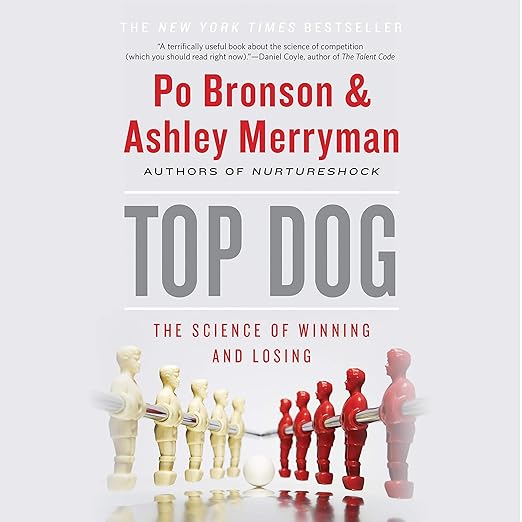
Quick Take
- Narration: Po Bronson narrates his own work with the comfortable authority of someone who has lived inside this research for years; the delivery is conversational and direct, which suits the pop-science format well.
- Themes: Competition psychology, testosterone and neuroscience, team dynamics vs. individual performance
- Mood: Energizing and thought-provoking, with a lab-coat edge
- Verdict: A compelling science-driven examination of how competition actually works that will change how you read a sports score, a sales leaderboard, or your own response to pressure.
I started listening to Top Dog on a Tuesday morning when I was already thinking about a presentation I had coming up later that week. One of those situations where you know you perform well under the right conditions and terribly under the wrong ones, but you can never quite figure out what tips the balance. By the time Po Bronson got to the chapter on the neuroscience of home field advantage, I had my headphones in and was pacing around my kitchen taking mental notes. The book had already done the thing good nonfiction does at its best: made me feel that some fragment of experience I had accepted as mysterious was, in fact, explainable.
Po Bronson and Ashley Merryman are best known for Nurtureshock, and Top Dog is very much in that same intellectual tradition: take a concept most people think they understand, then spend nine hours systematically demonstrating that almost everything they think they know is either wrong or incomplete. The subject this time is competition itself. Not tactics or strategy, but the underlying biology, psychology, and social architecture that determines who rises and who collapses when the pressure arrives. It is a broader question than it first appears, and the book earns its breadth.
The Science Behind Winning and Losing
What makes this audiobook land with such force is that Bronson and Merryman are not trafficking in motivational vagueness. They are drawing on real studies, from behavioral economics to endocrinology to sports science, and translating them into genuinely useful frameworks. The central distinction the book builds toward is the difference between what researchers call a promotion mindset and a prevention mindset: one oriented toward gaining something, the other oriented toward not losing it. Teams with a promotion orientation, the book argues, are roughly 80% more likely to win competitive encounters. That figure stuck with me because it reframes the entire question of mental toughness from personality trait to something more like a choice of focus, and that reframing has immediate practical consequences.
The testosterone chapter is particularly instructive, and somewhat uncomfortable. Bronson walks through how testosterone levels rise before competition and fall after a loss, creating feedback loops that can entrench patterns of dominance or defeat. More surprisingly, the research on cortisol suggests that some people genuinely process stress as excitement, while others experience it as threat. These are not simply attitude differences but neurological ones, shaped by genetics. One reviewer, H. Chung, noted that dopamine levels, which are genetically influenced, can determine whether someone thrives or has a meltdown during a standardized test. That point will make you reconsider a lot of how we talk about preparation and grit, and how much of what we attribute to character is actually chemistry.
When the Research Challenges Received Wisdom
The book’s most interesting interventions come when Bronson and Merryman push against comfortable narratives. The chapter on women and risk calculation is genuinely counterintuitive: the research shows women are better at calculating risk than men in many competitive contexts, not worse, but that they tend to opt out of competitions structured in ways that disadvantage them. The implication is that the problem is not female risk-aversion but competitive structures designed without accounting for how they selectively filter out certain kinds of ability. That is a structural argument rather than a psychological one, and it lands harder for being grounded in data.
There is also a sustained and well-argued section on rivals. Why do rivals motivate more than strangers? Why does competing against someone you know personally produce different neurological and performance responses than competing against someone you have never encountered? The answers are more nuanced than a simple account of ego would suggest. The book also explores the ways that home field advantage operates in office settings, not just sports arenas, which is where the research becomes immediately useful for anyone who has noticed that they negotiate or present differently depending on whose turf they are on. Those insights have a durability that outlasts any individual chapter.
The Limits of Knowledge Without Prescription
Where the book occasionally shows its limits is in the gap between research findings and actionable takeaways. Knowing that your cortisol response to stress is shaped by genetics is interesting, but the book does not always give you clear tools for working with that fact in real time. A professional money manager who reviewed the book articulated the central caveat: being correct and being too early amounts to being wrong. That tension between insight and timing runs through several of the book’s more forward-looking arguments, where the science is solid but the path from understanding to application is left for the reader to navigate.
Still, Bronson’s narration keeps things grounded and conversational throughout. He reads as if he finds the material genuinely surprising, which carries over to the listener. The final quarter of the book, which is largely a reference section, is unusually well-organized for a pop-science title. Kevin Currie-Knight’s observation that the book bucks the self-esteem movement trend, arguing that competitive situations seem to bring out many people’s best, is accurate and represents the book’s most culturally significant contribution. In a moment when the concept of competition itself is under social scrutiny, Top Dog offers data rather than ideology, which is the appropriate response.
Who Should Listen
The listener who will get the most from Top Dog is someone who already operates in a competitive environment and has noticed that their own performance is inconsistent in ways they cannot fully explain. Athletes, certainly, but also executives, sales professionals, academics, anyone who sits exams, and parents trying to understand what their children are actually experiencing under competitive pressure. The book does not moralize about competition or declare it good or bad. It simply describes how it works with more accuracy than most of us have been given before, and that accuracy is, in the end, genuinely useful.
Frequently Asked Questions
Does Po Bronson narrating his own work create any problems for the listening experience?
No, it actually works in the book’s favor. Bronson’s tone is relaxed and conversational, which suits a book that is translating academic research for a general audience. He reads as if he finds the material genuinely surprising, which carries over to the listener.
Is Top Dog primarily about sports, or does the research apply to other competitive contexts?
The research spans a wide range: sports, standardized testing, sales contests, office negotiations, software development teams, and Silicon Valley startup culture. Sports examples appear throughout but are used as illustrations of broader principles rather than the main focus.
How does Top Dog compare to Bronson and Merryman’s earlier book Nurtureshock?
Fans of Nurtureshock will find the same blend of counterintuitive research and accessible storytelling. Top Dog is arguably more cohesive because all the material funnels toward a single central question, whereas Nurtureshock covered a wider range of topics. Multiple reviewers who loved Nurtureshock rate this one equally or higher.
Does the book take a position on whether competition is healthy or harmful?
It deliberately avoids a moral verdict. The book’s argument is that competition is a complex stimulus with variable effects depending on individual neurology, social structure, and framing. Bronson and Merryman are interested in understanding those variables, not in issuing a cultural verdict on competition itself.