Quick Take
- Narration: Blackhurst reading his own investigation carries genuine authority, though some listeners may find a journalist’s delivery more deliberate than propulsive.
- Themes: Corporate impunity, money laundering, the gap between legal accountability and institutional power
- Mood: Methodical and outrage-inducing
- Verdict: A well-researched account of how HSBC facilitated the Sinaloa cartel’s financial operations; most rewarding for listeners who want context and character over pace.
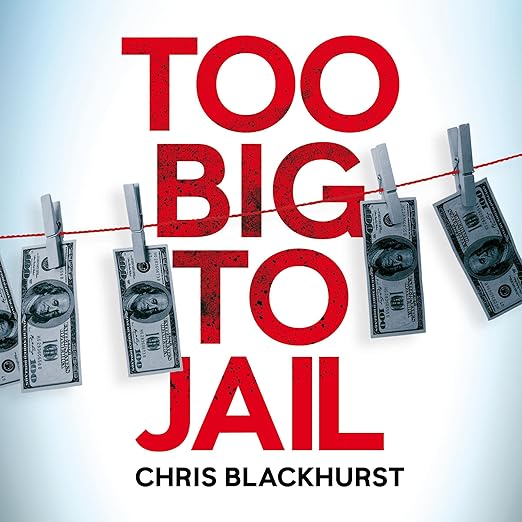
I had been reading about the 2008 financial crisis and its aftermath for most of the previous month when I picked up Too Big to Jail. By that point I was in a particular frame of mind: primed for stories about institutional impunity and the mechanisms by which powerful organizations manage to exist outside the reach of the consequences their decisions create. Chris Blackhurst’s investigation into HSBC’s money laundering activities for El Chapo and the Sinaloa cartel fit that frame precisely. I finished it in three sessions over a week, and by the end I had developed a considerably more detailed understanding of how a bank named as one of the best-run organizations in the world ended up with a 1.9 billion dollar US fine and zero individual prosecutions.
The central question Blackhurst poses is not just what happened but why nobody went to prison for it. Between 2003 and 2010, HSBC processed billions of dollars of drug money through its systems, facilitating one of the most murderous criminal organizations on the planet in its expansion. The record fine was, at the time, the largest ever levied against a bank. And yet. The deferred prosecution agreement that HSBC signed instead of facing trial has become one of the defining examples of what regulators and legal scholars mean when they use the phrase too big to fail being weaponized into too big to jail: the argument, essentially, that prosecuting a bank of sufficient systemic importance would cause collateral damage so severe that the cure would outweigh the crime.
Our Take on Too Big to Jail
Blackhurst, a former editor of The Independent with deep contacts in British financial and political circles, is particularly good at rendering the cultural disconnect at the heart of the story. The contrast he develops between British gentlemen bankers talking about their integrity and El Chapo’s narco-thugs figuring out what to do with billions of dollars in cash, as one reader with professional banking experience described it, is not just colorful. It illuminates how institutional cultures create blind spots that allow individuals to participate in systems they would, in isolation, recognize as criminal. The HSBC culture of global ambition and aggressive growth targets is shown not as a monolith of corruption but as a structure that made certain decisions easier to avoid examining.
The geography of the investigation is one of its strengths. Blackhurst moves the narrative across Hong Kong, London, Washington, the Cayman Islands, and Mexico with enough care that each location’s role in the architecture of the scheme becomes clear. HSBC’s origins in Hong Kong and its long history of operating across regulatory environments with varying rigor is part of the explanation for how the culture that allowed the Sinaloa relationship to develop took root, and Blackhurst traces that history with evident research depth.
Why Listen to Too Big to Jail
Blackhurst narrates his own work, and that choice carries the same tradeoffs it always does. The authority is real: this is the journalist who did the research and conducted the interviews, and that knowledge inflects his reading of the material. The delivery is measured rather than dramatic, which suits the subject’s complexity but may frustrate listeners who want a faster pace. A couple of reviewers found sections slow, particularly where the institutional history of HSBC required more context-setting. That criticism has some validity. The book is thorough, and thoroughness has a cost in pace when the material is institutional rather than narrative.
The cast of characters, politicians, bankers, drug dealers, FBI officers, and whistleblowers, is large, and the audio format without visual reference points means names and roles can blur across the 11.5-hour runtime. Listeners who already have some familiarity with HSBC’s history or with the broader anti-money-laundering regulatory environment will get more from the book than those coming in completely cold, not because the book is inaccessible but because the context helps the characters and decisions land with their full weight.
What to Watch For in Too Big to Jail
The whistleblower sections are among the most valuable in the book. The individuals who attempted to raise concerns within HSBC about what they were observing, and what happened to those individuals within the organization, is a portrait of how institutional culture suppresses inconvenient information that goes well beyond any single bank’s story. Blackhurst treats these figures with appropriate seriousness, and their accounts provide the most personal texture in what is otherwise primarily an institutional history.
Who Should Listen to Too Big to Jail
This is the right book for listeners who want to understand the mechanics of financial crime at scale, who work in or adjacent to banking and compliance, or who have been following the broader literature on corporate impunity and want a detailed case study rather than a general argument. Skip it if you require a fast pace or if institutional history without a single protagonist feels slow. The book is thorough and well-researched and deliberately takes the position that understanding how this happened matters more than maintaining dramatic momentum.
Frequently Asked Questions
Does Too Big to Jail explain why no HSBC executives faced criminal prosecution despite the record fine?
Yes, this is the central question of the book. Blackhurst examines the deferred prosecution agreement in detail, including the argument that prosecuting a systemically important bank would create collateral damage too severe for regulators to accept. The book is partly an investigation of a crime and partly an examination of why that crime went judicially unaddressed.
Is this book accessible to readers without a background in banking or finance?
Largely yes. Blackhurst provides context for financial mechanisms and regulatory processes, and several reviewers specifically noted the book works for novices to financial services. Listeners with professional banking background will find additional texture in the institutional culture analysis, but the main narrative is followed without specialist knowledge.
How does the narration by Blackhurst himself affect the listening experience?
Blackhurst reads with the measured authority of an experienced journalist rather than a voice actor, which suits the material’s gravity but produces a more deliberate pace than some listeners may prefer. The tradeoff is genuine credibility: you are hearing the journalist who conducted the investigation read his own findings.
Does Too Big to Jail cover the El Chapo story broadly, or specifically through the lens of HSBC’s role?
The book is focused on HSBC and the financial architecture that allowed the Sinaloa cartel’s money to be cleaned through a legitimate institution. El Chapo and the cartel are central characters, but Blackhurst’s interest is in how HSBC enabled the operation rather than in the cartel’s criminal activities more broadly.