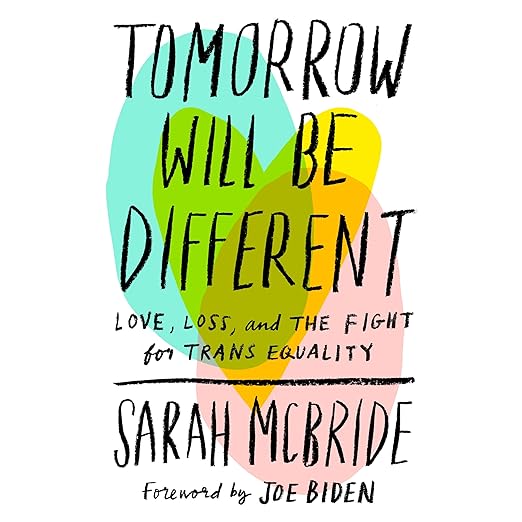
Sarah McBride opens Tomorrow Will Be Different with a specific memory: the moment before she pressed publish on a Facebook post at American University that would announce her identity as a transgender woman to the entire campus where she served as student body president. McBride, who later became the first openly transgender person to speak at a national political convention and subsequently the first openly transgender member of Congress, narrates this audiobook herself across nine hours and eighteen minutes, and the particular quality of her voice in that early scene, measured, clear, carrying something under the measured clarity, sets the register for everything that follows.
What We Made of It
Memoirs by political figures often resolve into advocacy by another means, subordinating personal experience to the argument being advanced. McBride's book does advance an argument, a clear and specific one about transgender rights, healthcare access, bathroom legislation, and the broader fight for equality, but it does not sacrifice the personal to make it. The relationship with Andy Bearse, the trans man and fellow activist she fell in love with and married, who died of cancer at thirty-four shortly after their wedding, occupies the emotional center of the book in a way that no political framing can contain or reduce. The grief sections are not political. They are private in the way that grief is always private, and McBride writes them with a directness that the rest of the book's advocacy framing earns rather than diminishes.
Reviewer Maggie Kottke describes the book as incredibly hopeful, uplifting, yet tragic, which catches the tonal complexity accurately. McBride is not writing a victimhood narrative. She is writing from a position of genuine privilege, as she acknowledges, and she is clear-eyed about how her family's support and social position shaped what was possible for her. That honesty about privilege, within a memoir about discrimination, is part of what makes the political argument credible rather than merely earnest.
One of the audiobook's more structurally interesting decisions is how McBride handles the timeline of Andy's illness. She does not present it as a separate narrative thread that interrupts the political story. Instead, the two develop in parallel, with Andy's diagnosis and treatment occurring during the same period as some of McBride's most high-profile advocacy work, including her role at the 2016 Democratic National Convention. The juxtaposition is not rhetorical, she is not using Andy's illness to make a political point. But it does create a portrait of an advocacy life as it is actually lived: alongside grief, alongside personal crisis, continuing because stopping is not an option when the work is urgent.
McBride narrating herself is not a trivial advantage. Reviewer Ross Ellis, who has met McBride in person, describes the book as authentic and moving, and the audiobook version makes that authenticity audible in the most literal sense. When McBride reads the sections about Andy's illness and death, nine hours and eighteen minutes of her voice working through that experience gives the listener something that a performed reading cannot: the specific texture of a person speaking about their own history. McBride has described herself as a public person, and this audiobook gives her the space to be a private person for most of it.
The political sections on transgender advocacy, walking the halls of the White House, working on inclusive legislation, speaking at the 2016 Democratic National Convention, are handled with the precision of someone who has spent years explaining complex policy to general audiences. McBride does not assume familiarity with the specific legislative battles she describes, and she connects individual policy fights, bathroom bills, healthcare exclusions, identity document requirements, to their concrete consequences for real people without losing the momentum of the personal narrative.
The section on bathroom legislation is one of the audiobook's most useful political chapters for listeners who followed the debates but never fully understood the legislative mechanics. McBride explains both what the legislation actually required and what it actually affected in terms of daily life, and she is honest about the gap between the legislative debates, which often treated the bathroom question as abstract and hypothetical, and the lived experience of transgender people navigating those spaces under hostile conditions. Her directness in this section is characteristic: she does not soften the material for audiences who might find it uncomfortable.
Things to Know Before Starting Tomorrow Will Be Different
The foreword by President Biden and the endorsement from then-Vice President Harris place this memoir firmly within a particular political alliance. Listeners across the political spectrum can engage with McBride's personal narrative productively, but the political framing is not neutral, and the book does not present itself as such. McBride is an advocate who happens to be writing a memoir, not a memoirist who happens to have been an advocate, and that distinction matters for how the book's arguments should be weighed.
The chronology is worth tracking. McBride structures the memoir to move between her personal history and the political history of the LGBTQ+ rights movement, and the two tracks do not always move at the same pace. The personal narrative accelerates in the middle sections around the relationship with Andy, while the political sections are sometimes more summary in character. Listeners who find the political sections drier than the personal ones are responding to a genuine unevenness in the material rather than a problem with the narration.
Best Suited For
Listeners who want to understand transgender experience from a first-person political perspective, as well as those who want a clear account of the legislative landscape around transgender rights in the 2010s, will find this essential listening. McBride's combination of personal vulnerability and policy expertise is rare, and the audiobook format with her own narration makes the combination available in its most direct form. Listeners who want political neutrality or who approach transgender rights from a position of opposition to the legislative goals McBride describes will find the book's framing a poor match. Those looking purely for political memoir without the personal grief narrative may find the Andy sections more extended than they expected, which would be a misreading of what the book is trying to do.
Key Details
- Voice: Sarah McBride narrating her own memoir gives the audiobook an irreplaceable dimension: her voice carries the specific emotional memory of events she lived, which no professional narrator could replicate.
- Big ideas: Transgender identity and public life, love and loss as political and personal experience, legislative advocacy and the slow work of civil rights
- Atmosphere: Warm and vulnerable with genuine political urgency, particularly in the sections on advocacy and the relationship with Andy
- Worth it?: McBride's memoir narrated by McBride herself is one of the more consequential LGBTQ+ political memoirs of the past decade, and the audiobook format makes its emotional core fully audible.
Common Questions
Does Sarah McBride narrate the Tomorrow Will Be Different audiobook herself?
Yes, and it is central to the experience. Her voice carries the specific emotional texture of events she lived through, including her relationship with Andy and his death from cancer, in a way that no third-party narrator could replicate.
Is the Tomorrow Will Be Different audiobook primarily a political document or a personal memoir?
Both, genuinely. The personal narrative including McBride's relationship with Andy Bearse and his death from cancer is as central as the political advocacy work. McBride does not subordinate one to the other, though the balance shifts across different sections.
How accessible is the Tomorrow Will Be Different audiobook for listeners unfamiliar with the specific legislative battles around transgender rights?
Very accessible. McBride explains specific policy debates in concrete terms and connects each to its real-world consequences for individuals. No prior knowledge of the legislation is required.
Does the Tomorrow Will Be Different audiobook have a partisan political framing that listeners should know about?
Yes. McBride is a Democratic politician and the book is explicitly aligned with progressive positions on transgender rights. The personal narrative is accessible across political differences, but the political framework reflects McBride's clear advocacy position.