
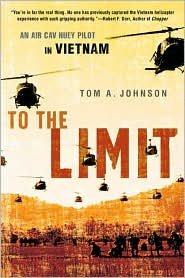
I came to To the Limit the way most readers probably come to military memoirs they have not heard of before: on the strength of the rating and the narrator's name. Tom A. Johnson's account of helicopter combat in Vietnam carries a 4.8 from 750 ratings, which is the kind of number that reflects sustained word-of-mouth from readers who actually served or who have read widely in this genre rather than a single burst of attention. David Drummond reading it is its own endorsement. At nearly fourteen hours, this is a commitment that asks something of the listener, and the rating suggests it pays back what it asks.
The book was originally published in 2007 and draws on Johnson's own experience as a helicopter pilot in Vietnam. The absence of a publisher-provided synopsis makes it necessary to let the genre, the ratings, and the narrator carry the framing here, and they carry it convincingly. The military memoir is one of the more demanding categories in nonfiction because it requires a writer to be simultaneously accurate about external events and honest about the interior experience of fear, adrenaline, and loss. Accounts that fail at this task tend to be either sanitized action narratives or unexamined trauma. The 4.8 rating suggests Johnson threads the needle.
Vietnam was the first war in which the helicopter became a primary tactical vehicle rather than a support asset. The Huey gunship and the medevac helicopter, the latter among the most dangerous and celebrated missions of the conflict, defined the war's particular texture in ways that ground combat memoirs often do not capture. Johnson's world in this book is the sky above the Mekong Delta and the highlands, the radio chatter and the tracers and the mechanical fragility of machines keeping people alive over terrain designed to kill them.
For readers whose Vietnam War reading has been concentrated on infantry accounts, Tim O'Brien's literary territory, an aerial perspective offers a genuinely different angle on the same conflict. The distances collapse differently from the air. The relationship between action and consequence operates at a different speed. Johnson's ground-level specificity about aircraft, mission types, and the hierarchies of helicopter warfare gives the book its authority for readers who want to know what the experience actually was rather than what it felt like in general terms. The tension between the technological precision of aerial operations and the chaos on the ground below is a recurring theme that gives the memoir its distinctive texture.
What Tom A. Johnson Gets Right
David Drummond is among the most decorated narrators in contemporary audiobook production, with a particular gift for nonfiction that requires sustained tonal consistency across long runtimes. Military memoir is a genre that can flatten into monotony when the narrator does not find the variation within the surface sameness of combat narrative, one mission flows into another, one near-miss into the next. Drummond knows how to give each scene its own weight without manufacturing false peaks. The result is a listen that maintains attention through nearly fourteen hours without the fatigue that lesser productions in this genre can induce.
The 2007 release date places this book in a specific moment in Vietnam memoir publishing, a period of serious reexamination from veterans who were finally ready to write. The audio release on Audible has extended its reach to a new generation of listeners who might not have encountered it in print, which is the kind of thing the audio format does particularly well for back-catalog military nonfiction. Drummond's reading gives the book a second life it fully deserves.
Where Tom A. Johnson Loses Some Ground
A 4.8 from 750 reviewers in a genre where harsh critics are common and the readership has high standards for accuracy is worth pausing over. It suggests a book that gets the external details right for readers who know the war, while also delivering something emotionally honest enough to reach readers who are coming to it without prior knowledge. Military memoir at this level functions simultaneously as history, as witness, and as human document.
The best books in this tradition manage to be all three at once, to give you the operational facts, the sensory reality, and the interior life of someone in an extreme situation that most of us will never approach. The rating across a substantial and knowledgeable readership suggests Johnson's memoir belongs in that company.
Who Should Pick Up To the Limit
The absence of a published synopsis on several retail platforms is unusual for a book with this kind of rating and readership. It suggests the book circulates primarily through direct recommendation among veterans and military history readers rather than through discovery mechanisms driven by marketing copy. That is, if anything, a mark in its favor, the audience that found it did so because someone they trusted told them to read it. For listeners coming to it through this review, the signal worth trusting is the 4.8 from 750 reviewers and the David Drummond narration. Both indicate a production that takes its subject seriously and delivers on that seriousness across a substantial runtime.
Common Questions
Is To the Limit specifically about helicopter combat, and does it require prior knowledge of aviation or military operations to follow?
Yes, the book centers on helicopter operations in Vietnam. Some tolerance for technical aviation and military operational detail is helpful, but the book's emotional and human core is accessible without specialist knowledge. Readers who enjoyed other aerial Vietnam War accounts will find the terrain familiar.
With no synopsis available, how can listeners know what kind of Vietnam War experience Tom A. Johnson is recounting?
The publisher and genre context establish this as a firsthand helicopter combat memoir from a pilot's perspective. The 4.8 rating from a militarily literate readership is a reliable signal of accuracy and depth. It sits in the tradition of first-person Vietnam aviation accounts rather than command-level retrospectives.
How does David Drummond's narration handle the technical flying sequences versus the personal and emotional passages?
Drummond is one of the most versatile narrators in military nonfiction, and his ability to modulate between operational specificity and personal reflection is one of the format's strengths. He keeps the technical passages from becoming recitations while giving the emotional content space to land without overplaying it.
At nearly fourteen hours, does the audiobook sustain tension across its full runtime?
The 4.8 rating from 750 reviewers suggests strongly that it does. Military memoir can flatten into repetition in lesser examples, but Drummond's pacing and Johnson's evident skill as a narrator of his own experience appear to keep the listen engaging across its considerable length.






