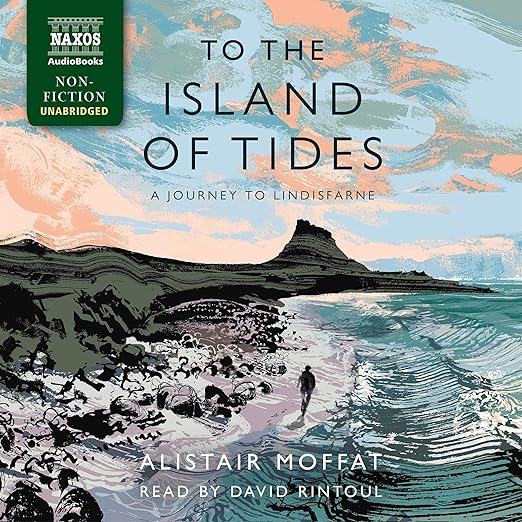
I started listening to To the Island of Tides on a long train journey through the north of England, which is not the worst way to encounter a book about pilgrimage through Scotland and Northumbria toward the Holy Isle of Lindisfarne. By the time Alistair Moffat reached the causeway, I had the distinct sense that geography and listening context had conspired to make the experience more than it might have been on a commute through a city. This is a book that rewards space and silence.
Moffat is a historian of the Scottish Borders with a long bibliography behind him, and that expertise is everywhere in this book without ever becoming heavy. He walks from his home in the Borders through a landscape layered with Roman, medieval, Viking, and early Christian history, following the path associated with Saint Cuthbert toward the island that was the center of his monastic life. But the book is also, unmistakably, a personal reckoning, and that dual structure is what gives it its unusual texture.
Our Take on To the Island of Tides
Moffat is candid, with the kind of honesty that sits more comfortably in a walking book than it would in a conventional memoir, about why he is making this journey. He is at an age where mortality has become a daily presence rather than an abstract concept, and the landscape he walks through is full of men and women who confronted exactly that reality and built something enduring from it. Cuthbert, the seventh-century monk who became the defining spiritual figure of early Northumbrian Christianity, is a guide of sorts: a man who chose solitude and prayer and the harshness of the tidal island as a response to the difficulty of being alive.
One reviewer noted that Moffat presents a "rigid, buffered self, only passing through" despite walking through a spiritually porous landscape, and I think that is a fair description. Moffat is not a religious man, and the book does not pretend otherwise. But there is something honest in watching a secular humanist walk through sacred geography and find himself moved by it anyway. He is looking for something in the landscape that he cannot quite name, and the audiobook is most alive in the moments where that search surfaces most clearly.
Why Listen to To the Island of Tides
David Rintoul is Scottish, classically trained, and thoroughly at home with Moffat's prose. His voice has the right quality for this material: unhurried, grounded, precise. When Moffat is describing the Cheviot Hills or the ruins of a priory or the tide patterns around Lindisfarne, Rintoul reads as if he can see the landscape himself. This is the particular gift of a narrator who shares cultural geography with the author, and it matters more here than it might in a different kind of book.
The historical passages benefit especially. Moffat is clearly energized by the Roman history of the region, the early medieval period, and the Viking raids that tested and ultimately ended Lindisfarne's monastic golden age. Rintoul navigates this material without losing the atmospheric quality that the book sustains throughout. The transition between historical annotation and personal reflection, which Moffat manages gracefully on the page, translates well in this performance.
What to Watch For in To the Island of Tides
One reviewer observed that the book runs roughly seventy-five percent Scotland and twenty-five percent Cuthbert, which is accurate and worth knowing before you begin. If you come to this book primarily as a devotional text or a life of the saint, you will need to adjust your expectations. Moffat uses Cuthbert as a lens and an occasion rather than as a subject, and the result is a meditation on landscape, time, and mortality that is informed by but not defined by hagiography.
The final sections on Lindisfarne itself and the smaller Inner Farne island, where Cuthbert spent his last years in radical solitude, are the most quietly powerful passages in the audiobook. Moffat does not manufacture spiritual conversion. What he finds instead is something more durable: a sense of generational continuity, a way of understanding his own life in relation to the accumulated experience of the landscape he has walked through. That is not a small thing.
Who Should Listen to To the Island of Tides
Listeners drawn to walking literature in the tradition of Robert Macfarlane or Patrick Leigh Fermor will find much to appreciate here, though Moffat's voice is more plainly personal than either of those writers. Readers with an interest in early medieval British Christianity, Scottish Border history, or the landscape of Northumbria will find the historical texture richly rewarding. Those looking for conventional pilgrimage narrative or devotional uplift may find Moffat's secular humanism a mismatch. This audiobook rewards patience and a certain willingness to sit with a book that does not resolve into easy conclusions.
Before You Press Play
- Narration: David Rintoul, a Scottish actor with deep roots in literary performance, is ideally cast. His voice carries the weight of the Border landscape without theatricality, making the meditative passages land precisely as they should.
- Themes: Pilgrimage and place, mortality and reckoning, the early Christian tradition of northern Britain
- Mood: Contemplative and unhurried, with occasional passages of genuine stillness
- Verdict: A quietly remarkable audiobook for listeners who want something more than travel writing, less than conventional history, and willing to sit with a book that moves at the pace of walking.
Frequently Asked Questions
Is this a religious audiobook, or is it accessible to secular listeners?
Moffat is explicitly secular and the book reflects that. He is drawn to the landscape's spiritual history without sharing the faith behind it, which makes the book more accessible to non-religious listeners than the Lindisfarne subject matter might suggest.
How much of the audiobook focuses on Scotland versus the island of Lindisfarne itself?
Reviewers estimate roughly three-quarters of the content covers the Border landscape and walk, with the final quarter devoted to Lindisfarne and Inner Farne. The journey is as much the subject as the destination.
Is David Rintoul's narration a good match for Moffat's prose style?
Very much so. Rintoul's Scottish accent and measured delivery fit both the landscape and Moffat's meditative register. He brings enough warmth to the personal passages without overdramatizing the historical sections.