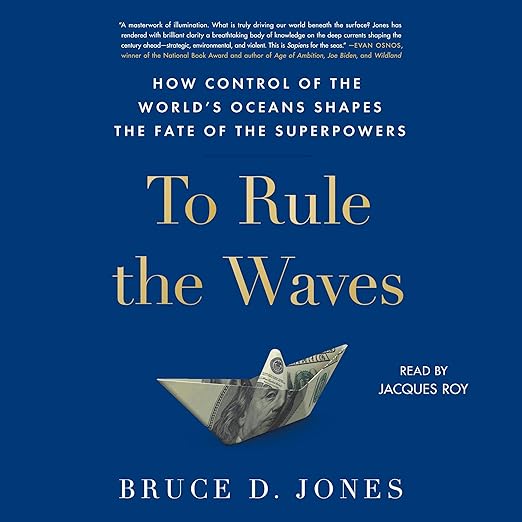
Quick Take
- Narration: Jacques Roy delivers the geopolitical analysis with clarity and control, handling technical passages without losing the sense of voyage the material demands.
- Themes: Maritime geopolitics, global commerce and shipping, naval power competition
- Mood: Methodical and expansive, with bursts of vivid reportage from ports and naval bases
- Verdict: A thorough and well-sourced argument that the oceans are the defining arena of twenty-first-century power competition.
I started this one on a long flight, which felt appropriate. There is something about being suspended above the Atlantic at thirty thousand feet that makes you receptive to arguments about how much of the world below you is moving across water at any given moment. Bruce D. Jones opens To Rule the Waves with a simple statistical claim that most people find genuinely surprising: nine-tenths of global commerce is linked to sea-based flows. Everything after that is an attempt to make you understand what that number actually means.
Jones is a senior fellow at the Brookings Institution and has served as a UN adviser and US government consultant, which gave him access that most researchers in this field simply do not have. He visited container ports in Hong Kong and Shanghai, walked the facilities of the American Seventh Fleet’s naval base in Hawaii, and examined the security infrastructure of the Port of New York. One reviewer who described the book’s unusual access as material you would not learn of anywhere else is not overstating it. The behind-the-scenes reporting is the book’s most consistently valuable feature.
Our Take on To Rule the Waves
Jones is arguing that the three defining geopolitical contests of our era, for military power, for economic dominance, and over climate change, are all playing out on and beneath the oceans in ways that mainstream security discourse has consistently underweighted. The nuclear age redirected our anxieties toward airspace and missile systems. We forgot about the water. To Rule the Waves is an attempt to correct that amnesia, and it does so through a combination of historical narrative, firsthand reporting, and strategic analysis that makes for a genuinely distinctive reading experience.
The historical sections tracing how oceans shaped imperial competition from the age of sail through the twentieth century are engaging and efficiently written. Jones does not linger on periods he has already explained, and the transition from historical overview to contemporary analysis is handled smoothly. Where the book is most alive is in its contemporary reporting: the description of how a forty-foot steel shipping container moves from an Asian factory floor to a European retail shelf, and who profits from each leg of that journey, is the kind of material that illuminates the global economy in concrete rather than abstract terms.
Why Listen to To Rule the Waves
Jacques Roy’s narration manages the book’s tonal range well. The historical passages get slightly more color in his delivery than the analytical sections, which is the right call: you want momentum in the narrative and clarity in the argument. He handles the technical vocabulary of naval architecture and maritime logistics without stumbling, which matters in a text where precision is part of the point.
At twelve and a quarter hours, the audiobook is substantive without being punishing. The structure moves through distinct episodes of port visits and strategic analysis rather than building a single continuous argument, which means you can dip in and out without losing the thread entirely, though it rewards sequential listening.
What to Watch For in To Rule the Waves
One informed reviewer noted several factual errors in the text, including an incorrect claim about Norwegian submarine facilities before World War II, and flagged the absence of maps as a significant structural gap for readers unfamiliar with the geography being discussed. In audio format, the absence of maps is simply a given, but listeners would benefit from having a world map open during the port-by-port sections. The factual errors cited appear to be isolated to specific historical passages and do not undermine the book’s central geopolitical argument.
Another reviewer noted that the book is informative without being compulsively readable, and that is a fair observation. Jones is a policy analyst and a rigorous one, not a narrative journalist. Some passages read like sophisticated white papers rather than literary nonfiction, and listeners expecting the propulsion of, say, Robert Kaplan’s Revenge of Geography may find the tempo occasionally deliberate.
Who Should Listen to To Rule the Waves
Well suited to listeners interested in geopolitics, global economics, and international security who want source material beyond standard punditry. Pairs naturally with Kaplan’s work and with Tim Marshall’s Prisoners of Geography for a broad framework of how physical geography shapes power. Policy professionals, naval history readers, and anyone trying to understand the US-China competition through a lens other than technology and finance will find this particularly useful.
Skip it if you need your nonfiction to carry consistent narrative tension. This is a book of ideas supported by vivid reporting, not a work of character-driven journalism.
Frequently Asked Questions
Is To Rule the Waves focused on the US-China rivalry or does it cover broader maritime competition?
Both. China’s naval expansion and its port infrastructure investments worldwide are central threads, but Jones also covers Russian, Indian, and European maritime strategy, and frames the American position within a genuinely multilateral competition rather than a bilateral standoff.
Does the audiobook format work for a book this heavy on geopolitical analysis?
Reasonably well. The vivid port-visit passages translate better to audio than the strategic analysis sections, which benefit from the ability to pause and reread. Having a map available during listening is advisable for the geography-heavy chapters.
How current is the analysis given the book was published in 2021?
The structural arguments about maritime power, shipping infrastructure, and naval arms races remain valid. Specific details about US-China tensions and climate agreements have evolved, but the framework Jones builds holds up as a lens for evaluating more recent developments.
Is this comparable to Robert Kaplan’s geopolitical writing?
In subject matter, yes. In style, Jones is more policy-analytical and Kaplan is more literary and ruminative. Jones offers better access reporting and tighter strategic argument; Kaplan offers more atmospheric prose. They complement each other well.