Key Details
- Read by: Bret Baier narrates with the same clear, unhurried broadcast delivery that defines his television career, favoring momentum and explanation over dramatic flourish.
- At its heart: Reconstruction politics, underappreciated leadership, the fragility of a reunified nation
- Vibe: Measured, momentum-driven, quietly urgent
- Short version: A clear, engaging narrative history that makes the strongest case yet for Grant's underappreciated presidency, best for listeners who want storytelling over academic distance.
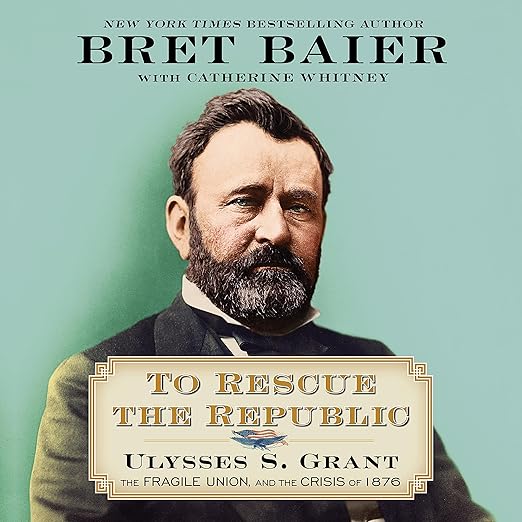
Ulysses S. Grant spent his final weeks in the White House brokering a compromise most Americans have never heard of, one that resolved a contested election but condemned the South to another century of civil rights oppression, and that paradox sits at the center of Bret Baier's audiobook. Baier, Fox News Channel's Chief Political Anchor, narrates his own book here, and the choice makes sense immediately: this is a broadcaster's approach to history, paced for momentum and clarity rather than academic density. To Rescue the Republic spans Grant's full arc, from a tanner's son in Ohio to the general who accepted Lee's surrender at Richmond to the president who navigated the calamitous 1876 election crisis against Rutherford B. Hayes and Samuel Tilden. Eleven hours and forty-one minutes covers a lot of American history without ever feeling rushed.
A Closer Look at To Rescue the Republic
Baier's framing throughout is that Grant remains underappreciated relative to his actual impact, and the book builds its case methodically: the Mexican American War service, Lincoln's decision to appoint him Lieutenant General in March 1864, the swift collapse of Richmond within a year, and then the harder, less mythologized work of Reconstruction and countering the Ku Klux Klan as president. Reviewer Mencken called it a genuinely enjoyable and illuminating look at an underrated American figure, and that word, underrated, does a lot of work in explaining why Baier chose this subject. Historian Douglas Brinkley's blurb calls this 'narrative history at its absolute finest,' and Baier's storytelling instincts as a broadcast journalist mostly clear that high bar.
The 1876 electoral crisis gets the most narrative weight, and rightly so, since it's the least familiar part of Grant's story to most listeners. Baier walks through how Grant, facing no clear winner between Hayes and Tilden and threats of Southern revolt, established an electoral commission to settle the dispute peacefully. The resulting grand bargain installed Hayes as president in exchange for concessions that effectively ended Reconstruction, a compromise Baier presents honestly as both a genuine act of statesmanship and a tragedy for the civil rights of Black Americans in the South. That dual framing, refusing to let Grant off the hook even while praising his instinct for national unity, is the book's most intellectually honest move.
What Makes To Rescue the Republic Worth Hearing
Baier's own voice matters here in a way that a professional narrator's wouldn't. Decades of live political broadcasting have given him an instinct for pacing complex, multi-threaded stories so a general audience can follow the stakes without a history degree, and that skill translates directly into how this audiobook moves through Reconstruction-era politics without losing momentum. He doesn't perform outrage or reverence; he explains, the way he would walk a television audience through a breaking news story, and that measured delivery suits material this politically fraught. Reviewer Jesanika responded strongly to the insight into Grant's character as a strong, humble, and thoughtful man, which is precisely the throughline Baier's narration keeps returning to.
This is part of Baier's broader Presidential series examining underappreciated moments of American leadership, and while no prior installment is required to follow this one, listeners who've heard his other presidential histories will recognize the same narrative approach: character-driven, momentum-focused, willing to sit with moral complexity rather than flatten a historical figure into hero or villain. The book draws on what the synopsis describes as fresh detail from battlefield decisions to closed-door political negotiations, and Baier's narration treats both registers, military strategy and backroom politics, with the same clear, unhurried explanatory tone throughout the full runtime.
Where Bret Baier Loses Some Ground
Listeners expecting a straightforward military biography should know this leans heavily into the political history of Reconstruction and the 1876 crisis, which occupies a significant portion of the back half. That's the book's real subject, arguably more than the Civil War battles themselves, so go in expecting political and constitutional history alongside the expected wartime material. Baier doesn't shy away from the ugliest parts of this period, including the Klan's resurgence and the human cost of the Hayes-Tilden compromise, but listeners hoping for extensive combat narrative in the Civil War chapters may find the balance tilted more toward the presidency and its aftermath than the battlefield.
As a broadcast journalist rather than a career historian, Baier's narration occasionally reads as more advocacy for Grant's underappreciated legacy than neutral analysis, and that's worth knowing going in. The book has a clear thesis, that Grant deserves more credit than history has given him, and it argues that thesis consistently rather than presenting a fully balanced accounting of his flaws. Reviewers so far have responded well to this approach, with a 4.8 rating across five reviews, but listeners who prefer historians who withhold judgment more than Baier does here should adjust expectations before starting.
It's also worth situating this within the broader landscape of recent Grant scholarship, which has spent the last two decades rehabilitating his reputation after a long stretch of dismissive treatment by earlier historians. Baier isn't breaking entirely new scholarly ground here; he's synthesizing that rehabilitation for a popular audience with the narrative instincts of a broadcast journalist rather than an academic historian. That distinction matters for listeners deciding whether this or a more traditional academic biography better suits what they're looking for in a Grant audiobook specifically.
Who Bret Baier Is Writing For
This audiobook suits listeners of narrative American political history who want a clear, momentum-driven account rather than an academic one. If you appreciated the storytelling approach of popular presidential histories and want a self-narrated edition with genuine broadcast polish, Baier delivers exactly that across eleven engaging hours covering Grant's full, complicated arc from soldier to president.
Skip it if you want a purely military account of the Civil War with minimal political aftermath, or if you're looking for a more academically neutral treatment of Grant's presidency and its compromises. For listeners genuinely curious about the electoral crisis of 1876 and how close the reunified nation came to unraveling again, though, this is a clear, well-paced entry point into a chapter of American history that rarely gets this kind of sustained attention.