
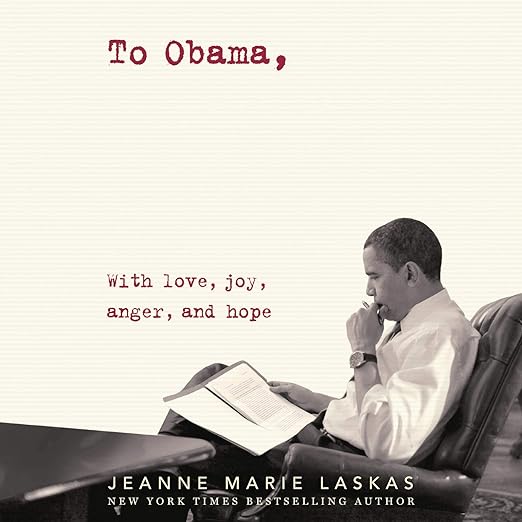
On a quiet evening a few years back, a friend described the feeling of reading the letters in To Obama as like finding someone's private correspondence and realizing the whole country had written it. That description stayed with me, and it came back when I returned to this audiobook. Jeanne Marie Laskas narrates her own account of President Obama's Office of Presidential Correspondence, the system by which ten letters per day (ten out of the ten thousand that arrived daily) were selected, processed, and placed in the president's hands each evening of his eight-year presidency. This audiobook is the printed book rendered as the multimedia project it was always trying to become.
The format here is worth explaining before anything else, because it determines everything about the listening experience. Laskas self-narrates the connecting tissue: the interviews, the context, her own reportorial observations. But the letters themselves are read by the people who wrote them, or by a cast of nearly thirty professional voice actors speaking as those who could not participate directly. Names like Sullivan Jones, Macleod Andrews, Paula Christensen, Hillary Huber, Marc Thompson, and Emily Woo Zeller appear alongside Heba Hallak, Marjorie McKinney, and Vicki Shearer, private citizens who wrote to their president and whose words, in this audiobook, return to something like the intimacy they had before they became research material.
Heba Hallak Reads Her Own Syrian Village Letter
Laskas spent years interviewing the letter writers, the White House staff who processed the mail, and President Obama himself. The result is a book that has three distinct subjects braided together: the letters as documents, the institutional infrastructure that handled them, and the relationship between a president and the citizenry's private voice. What the audiobook adds to all of that is the quality of presence. When Heba Hallak reads the letter about the day the tanks rolled into her Syrian village, the text of that letter is no longer a report of an experience; it is as close to the original act of writing as a recorded medium can get.
One reviewer described the book as showing "the human side of Obama" through his engagement with mail that was, by design, unfiltered. Obama was the first president to archive the entirety of his constituent correspondence and the first to interact with it daily, at his own request. The OPC staff describe sorting mail that included pleas in the middle of financial crisis, thank-you letters from families watching the Affordable Care Act take effect, letters of rage and fear and hope and grievance that arrived in equal measure throughout his administration. What the audiobook conveys, through Laskas's narration and the multiplicity of letter-reading voices, is that ten letters a day out of ten thousand is both a fraction and, paradoxically, a distillation.
When Letters Become Voices Among Other Voices
The case for the audiobook over the print edition is unusually strong with this title. In the print version, the letters are text among other text, rendered indistinguishable in medium from Laskas's analysis. In the audio version, they are voices among other voices, and the distinction matters enormously. The letter from Kelli, whose grandfathers finally married legally after thirty-five years together, arrives differently when spoken aloud than when read silently. Bill's description of having his views on immigration reformed by a boy escaping MS-13 gang violence carries the specific weight of an ordinary person reckoning with the distance between a political position and an individual face. Marjorie's confrontation with her own racial bias during the George Zimmerman trial is perhaps the most uncomfortable entry in the collection, and in audio it lands without the reading-ahead mechanism that print permits.
Reviewers consistently describe this book as one they could not put down, and the effect in audio is comparable: Laskas has structured the narrative with enough momentum that the listener is carried from letter to interview to historical context without experiencing the book's length as weight. At twelve hours and twenty-one minutes, the production is substantial, but the variety of voices prevents the listening fatigue that a single-narrator twelve-hour audiobook can produce.
Each New Voice Needs a Moment of Orientation
The large cast of narrators requires some attentional adjustment in the early chapters. Laskas's connecting narration establishes the register and context, but each new voice reading a letter needs a moment of orientation: who is this, what is their relationship to the president, when did they write. The audiobook's production handles these transitions well, but listeners who prefer the simplicity of single-narrator experiences should know they are entering a more complex sonic environment.
The book's political valence is worth naming clearly: this is a deeply sympathetic account of the Obama presidency through the lens of constituent correspondence, and it does not attempt neutrality about the value of the project it documents. Vicki's story about a family divided by the 2016 election is one of the few places where Laskas engages directly with the broader political context that followed the Obama years, and it arrives with the weight of everything that preceded it. Listeners who want the letters to stand as politically neutral historical documents will find that the framing is not designed to produce that experience.
Nowhere Else to Send What Needed Saying
Readers interested in presidential history, in the mechanics of how political institutions process constituent voices, or in the experience of American political life during the Obama years from the ground up will find this audiobook unlike anything else in its genre. The multi-voice production elevates it above the memoir-journalism hybrid it might have been and into something closer to an oral history.
Those who want fast-paced narrative or political analysis rather than intimate documentary will find the pacing too reflective. This is a book that asks you to sit with individual voices and let them land, and that requires a listening posture less common in political nonfiction. Anyone who has ever felt that the gap between personal experience and political language is unbridgeable will find that To Obama has spent twelve hours building an argument against that feeling, using the letters of people who wrote to their president when they had nowhere else to send what they needed to say.
At a Glance
- Voice: Jeanne Marie Laskas self-narrates a production featuring nearly thirty additional voice actors reading the letters themselves, creating an immersive experience unlike conventional single-narrator audiobooks.
- Big ideas: The private voice of a nation, empathy as political act, the human cost of policy reduced to correspondence
- Atmosphere: Intimate and emotionally layered, with the specific texture of a project that began as journalism and became something more personal
- Worth it?: The audiobook format transforms To Obama into something the print edition cannot be: a choir of ordinary American voices reading their own words, with the author threading the whole experience together.







