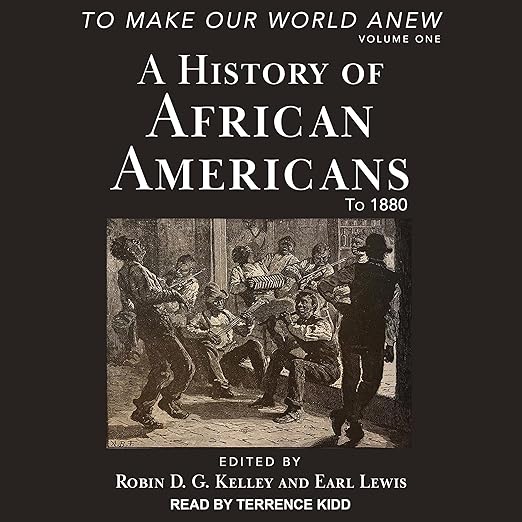
Ten to twenty million people were forced across the Atlantic during the slave trade that opens this sweeping audiobook, and the eleven historians Robin D.G. Kelley assembled do not look away from that scale. To Make Our World Anew is the first of two volumes distilling the work of eleven leading historians into a single continuous account of African American history, beginning with Africa itself and carrying through the Haitian Revolution, slave rebellions, the Civil War, Reconstruction, and the rise of Jim Crow. Terrence Kidd narrates all of it in one steady voice, unifying material that originally came from eleven distinct scholarly contributors.
Turning eleven historians' individually authored chapters into one cohesive audiobook is a real structural challenge, and Terrence Kidd's steady, unhurried delivery is what holds it together. Rather than sounding like a patchwork of academic voices, the narration reads as a single continuous account, letting the material's own chronological structure, from Africa through Reconstruction, do the work of connecting one contributor's chapter to the next.
The synopsis promises vivid first-person accounts and short character sketches meant to let listeners relive history rather than simply learn dates, and the reviews back that up directly. T.'s blunt three-word verdict, calling it painful and disturbing but full of information, captures both halves of that promise: the human cost is never abstracted away, and the volume of real research behind it never lets up either.
The synopsis's own description of the book as a panoramic view is an accurate one structurally: rather than following a single protagonist or even a single region, the eleven contributors collectively cover Africa, the Caribbean, and the United States across centuries, weaving in short character sketches rather than committing to one continuous narrative thread. That breadth is the book's central ambition, and Terrence Kidd's narration is what keeps a listener oriented across so many shifting vantage points.
The synopsis itself credits this as Kelley and Lewis's To Make Our World Anew, though only Robin D.G. Kelley appears in this listing's byline. That's a minor but real undercredit worth knowing about for anyone trying to track down the full scholarly apparatus or looking up the second editor's other work separately.
Madam C.J. Walker and the Era of Black Institution-Building
The Haitian Revolution gets real weight here, and it deserves it: the 1804 birth of the first independent Black nation in the New World is exactly the kind of pivotal, under-discussed event a survey this ambitious needs to cover properly rather than skimming past on the way to more familiar American history. Pairing that international scope with detailed coverage of slave rebellions and resistance within the United States gives the book a wider lens than a purely domestic history would.
Reviewer btrimble highlights specific texture that sticks with a listener: the emergence of all-Black towns, the 1890s becoming known in some circles as the Woman's Era because of the sheer number of exceptional Black women leaders active during it, and Madam C.J. Walker building a hair-care business empire worth millions. Details at that level of specificity are what keep a broad historical survey from flattening into a list of dates and movements.
SLTSTRM's review adds a personal dimension worth noting: assigned for a class, the book left her with a clearer sense of why systemic mistreatment persists into the present, connecting historical pattern directly to lived experience today. That's precisely the kind of relevance a well-built history audiobook should be able to deliver, and it suggests the book works as intended for classroom or self-directed study alike.
Institution-building gets equal weight alongside oppression and resistance, and the founding of Howard University stands out as a specific, concrete marker of that emphasis: rather than ending the story of Reconstruction on the note of Jim Crow's rise alone, the book tracks the parallel story of Black communities building lasting educational infrastructure in the same period. That pairing, systemic backlash alongside deliberate institution-building, keeps the narrative from reading as purely a chronicle of victimization.
Fourteen Hours Built for Chapter-by-Chapter Listening
This is volume one of two, and its coverage runs from Africa through the early twentieth century, roughly the Jim Crow era and the founding of institutions like Howard University, based on both the synopsis and the reviewers' references to that period. Listeners specifically wanting coverage of more recent decades, up through contemporary Black filmmakers and politicians as the two-volume set eventually reaches, will need the second volume to get there.
T.'s review is worth taking as a genuine content warning rather than just a rating: this material is, by multiple reviewers' own description, painful and disturbing in places, covering slavery, lynching, and systemic violence without softening it for comfort. That's appropriate to the subject matter, but sensitive listeners should go in with that expectation set correctly rather than discovering it mid-chapter.
Slave rebellions and active resistance get specific, detailed coverage rather than being folded into a more passive account of enslavement, which is a deliberate framing choice worth knowing about going in: this is not a history that treats enslaved people primarily as victims of events happening to them, but one that tracks organized resistance as a throughline in its own right, alongside the larger political and economic history around it.
Fourteen hours and thirteen minutes spread across eleven different historians' contributions lends itself naturally to chapter-by-chapter listening rather than one continuous sitting; each contributor's section functions as a reasonably self-contained unit covering a specific period or theme, which makes this an easier book to pick up and set down over days or weeks than a tightly plotted single-author narrative would be. That structure works in the audiobook's favor for anyone treating it as ongoing study material rather than a single binge listen.
Students and Educators Are the Core Audience
Students building foundational knowledge of African American history, educators assigning coursework, exactly the use SLTSTRM describes in her own review, and general listeners who want a rigorously researched survey rather than a single-author take are all well served here. The eleven-historian structure means readers get real breadth of expertise rather than one perspective stretched thin across centuries.
The book's use in at least one listener's coursework, per SLTSTRM's review, points to a real secondary audience: students and instructors looking for an audio-accessible alternative to dense academic reading, without losing the rigor eleven professional historians bring to the material.
Skip this one, or at least this volume specifically, if you're looking for coverage of the past several decades; volume two is where that material lives. It's also not the right choice if you want a lighter, easier listen given how consistently heavy the subject matter runs throughout.
Good to Know
Can Terrence Kidd's narration unify eleven different historians' chapters into one cohesive audiobook?
Yes. His steady, consistent delivery across contributors is a key reason the book reads as one continuous account rather than a patchwork of separate academic voices.
Is this audiobook appropriate for classroom or student use?
At least one listener specifically used it for a class and found it thorough and clarifying, suggesting it holds up well as assigned or self-directed academic listening.