The Short Version
- Read by: Grover Gardner handles 35 hours of Rockefeller, Standard Oil and a long line of cameos alone.
- At its heart: monopoly and regulation, faith and philanthropy, family secrecy, the birth of the American corporation.
- Vibe: measured, granular, quietly startling when the private papers open.
- Short version: the most rewarding of Chernow's biographies for anyone willing to give it a month.
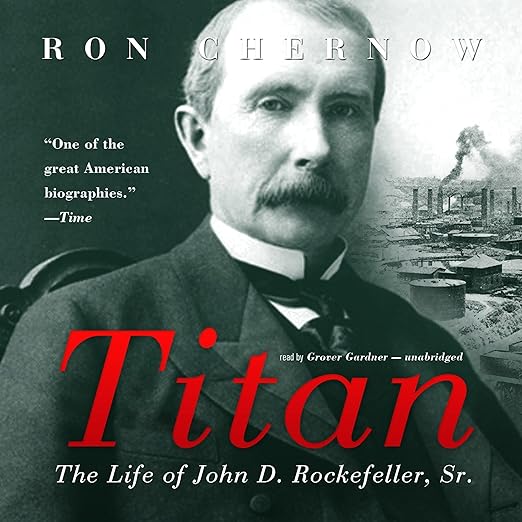
Daniel Putman opens a five-star review by complaining about the cover. It is a bland grayish jacket, the review says, showing a grim, almost sadistic-looking Rockefeller against a sterile cityscape, an image that does not encourage anyone to expect an enjoyable read. That is a fair objection to an object no buyer of this audiobook will ever hold in a hand. What Putman is really describing, though, is the distance between how this book presents itself and what it actually turns out to be, and across 35 hours and 3 minutes that distance is the whole experience.
Ninety Percent of the Oil, Called the Octopus
Ron Chernow had something no previous biographer of John D. Rockefeller possessed, which was unrestricted access to an exceptionally rich trove of family papers. The publisher's copy leans on that fact, and it earns the emphasis. Three generations of historians had circled the first billionaire in American history without pinning him down, and the copy on this listing says so outright. Titan is the first full-length life built on the private record instead of the public one, and the claim it makes for itself is that the resulting portrait indelibly alters the image of its subject. That is a large promise, and the length is partly how it gets kept: 35 hours leaves room for the family scandals, tragedies and misfortunes the publisher says have never surfaced before.
Standard Oil supplies the spine of the story. Muckrakers branded the trust the Octopus, and at its peak it refined and marketed nearly 90 percent of the oil produced in the country. The charges against it were specific: grand-scale collusion with the railroads, predatory pricing, industrial espionage, wholesale bribery of political officials. Rockefeller spent more than 30 years dodging investigations before Teddy Roosevelt and his trustbusters mounted the marathon crusade that finally brought the company to bay.
Michael Lyman filed the oddest entry here, endearing in its way. Lyman is a licensed tour guide in Saint Augustine, Florida, a Baptist like Rockefeller, and a member of Ancient City Baptist, a building that Henry Morrison Flagler helped pay for. Flagler was Rockefeller's close friend and partner at Standard Oil, and the review spends most of its length on Florida geography before arriving at the book. Local history, not literary judgment, but it does show how far this story reaches.
Gardner Keeps a Dozen Titans Legible Alone
Thirty-five hours and 3 minutes is a lot of biography, and the strongest argument for spending it comes from a reader who had already spent plenty. Putman had read and enjoyed Chernow's lives of Washington, Hamilton and Grant, expected dry going on Standard Oil, and came away calling this the best of the four. That is a meaningful comparison, because those other books are the ones most people reach for first, and this one is by some distance the least fashionable subject.
Kanwar Anand, writing from India, makes the other case, a stranger one. The review is organized as a numbered list of reasons, and the first is about conviction: Rockefeller chose his virtues and his vices, held to them tirelessly, believed himself a man of God, and never questioned that God even when the world questioned his conduct. The second point is that the writing itself is exemplary. Whether you find the first item admirable or chilling is exactly the tension Chernow is working with.
Grover Gardner works alone, with no co-reader listed, and the assignment is bigger than the runtime suggests. Beyond Rockefeller and his family, the book brings on Joseph Pulitzer, William Randolph Hearst, Jay Gould, William Vanderbilt, Ida Tarbell, Andrew Carnegie, Carl Jung, J. P. Morgan, William James, Henry Clay Frick, Mark Twain and Will Rogers. A single reader has to keep a cast of that size legible over a month of listening without turning any of them into caricature.
Five Verdicts Above, One Badge Below
Chernow is not writing a prosecution, and listeners should know that going in. The book supplies abundant evidence of the misdeeds and then declines to convict, discarding the cold-blooded monster of legend for a quirkier, more human portrait: a devout Baptist, a temperance advocate, a man who gave money away more generously than anyone before him. Anyone arriving wanting a straightforward indictment of monopoly capitalism will find the tone too forgiving. Anyone arriving wanting a hymn will find the documented bribery inconvenient.
Language is the next obstacle. Two signed verdicts out of five arrive in something other than English, and one of them runs to four words. Another carries nothing but a personal name in its title line. Add the tour guide's Florida digression and the cover critique, and the usable English evidence about this recording comes down to two considered assessments, neither of which describes the listening. For a 35-hour purchase that is a thin column, so weigh the reputation of the book above the volume of feedback under it.
The badge reads 4.6, the counter beside it says three votes, and five people have signed a verdict beneath it, every one of them a five. That combination does not resolve into arithmetic I would trust, so I am not going to pretend it does. What can be said is simpler: nobody who wrote here graded the book below full marks, and the displayed average sits below every visible grade. Read the number as noise and the responses as the actual signal.
The Rockefeller Foundation Half Most People Never Learn
Readers who came out of Chernow's other biographies wanting more will get the fullest version of what he does here, and Putman's verdict suggests the payoff is larger than the subject's reputation implies. Business and finance listeners get a founding case study in monopoly, regulation and the birth of the modern corporation. History listeners get the post Civil War transformation from small business to giant corporation, told through one household. Anyone interested in philanthropy gets the Rockefeller Foundation and the University of Chicago as part of the same story, which is the half of this life most people never learn. Commuters and walkers with long routines are the natural audience, since the chronological structure means you can leave it for a week and pick it back up without losing your place.
Leave it alone if you want a brisk overview, because 35 hours of family scandal, refinery economics and legal maneuvering is not that. Anyone who needs an industrial villain to stay a villain will find the portrait complicating itself every few chapters, and that is the book working exactly as designed. Thirty-five hours is a commitment, and this one repays it, provided you want the man and not the myth.
Does Titan assume I already know the Standard Oil story?
No. Chernow builds the company from Rockefeller's rustic origins forward, so the refining business, the railroad deals and the antitrust fight all arrive explained. Some familiarity with late nineteenth century America helps, but the book supplies its own context. Listeners new to the period will follow it without outside reading.
How does the Titan audiobook handle the financial detail?
Chernow writes narrative history, not financial analysis, so ledgers arrive inside scenes and arguments, never in tables. That suits audio well, since almost nothing in the text needs to be looked at twice. Listeners who want spreadsheets and share structures will find the treatment lighter than expected.
Is 35 hours of audiobook realistic for a first Rockefeller biography?
It is long, but the structure helps. The book moves chronologically through a very eventful life, and cameos from Pulitzer, Carnegie, Tarbell and Mark Twain break the pace at regular intervals. Most listeners spread it across several weeks. Nothing about the material rewards rushing through it.
What do the reviews here tell me about the recording itself?
Almost nothing. Five people wrote, and their subjects are the jacket art, a tour guide's local church history, a numbered list of moral lessons, four words in Dutch and a short note in Spanish. Not one of them mentions the narration, so the sample clip is your only preview.