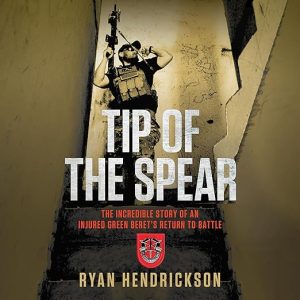
Ryan Hendrickson's own account of the moment his right foot came apart beneath him outside a mud-hut compound in 2010 sits at the center of this audiobook, and the craft decision that makes it work is restraint rather than dramatization. Hendrickson was a Green Beret serving as the tip of the spear, the soldier whose job was clearing the route of IEDs ahead of American and Afghan troops, when he stepped on a device that many soldiers do not survive stepping on. What follows across eight hours and twenty-five minutes is not just a recovery story but an account of two dozen surgeries, a prosthetic device called an IDEO that let him walk again, and a fight to return to active duty that most medically retired soldiers never attempt, let alone complete.
The structural choice that elevates this above a standard inspirational military memoir is the second act Hendrickson earns: after rejoining the Green Berets and redeploying to Afghanistan in 2012, he volunteered again in 2016, and it is during that second deployment, under heavy Taliban fire, that he risked his life to rescue three Afghan soldiers and recover the bodies of two others under the ethos that no one gets left behind, the action that earned him the Silver Star. Structuring the book around two separate acts of extraordinary physical will, first the recovery and then the deliberate return to danger, gives the narrative a shape that a single-injury-to-triumph arc would not have.
It helps to understand what the twelve-man team Hendrickson served with actually is: a Green Beret Operational Detachment Alpha, the basic building block of Army Special Forces, built specifically so a small team can train, advise, and fight alongside foreign partner forces rather than simply operating alone. Knowing that structure going in makes clearer why a single soldier's IED-clearing role carried the weight it did; the entire team's safety depended on that one job being done correctly, step after step, mission after mission.
What Stands Out
Reviewer Elizabeth Armatys captures something real about the book's tonal range, describing it as gripping and emotional while also noting it had her laughing and crying within the same chapters, and that mix of dark humor and hard-won gravity is a genuine hallmark of how Special Forces veterans tend to narrate trauma when they narrate it honestly. Reviewer klack002, who first heard about Hendrickson through a podcast, makes a point worth underlining: most military memoirs from Green Berets and other special operations veterans arrive watered down, either by security review or by the author's own instinct to protect the reader, and this one is praised specifically for breaking down military jargon rather than hiding behind it.
A real craft argument also favors choosing the audio edition specifically over print here. A first-person combat and recovery memoir depends heavily on pacing, on when a sentence is allowed to land and when it needs to move quickly, and reviewer bushidojock's description of flying through the book because it does not have any boring chapters to worry about is exactly the kind of momentum a well-paced narration can sustain even more effectively than silent reading, since the performer controls exactly how long a hard moment is allowed to sit before the next one arrives.
Readers who gravitate toward modern Special Forces memoirs, Marcus Luttrell's Lone Survivor or the various No Easy Day-style accounts that followed the post-9/11 wars, will recognize the genre's usual shape here, but Hendrickson's book distinguishes itself by refusing to end at the moment of injury the way many comparable memoirs do. The genre convention is survival-and-reflection; this book insists on a second combat chapter most of its peers never attempt.
Things to Know Before Starting Tip of the Spear
Brock Vickers narrates with the kind of grounded, unadorned delivery that this kind of first-person combat memoir needs; no reviewer commentary specifically praising or critiquing his performance is attached to this listing, so this is a genre-fit assessment rather than a confirmed verdict, but the material itself, technical medical detail alongside genuine battlefield stakes, calls for exactly the plainspoken register a good narrator brings to Special Forces memoirs rather than an overly polished or theatrical one.
Listeners should go in aware that the injury and recovery sections include real medical detail, skin grafts, prosthetic mechanics, the physical tests Hendrickson had to pass to requalify for active duty, presented without much softening. This is not a book that shies away from the specifics of what an IED does to a human body, and while that honesty is part of what makes the recovery arc land, it is worth knowing before starting an eight-hour commitment built around it.
The IDEO device central to Hendrickson's recovery, the Intrepid Dynamic Exoskeletal Orthosis, was developed at the Center for the Intrepid at Brooke Army Medical Center specifically to let severely wounded service members return to high-demand physical roles rather than simply regain basic mobility, and understanding that real medical context adds weight to just how unusual Hendrickson's return to full Green Beret duty actually was, even within a system built to support exactly that kind of comeback.
It is worth understanding exactly what the Silver Star represents within the military honors system: the nation's third-highest decoration for valor, awarded only after formal review of the specific actions described, which means the citation behind Hendrickson's award carries an official, independently verified account of the 2016 rescue that sits alongside his own first-person telling of it in this book.
Best Suited For
This audiobook is a strong fit for listeners drawn to modern Special Forces memoirs in the tradition of Marcus Luttrell or Kyle Carpenter, anyone specifically interested in stories of soldiers who fought their way back to active duty after a catastrophic injury rather than simply surviving it, and listeners who want the recovery genre paired with a genuine second act of combat heroism rather than ending at the moment of physical rehabilitation.
It is a reasonable skip only for listeners who find graphic medical detail difficult to sit with in audio form, since the narration does not create the same visual distance a printed page can offer. Everyone else, including readers with no particular prior interest in military memoirs, should find Hendrickson's own voice, filtered through Vickers's steady narration, a genuinely accessible entry point into a very specific corner of modern American military experience. Listeners who finish this one hungry for more will find a natural next step in other Special Forces recovery narratives covering similar ground.
Questions Listeners Ask
How long is the Tip of the Spear audiobook?
This edition runs eight hours and twenty-five minutes, a brisk pace for a memoir covering both a catastrophic injury and a full return to combat duty.
Does this audiobook include graphic medical detail about Ryan Hendrickson's injury?
Yes, the recovery sections describe his IED injury, surgeries, and prosthetic rehabilitation without much softening, which is part of what makes the return-to-duty arc land.
Is Tip of the Spear only for listeners already interested in military memoirs?
No, reviewers describe it as accessible even to listeners with no prior interest in the genre, thanks to Hendrickson's plainspoken storytelling.