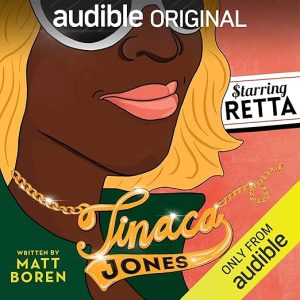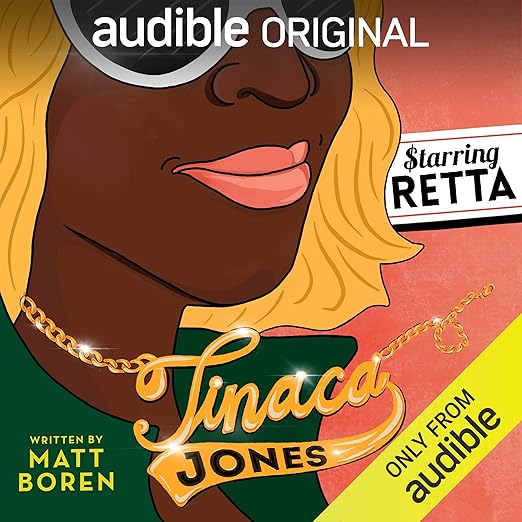
- Narrator: Retta owns this completely, bringing the same warm authority she's known for on screen to a comedic monologue that demands a performer who can sustain an entire character for two hours without a supporting cast.
- Subjects: Identity theft and the fight to reclaim selfhood, ambition versus exploitation, Black women and the cost of public visibility
- Tone: Raucous and righteous, with an edge of cultural friction
- Bottom line: At just over two hours, this Audible Original delivers genuine comic momentum, though its cultural politics will not land the same way for all listeners.
Two hours is a specific kind of audiobook commitment, long enough to require a sit-down listen but short enough to clear in a single afternoon. I came to Tinaca Jones on a Saturday when I wanted something funny without too many demands. The premise, a woman's identity stolen by an opportunistic celebrity pretender with the whole account delivered as a legal deposition, is the kind of high-concept comedy that either executes brilliantly or collapses under its own cleverness. With Retta in the narrator's chair, it executes.
Matt Boren's script centers on Tinaca Jones, a grocery cashier who has spent years building toward her lifestyle brand launch, only to have a woman named Kelly Smith swipe her name and parlay it into overnight fame with a red-carpet stunt. What follows is Tinaca's account of the battle to get her name back, filtered through the very specific comedic form of a legal deposition. The setup is genuinely clever. A deposition is the perfect frame for a woman who wants to tell her own story on her own terms, at length, with digressions.
What We Made of It
Retta's performance is the load-bearing element. She brings the same energy that made her a Parks and Recreation standout, warmth cut with impatience, confidence that reads as earned rather than performed, to a character who is essentially delivering a monologue for two hours. The comedy works because Retta makes you believe in Tinaca as a specific person rather than a comic type. Listeners who have enjoyed Retta's work on screen will hear exactly the register they expect, which is either a selling point or a limitation depending on your relationship to that persona.
The piece carries genuine cultural freight that the comedy cannot fully absorb. One reviewer called it a minstrel show; others found it straightforwardly hilarious. The dissonance between those reactions points to real questions about who gets to write comedic Black women characters and what assumptions get smuggled in under the cover of farce. That tension doesn't disappear because the listener is enjoying the performance, and it's worth sitting with rather than dismissing.
What Makes Tinaca Jones Worth Hearing
For listeners who come primarily for Retta, this is an easy recommendation. Her comic instincts are exceptional and she seems genuinely invested in Tinaca's indignation rather than simply reading lines. The deposition structure gives her natural pauses to work with and the script gives her real sentences to bite into. If you find one-person audio performances more engaging than ensemble productions, this format suits the material very well.
The runtime also matters. At just over two hours, Tinaca Jones asks very little of your schedule and delivers a complete comedic arc. Boren doesn't overstay the premise, which is a discipline that longer comedy productions often fail to exercise. The pacing is tight throughout and the concept doesn't outlast its welcome.
What Might Not Land
The deposition structure is doing more work than it first appears. Boren uses the format to control information carefully. Tinaca's account is selective, self-flattering, and occasionally unreliable in ways that add a layer of comedy beneath the obvious jokes. Watch for the moments when what she says she did and what clearly happened diverge. Also notice how the character of Kelly Smith is kept entirely offscreen, which is both a practical choice and a thematic one: the antagonist matters only in terms of what she took, not who she is.
The Right Listener for Tinaca Jones
Listen if you're a Retta fan who wants to hear her sustain a comedic character across a full performance, or if you need something short and sharp for an afternoon. Also consider it if you're interested in audio comedy that uses the form itself as part of the joke. Approach with awareness of the cultural debate around the characterization, which is a real and documented conversation in the review record. Both reactions, loving it and finding it troubling, are represented among listeners who have engaged with it seriously.
A Few Questions About Tinaca Jones
Is Tinaca Jones a standalone or part of a series?
It is a complete standalone Audible Original. At two hours and two minutes, it tells a self-contained story with a full resolution. There are no sequels and no prior listening context is needed.
Why do some reviews call Tinaca Jones offensive while others give it five stars?
The reviews reflect a genuine divide. Some readers find the characterization of Tinaca loving and funny. Others find the combination of elements, written by a white male author, to reproduce stereotypes rather than subvert them. Both reactions are present in the review record and both deserve consideration before listening.
How explicit is the language in this audiobook?
The publisher advisory is clear: this content is not for kids and features adult language throughout. Retta's delivery leans into Tinaca's sailor mouth as a character trait. If strong language is a barrier, this is not the right listen.
What is the deposition format and how does it affect the listening experience?
The entire story is told as Tinaca's account of events during a legal deposition, which means she addresses an implied questioner and speaks directly about everything that happened. It creates a confessional, intimate energy that suits the comedic material and gives Retta a structure to work within.