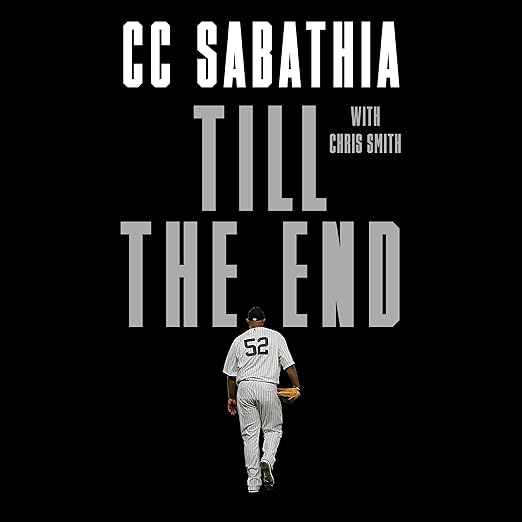
- Performance: Guy Lockard handles CC Sabathia's story with steady warmth, sustaining the memoir's honest, conversational register across its 8.5-hour runtime.
- What it covers: Addiction and recovery within professional sport, race and belonging in baseball, resilience and the cost of physical deterioration
- Feel: Honest and emotionally direct without being sensational
- Our call: A sports memoir that takes its emotional risks seriously, strongest in the sections where Sabathia stops talking about pitching and talks about surviving.
CC Sabathia grew up in Vallejo, California, a baseball town where the sport was not a hobby but a social language, and he was speaking it fluently by the time he was a preteen. This audiobook is a memoir that follows his arc from that Vallejo childhood through his years with Cleveland, Milwaukee, the New York Yankees championship run, and eventually into the recovery that forced him to reckon with what the sport and his relationship to alcohol had cost him. Sabathia is direct about things that athletes in his position frequently are not, and that directness is the reason Till the End reads as more than a career summary dressed up with personal anecdotes.
The questions that open the synopsis, about what it means to be born with enormous gifts in a life shadowed by tragedy, are not rhetorical framing. They are the actual architecture of the book. Sabathia is consistently interested in the relationship between what baseball gave him and what it enabled him to avoid confronting. The sport provided structure, identity, and a framework for navigating an adult world he entered as a teenager. But that same structure became, in time, part of the scaffolding that allowed his drinking to stay hidden, both from others and from himself.
The addiction narrative is the spine of the book, but Sabathia earns it rather than leaning on it. He does not frame his story primarily as a recovery narrative with baseball as backdrop. He frames it as a baseball story whose complications are inseparable from the personal history that ran parallel to the career. The drinking was present early, he acknowledges, in ways that people around him either did not see or chose to overlook. The culture of professional baseball in the 1990s and early 2000s, where alcohol was institutional in clubhouses and the social framework around players, made certain patterns invisible by design.
One reviewer who knew Sabathia personally since he was seventeen noted that the addiction was present earlier than they had realized, and found the disclosure both enlightening and characteristic of Sabathia's honesty. That firsthand testimonial carries weight precisely because it comes from proximity: someone who saw Sabathia as a teenager and is now reading his account of what was already forming underneath the surface of a visibly exceptional young athlete.
Lockard Renders Pragmatism and Underlying Sadness
Sabathia is also one of the more articulate voices writing about race in baseball, and that material is given real space here. His account of baseball's demographic shifts, the declining presence of Black American players at the highest level of the sport during his career, the particular pressures of being a Black pitcher in the American League's marquee franchise, and the ways racism operated in the sport's culture during what he calls its most turbulent era, is direct and specific. He does not speak in generalities about diversity. He speaks about specific incidents, specific dynamics, and what it felt like to navigate them while also managing the performance expectations of pitching for the Yankees.
Guy Lockard's narration suits the material. Sabathia's own voice as a writer is conversational and unguarded, and Lockard sustains that register rather than adding theatrical weight where the text does not call for it. The sections describing the mechanical deterioration of Sabathia's body over the latter years of his career, his knee, his declining velocity, the physical reality of a large man asking an extraordinary athlete's body to keep performing past its natural limits, are handled with a combination of pragmatism and underlying sadness that Lockard renders accurately.
Alcohol as a Third Party in the Marriage
The memoir's treatment of Sabathia's wife Amber and their marriage is worth noting. She is a consistent presence in the narrative, and Sabathia is honest about the ways his addiction affected her and their children. He does not romanticize the recovery as a clean turnaround: it is described as a difficult, ongoing renegotiation of what his relationship with the people he loves actually looks like without alcohol as a third party to every dynamic. That level of specificity about the domestic fallout of addiction is less common in sports memoirs than the recovery story itself, and Sabathia handles it with appropriate weight.
Listeners who come to this book primarily for pitching analysis and Yankee dynasty content will find both present and well-detailed. The technical sections on pitching strategy, pitch sequencing, the adjustment required when velocity declined and Sabathia had to become a different kind of pitcher to stay effective, are written from the inside. But those sections are in service of a larger story rather than the point in themselves, and readers who want pure baseball analysis may find the memoir's emotional terrain sometimes interrupts the game narrative. That is, in fact, the right priority for the book Sabathia wanted to write.
Addiction and Recovery for Non-Sports Listeners Too
Baseball fans who followed the Yankees during their most recent championship era will find this essential context from the perspective of their most durable starting pitcher. Listeners interested in addiction and recovery narratives who are not primarily sports readers will also find value here, because Sabathia is honest about the shape of the problem in ways that transcend the sports setting. The memoir's engagement with race in professional baseball makes it relevant beyond both audiences, as a document of what it felt like to occupy a particular position in American professional sport during a specific and complicated era. Listeners who want something with the courage of genuine disclosure rather than the polish of reputation management will find this memoir delivers on that promise.
Common Questions
How explicitly does this audiobook address racism in professional baseball?
Quite directly. Sabathia discusses the declining presence of Black American players in major league baseball during his career, specific experiences of racism within the sport, and what it meant to pitch for the Yankees as a Black man during what he characterizes as one of baseball's most turbulent eras. This material is given substantial space rather than brief acknowledgment.
Is the Till the End audiobook suitable for listeners who are not baseball fans?
Yes, particularly for listeners interested in addiction and recovery, or in memoir about the gap between professional success and private struggle. The baseball context is present throughout, but Sabathia's account of his drinking, recovery, and the effect on his marriage and family is written with enough specificity to resonate well beyond the sport.