Quick Take
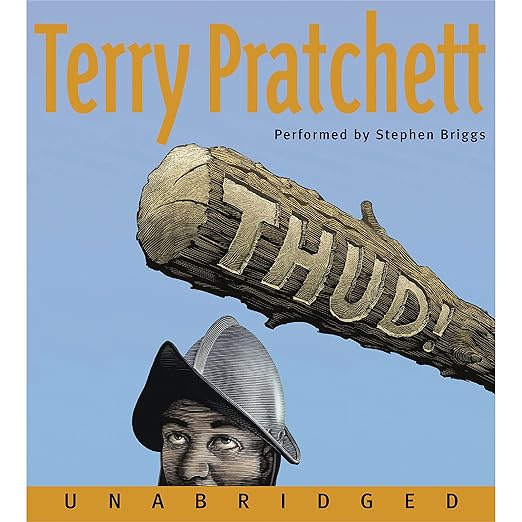
- Narration: Stephen Briggs is the definitive Discworld narrator, and his command of the ensemble, Watch regulars, dwarfs, trolls, and the Igor, is at its most assured here.
- Themes: Sectarian violence and tribalism, the demands of duty and fatherhood, how ancient hatreds become self-perpetuating
- Mood: Richly comic on the surface, genuinely sober underneath, Pratchett doing what he did better than anyone
- Verdict: One of the strongest entries in the Watch sub-series, and one of the most politically relevant Discworld novels in the full catalog.
I came to Thud! for the third time on a long train journey, and found myself thinking, about halfway through, that Pratchett had been writing about the specific shape of modern political tribalism for decades before we had the vocabulary to name it precisely. The passage where Carrot describes the logic of sectarian thinking, if you’re not an apple, you’re a banana, is one of those moments where satire and observation collapse into the same thing. The Koom Valley legend, the ancient dwarfs-vs-trolls conflict that nobody alive actually witnessed but everybody carries as a founding wound, is one of Pratchett’s most precise constructions.
Thud! is book thirty-four of Discworld and the eighth novel centered on the Ankh-Morpork City Watch. Commander Sam Vimes is holding his city together while it teeters on the edge of sectarian violence, a troll has been murdered, a dwarf extremist group called the Summoning Dark is moving through the city, and Koom Valley Day is approaching. Vimes also has to be home by six o’clock every evening to read Where’s My Cow? to his infant son. That second obligation is not treated as comic relief. It is treated as the most important thing in the book.
The Sam Vimes Question at the Heart of It All
One reviewer called Thud! possibly the best novel in the entire Discworld series, which is a bold claim across a forty-one book catalog, but I understand the impulse. What makes this entry exceptional is the way Pratchett deepens Vimes’ moral framework without simplifying it. Vimes is a complicated man, working-class chip on his shoulder, married above his station, constantly fighting his own capacity for violence, tasked with policing a city whose power structures he fundamentally distrusts. Thud! puts pressure on every one of those complications simultaneously.
The Summoning Dark subplot, in which a malevolent presence attempts to use Vimes’ own anger and sense of justice as a vehicle for something much darker, is one of the most genuinely frightening things Pratchett ever wrote. The horror isn’t supernatural in the conventional sense, it’s the horror of recognizing the ease with which righteous anger can be turned toward something unrighteous. Vimes’ confrontation with it, and the thing that saves him, is the book’s emotional center. The Where’s My Cow? ritual isn’t comic padding. It’s the answer to a very serious question about what keeps a person human.
Briggs and the Sound of Ankh-Morpork
Stephen Briggs narrated the majority of the Discworld audiobook catalog and is so thoroughly embedded in this world that the characters are, for most listeners, inseparable from his interpretations. In Thud!, he has an enormous cast to manage: Vimes, Carrot, Angua, Cheery, Colon, Nobby, dwarfs of differing registers, several trolls, Sybil, Willikins, an Igor, and the voice of the Summoning Dark itself. Briggs handles all of it without confusion, each character has a distinct sonic identity that he maintains consistently across ten-plus hours. His Vimes in particular captures the precise quality of exhausted, deeply-felt integrity that the character requires.
This is not an audiobook production with music or effects, just a single narrator doing the full work. For most Discworld fans that is the correct approach. Briggs’ character-performance-focused style serves the dense observation and wit in Pratchett’s prose without calling attention to the narration itself.
What the Subplots Are Actually Doing
One reviewer noted that the subplots felt stronger than the main storyline, and while I don’t fully agree, I understand what they’re responding to. Thud! is structured unusually for a Watch novel in that the central mystery, who killed Grag Hamcrusher, is almost secondary to the political and psychological tensions surrounding it. The investigation is the scaffolding; the actual subject of the novel is what happens to a society when its founding myths become more important than the truth, and when the people who benefit from perpetuating conflict are allowed to define the terms of the conflict. Pratchett wraps all of that inside a police procedural with extremely good jokes, because he was Terry Pratchett and that is what he did.
Sybil in Thud! is not merely Vimes’ admirable wife; she is a person with her own strategy and her own considerable force. Angua and Sally’s dynamic adds another layer to the sectarian-tension theme without overstating it. Pratchett treats the female characters in this book with the same structural seriousness as the male ones, and the subplots are strong partly because of that consistency.
Who Should Listen / Who Should Skip
Thud! is best approached by listeners who have read at least some of the Watch sub-series, Guards! Guards!, Men at Arms, Feet of Clay, Jingo, The Fifth Elephant, and Night Watch in particular. The emotional payoff of Vimes’ arc across the series is cumulative, and jumping in here cold means missing the context that gives the Summoning Dark sequence its full weight. For established Discworld listeners, this is essential. One reviewer came here first and then went back to the beginning; that is a valid path, but not the ideal one. If you have never tried Pratchett, Guards! Guards! is the right entry point, with Thud! as a destination you’ll be very glad to reach.
Frequently Asked Questions
Is Thud! a good starting point for the Discworld series, or do I need to read the Watch novels in order?
Starting here is not recommended, though one reviewer did exactly that and enjoyed it enough to go back to the beginning. The Watch sub-series begins with Guards! Guards!, and the accumulated emotional weight of Vimes’ character across eight books is what makes the Summoning Dark subplot genuinely powerful.
The description mentions racial hatred and sectarian violence, how heavy does the book actually get?
Heavier than casual Discworld readers might expect, but never without the comedy running in parallel. Pratchett makes his serious points through the humor rather than despite it. The Koom Valley sections have genuine menace, and the Summoning Dark subplot reaches for something close to horror. It remains funny throughout, but the humor serves the seriousness rather than undercutting it.
How does Stephen Briggs’ narration compare to the Tony Robinson abridged versions from BBC Radio?
Briggs narrates the full, unabridged text, which means the complete Watch story with all subplots intact. His approach is focused on character differentiation and comedic timing rather than theatrical atmosphere. Most Discworld fans consider his narrations the canonical audio versions.
Thud! won a Reader’s Favourite award in the Discworld Cup, is it really considered the best in the series?
It was voted readers’ favourite in that particular poll, which speaks to its wide appeal within the fanbase. Night Watch has a strong claim to being the most artistically ambitious Watch novel, and Small Gods is frequently cited as Pratchett’s most formally accomplished standalone. But Thud! synthesizes the Watch sub-series’ themes with unusual completeness, which likely explains the vote.