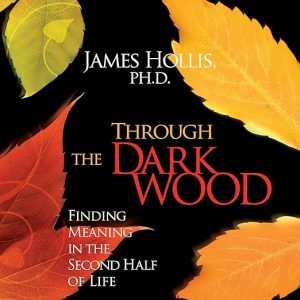
James Hollis PhD reading his own work is not a neutral choice. Through the Dark Wood audiobook is built around a Jungian analyst talking to you about the passage through midlife, about the collision between the life you have built and the life your soul actually demands, and that kind of material lands differently when you hear the voice of the person who has spent forty years sitting with hundreds of patients through exactly this transition. Hollis is one of the most respected figures in contemporary Jungian psychology, and the reputation he holds among readers who have engaged with his books across two decades comes through clearly in the testimony of those who have returned to this recording twenty times or more.
How Through the Dark Wood Holds Up
The title draws on Dante. When the illusions of our youth begin to crumble, Hollis explains, we reach what the poet called the dark wood, that disorienting middle passage where the maps we were given no longer match the territory of our actual experience. This framing is precise rather than ornamental. Hollis is a scholar of literature as much as a clinician, and his use of Dante as the organizing metaphor for midlife transition is not decorative. The dark wood is a place where the usual landmarks are gone, where you cannot tell how far you are from either origin or destination, where the question of what you are actually doing with your time on earth becomes impossible to avoid.
The audiobook covers what Hollis identifies as the core challenges of the second half of life: moving from relationships built on need toward relationships capable of genuine intimacy, cultivating a spirituality that can survive the loss of earlier, simpler frameworks, learning to let go of beliefs that no longer match your actual experience. Drawing on his work with hundreds of clients, he presents what he calls the collision between the False Self, assembled from others' expectations, and the True Self, the instinctive interior life that refuses to stay submerged indefinitely. The framework is Jungian, but Hollis presents it with enough clarity that listeners without a psychology background can follow the argument. He is not interested in arcane terminology for its own sake; he is interested in the practical experience of people trying to figure out what they are supposed to do with the second half of their lives.
Why Through the Dark Wood Works as an Audiobook
Reviewer Tim Lukeman, who has been reading and rereading Hollis's books for two decades, makes a distinction worth holding onto: he describes these as talks rather than lectures. The experience of listening is precisely that. Hollis does not bark instructions or offer a quick-fix program. He reasons with you, shares the experiences of people he has worked with, acknowledges the difficulty of the material, and trusts you to do your own thinking. Reviewer msmorningstar, who listened to the original CD program during a daily commute, reported hearing something new or interpreting things differently on each repeat listen, which is exactly what tends to happen with genuinely dense and careful material.
Hollis's voice, described by reviewers as masculine and down to earth, caring and not preachy, is itself a significant part of why this audiobook works as well as it does. He is not performing authority; he is using it in service of the listener's own capacity for self-understanding. The audio format suits the material better than the print format for many listeners precisely because it slows the pace of engagement. You cannot skim a recording the way you can skip through a book, and Through the Dark Wood rewards the kind of sustained attention that audio enforces. The seven-hour-and-twenty-five-minute runtime, substantial by any measure, proves its worth through the density and care of what fills it.
Weak Spots in Through the Dark Wood
Hollis is a Jungian analyst, and the framework he uses, including concepts like the shadow, the complex, the False Self and True Self, assumes some willingness to engage with psychological vocabulary rather than demanding immediate proof. He explains as he goes, but this is not an introductory pop-psychology listen. Listeners who want concrete action steps rather than philosophical orientation may find the material more atmospheric than instructive. The midlife framing in the title and synopsis is also worth reading carefully. Hollis is not talking about a crisis in the popular sense of impulsive decisions and dramatic exits. He is describing a necessary interior reckoning that most people experience as disorienting precisely because it cannot be resolved by external action alone. The questions he poses do not come with prescribed answers; they come with the tools to develop your own answers over time.
The Right Listener for Through the Dark Wood
Listeners navigating a genuine sense that the life they have built does not match the life they feel called toward will find Hollis's analysis both accurate and steadying. Those with an existing interest in depth psychology or Jungian thought will have additional context for his framework. The audiobook is also genuinely rewarding for listeners who enjoy intellectual rigor applied to psychological questions that most popular wellness content flattens or avoids entirely. Skip it if you need clear, sequential instructions or if you are in a phase of life where the questions Hollis addresses do not yet feel pressing. But for listeners ready to sit with the questions that bring richness and difficulty to the second half of life in equal measure, Through the Dark Wood is as honest as this kind of material gets.
Common Questions
Do I need to know Jungian psychology before listening to this audiobook?
Some familiarity helps, but Hollis explains his framework as he goes. Listeners without a psychology background have found the material accessible, though the density may require more than one listen to fully absorb.
Why does James Hollis narrate his own audiobook rather than a professional narrator?
Hollis's self-narration is central to the listening experience. Reviewers consistently note that hearing him speak adds a dimension unavailable in print. The tone of a conversation with a thoughtful, seasoned analyst rather than a polished performance is the point.
Is Through the Dark Wood audiobook better for repeated listening or a single pass?
Multiple listeners report returning to it many times and continuing to find new meaning. Hollis's material is dense enough that a single pass yields only partial understanding. This is a recording designed for sustained engagement over time, not one-time consumption.