Quick Take
- Narration: Genevra Lupa Catalano reads with the appropriate energy for motivational fitness content, warm and encouraging without tipping into excessive enthusiasm.
- Themes: sustainable fitness habits over short-term results, functional strength for daily life, the burnout cycle in health culture
- Mood: Encouraging and practical, with a deliberate anti-extremism tone throughout
- Verdict: Reasonable entry-level fitness philosophy for someone in the burnout-and-restart cycle, though the one-hour runtime means every concept is introductory rather than developed.
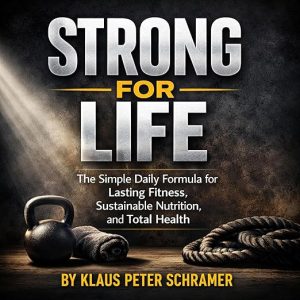
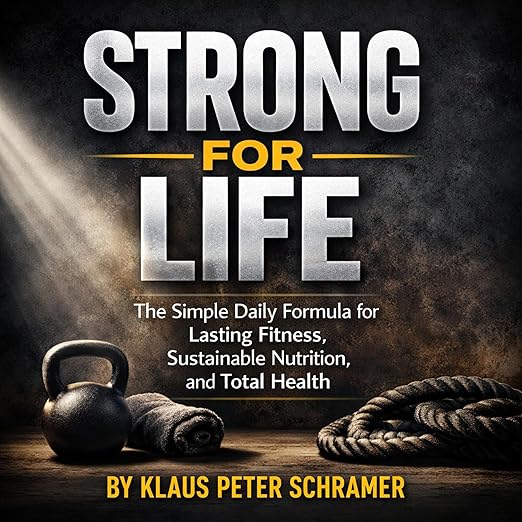
One hour is an unusual length for a fitness audiobook. It’s shorter than most commutes and considerably shorter than most workouts. I listened to Strong for Life on a Saturday morning run, which felt appropriately circular, and finished it still on the pavement with time to spare. What surprised me was that, within its genuinely tight scope, it was doing something coherent rather than just assembling motivational fragments.
Klaus Peter Schramer writes in the tradition of sustainable health over performance optimization, a crowded but genuinely necessary lane in a fitness culture that keeps producing burnout cycles. The core argument is that extreme workouts and strict diets fail not because people lack willpower but because they were designed for short-term intensity rather than long-term integration. Functional strength, by contrast, is built through modest daily consistency, and the habits that support it are designed to fit into actual lives rather than requiring those lives to be reorganized around fitness.
What Functional Strength Means Here and Why the Framing Matters
Schramer uses the term functional strength specifically to distinguish strength that supports everyday life from the kind of performance strength that is its own end. This is not a subtle distinction in principle, but it has real practical consequences for how training is approached. Functional strength goals are oriented toward: being able to move through your day without pain, lifting what needs to be lifted, maintaining energy through ordinary demands. The training that develops this kind of strength looks very different from training designed to maximize athletic performance, and Schramer is explicit about why that difference matters for longevity and consistency.
The sustainable nutrition component follows the same logic. Without detailing any specific diet, the audiobook makes the case for nutrition strategies built around what someone can maintain indefinitely rather than what produces the fastest initial result. This is less a framework than a principle, and the runtime doesn’t permit it to develop into anything more specific, which is both the book’s honest limitation and arguably its point. The principles are simple enough to actually use.
The Burnout Cycle This Book Is Explicitly Addressing
There’s a specific listener this book is written for: someone who has started and stopped fitness approaches multiple times, who has experienced the cycle of high motivation, extreme effort, unsustainable results, and collapse. Schramer names this pattern explicitly and frames it not as moral failure but as a predictable consequence of approaches designed for intensity rather than sustainability.
For that listener, the value of Strong for Life isn’t in the specific exercises or nutrition advice, it’s in having the cycle named and diagnosed and offered an alternative frame. The book doesn’t promise dramatic results; it promises that building strength and health is simpler and more methodical than fitness culture makes it appear. That’s a valuable message even if it isn’t a comprehensive program.
Genevra Lupa Catalano and the One-Hour Listen
Catalano brings a warm, steady energy to the narration that matches the book’s encouraging-without-overinflating tone. For a title this short, the narration style matters more than it might in a longer book, there’s no room for a slow build or for recovering from a wrong register. Catalano pitches it correctly: this is someone reading you something genuinely useful rather than selling you something urgently needed.
No reviews are currently available for this title, which means we’re working with limited signal on how listeners are responding. The 4.9 stars across 39 ratings suggests the audience finding it has found it genuinely useful. For a one-hour audiobook in the health space, that’s a reasonable indicator of audience fit even without review text to draw on.
Who Should Listen
Strong for Life works as an orientation reset for someone coming out of a burnout cycle who needs a different frame before trying again. It works as a short, low-friction entry point for someone who hasn’t been exercising at all and finds longer fitness books too overwhelming to start.
Don’t come to this for a program. There are no workout routines, no meal plans, no specific protocols. What there is is a philosophy of approach and a case for why the approach makes sense. If you need those first before the specifics, this is a good hour’s worth of framework. If you already have the philosophy and need the specifics, this isn’t the book.
Frequently Asked Questions
At one hour, is Strong for Life substantial enough to actually change how someone approaches fitness?
It’s substantial enough to shift framing, which may be exactly what someone stuck in a burnout cycle needs. It won’t provide a detailed program or protocol, the runtime doesn’t permit that, but the case it makes for sustainable over extreme approaches is coherent and worth an hour of your time if you recognize the cycle it’s describing.
Does Strong for Life recommend specific exercises or workout routines?
No. The audiobook operates at the philosophy and principle level rather than providing specific programming. It’s a framework for thinking about fitness sustainability rather than a training plan. If you need specific workout guidance, you’ll need a different resource alongside or after this one.
Who is Klaus Peter Schramer and what is his background in fitness?
The available metadata doesn’t detail Schramer’s specific credentials or background. The book is positioned as combining proven fitness principles, sustainable nutrition strategies, and holistic wellness insights, the framing suggests general health coaching rather than clinical or research-based authority. Approach the specific recommendations with that in mind.
Is this audiobook appropriate for someone who is older or has physical limitations?
The framing explicitly addresses fitness for people at any age, experience level, or current fitness level, with functional strength defined as strength that supports everyday life. The accessible philosophy is suitable for a wide range of starting points, though as with any fitness approach, specific medical conditions should be discussed with a healthcare provider.