Quick Take
- Narration: Amanda Young delivers a measured, empathetic performance that holds the weight of the material without becoming clinical. Her voice carries genuine warmth through some of the book’s most difficult passages.
- Themes: Sexual betrayal and addiction recovery, faith-integrated healing, couples therapy and intimacy rebuilding
- Mood: Raw and unflinching, yet ultimately hopeful
- Verdict: For couples navigating the aftermath of sexual betrayal, Roane and Eva Hunter’s dual perspective as both survivors and clinicians makes this one of the more credible and practically useful resources in the recovery space.
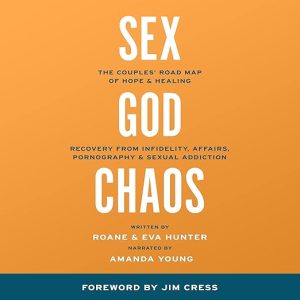
I came to this audiobook on a Tuesday afternoon, the kind of gray mid-week day when you sit down with something demanding because the subject itself demands it. Sex, God, and the Chaos of Betrayal is not easy listening in any conventional sense. Roane and Eva Hunter are pulling back the curtain on something that is still rarely spoken about with this level of transparency in faith-adjacent spaces: what happens when sexual addiction fractures a marriage, and how a couple can possibly rebuild when the damage is that deep.
The book’s subtitle does a lot of work. Chaos is exactly the right word. The Hunters frame sexual betrayal not simply as a relationship wound but as a full spiritual and psychological rupture, and they bring both lived authority and clinical precision to that framing. Roane’s own history with sexual addiction, narrated through the book with real candor, and Eva’s parallel experience as the betrayed partner give the material a weight that purely clinical recovery texts rarely achieve.
When Two Roles Collapse Into One Voice
What sets this book apart is the Hunters’ refusal to occupy only one position. They are simultaneously memoir writers, marriage therapists with active clinical practices, and people who have personally tested their own methodology. That overlap could easily produce a confused or self-congratulatory text, but the writing avoids that trap. The chapters move between personal narrative and practical framework in a way that feels deliberate rather than chaotic, and the roadmap sections are specific enough to be genuinely useful rather than abstractly inspirational.
Reviewer Jason, who described working through the book with his wife, noted that it taught them to be vulnerable and intimate in ways they had not previously imagined possible. That kind of testimony lands differently when you understand the Hunters’ clinical background. They have field-tested this material with real couples in crisis, and that shows in how they anticipate resistance, shame spirals, and the particular exhaustion of betrayed partners who have been told by well-meaning people to simply forgive and move forward.
The Faith Layer and What It Does to the Framing
This is explicitly a faith-integrated recovery resource. The Christian framework is not decorative. Reviewer Matthew C. Hayden described the book as uncovering parts of himself hidden deeply, and referenced the redemptive arc as load-bearing to his experience of healing. For readers who share that framework, the integration of spiritual accountability and theological hope around restoration will feel like exactly what the text promises. For those who do not come from a Christian context, the recovery principles themselves have secular utility, but the faith language is consistent and central enough that secular readers should know what they are entering.
Amanda Young’s narration manages this balance well. She does not over-spiritualize the delivery when the text shifts into clinical territory, and she does not flatten the emotional register when the personal narrative takes over. Five hours and eleven minutes is a relatively compact runtime for the scope of material covered, and Young’s pacing ensures none of it feels rushed.
What Recovery Actually Looks Like in Practice
The book’s most valuable section, by most accounts, is the roadmap itself. The Hunters do not offer a generic twelve-step repackaging. They address the specific dynamics of sexual betrayal: the disclosure process, the difference between surface remorse and genuine accountability, the particular ways that trauma bonding complicates the betrayed partner’s experience, and why conventional couples therapy often fails this population. One reviewer who described using the outline for personal recovery noted that it deserves more than four stars even while giving it four, a backhanded endorsement that speaks to the difficulty of rating a book that has saved something in your life.
The title signals all three of its operating registers: the sexual, the theological, and the interpersonal chaos that results when the two first collide. The Hunters do not flinch from any of them. That is the book’s greatest strength, and it is what makes it worth five hours and eleven minutes of close attention for the audience it is designed to serve.
Who Should Listen and Who Should Skip
Listen if you are navigating the aftermath of sexual betrayal in a committed relationship, if you are a therapist or pastoral counselor working with this population, or if you are a person in recovery from sexual addiction who wants a resource that honors both the clinical and spiritual dimensions of healing. Skip if you are looking for a secular-only recovery text, if the Christian framework will feel alienating rather than supportive, or if you need more than five hours of material for your particular situation.
Frequently Asked Questions
Do both Roane and Eva Hunter narrate the audiobook, or is it read by a single narrator?
Amanda Young narrates throughout. The dual perspective of Roane and Eva Hunter comes through the written content, but there is a single narrator voice for the entire audiobook.
Is this book primarily for the person who committed the betrayal, or for the betrayed partner?
It is written for both. The Hunters explicitly address the experiences of both the person with sexual addiction and the betrayed partner, and the recovery roadmap is designed to be worked through as a couple.
How explicit is the content about sexual addiction and affairs?
The book deals directly with porn addiction, affairs, sexual compulsivity, and their relational consequences. The treatment is clinical and honest rather than titillating, but readers who are in early trauma response may find the specificity of some sections difficult to sit with.
Does the Christian framework require religious belief to benefit from the recovery roadmap?
The faith integration is structural rather than decorative. While many of the clinical and practical principles translate across worldviews, the theological framing is consistent throughout, and the book’s model of accountability and restoration is explicitly rooted in Christian practice.