Quick Take
- Narration: Jessica Hoppe reading her own memoir is not optional, the intimacy required for this material, and the code-switching between registers that reflects her Latinx identity and recovery community experience, could not be reproduced by a hired narrator.
- Themes: Recovery and BIPOC erasure from recovery narratives, generational addiction, the American Dream and its costs
- Mood: Lyrical and investigative, emotionally pressurized throughout
- Verdict: One of the more important recovery memoirs of recent years, Hoppe’s work does not just tell a personal story but examines the institutional and historical forces that shaped it.
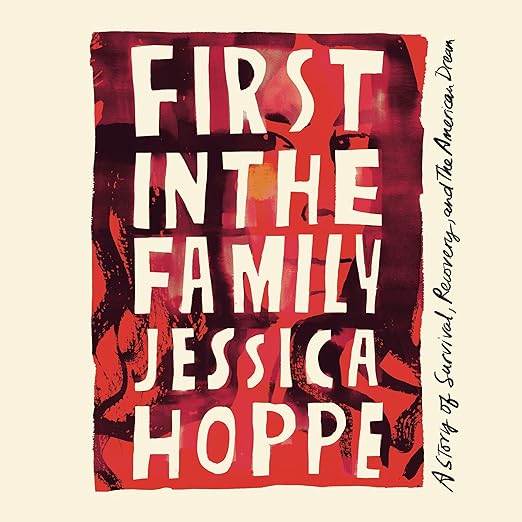
I finished First in the Family on a quiet Tuesday evening, and I sat with it for a while before reaching for anything else. That’s not always how recovery memoirs go, they can move through necessary pain toward earned resolution and leave you feeling instructed but not altered. What Hoppe does is different. She is not simply telling the story of her drinking and her recovery; she is conducting an investigation. Into her family’s history. Into the systems that shaped who was and wasn’t allowed to seek help. Into what it means to be the first in your family to name something and to survive it.
The memoir opens during the first year of COVID-19 quarantine, when overdose rates spiked to historically unprecedented levels and Hoppe’s cousin became one of those statistics. At that point, Hoppe had been in recovery for nearly four years without telling anyone. The first-person-female narrative that Hoppe inhabits is not triumphant. It is searching, and it is doing two things simultaneously: processing her own path and excavating the question of why her family’s relationship to substance use disorder was characterized by disappearance rather than treatment. “People just disappeared,” she writes. The investigation into that pattern becomes the spine of the book.
The Institutional Critique Embedded in the Personal Narrative
What distinguishes First in the Family from other recovery memoirs is its willingness to examine how recovery institutions have historically erased BIPOC communities from their narratives. This is not a digression, it is central to Hoppe’s story, because her family’s relationship to help-seeking was shaped by institutions that were not built for them. One reviewer describes the book as a “profound redefinition of substance abuse within the impacts of colonialism and racism on black and brown people” that “puts paid to the familiar tropes of AA.” That is a significant claim, and Hoppe earns it by anchoring the critique in specific family history rather than in abstraction.
The Self-Narration as Political and Emotional Choice
Hoppe reads her own memoir, and this is the correct decision. The voice is not polished in the way a professional audiobook narrator’s voice is polished, but that lack of polish is part of the information. You hear a person who is still inside the material, still carrying it, not looking back on it from a completed distance. This is particularly important during the family history sections, where Hoppe moves between her own recovery narrative and the broader investigation of what happened before her, the inherited dynamics that she is, as the title states, the first in the family to interrupt. A Macmillan Audio production from Flatiron Books, it has been prepared for audio with care.
The Company This Memoir Keeps
The comparisons invoked in the synopsis, The Recovering by Leslie Jamison, Somebody’s Daughter by Ashley C. Ford, Heavy by Kiese Laymon, are honest benchmarks. Hoppe shares with Jamison the intellectual impulse to examine addiction as a systemic rather than purely personal condition; she shares with Ford and Laymon the project of understanding the family system as both source of wound and object of love. At just over eight and a half hours, this is substantial listening, and it rewards that investment. Lilliam Rivera’s blurb, “a powerful thunderclap of a memoir”, is the kind of endorsement that overuses metaphor, but in this case the charge behind it is real.
Frequently Asked Questions
Does First in the Family require familiarity with 12-Step recovery culture to understand, or is it accessible to general readers?
Accessible to general readers. Hoppe is examining recovery institutions critically rather than assuming participation in them. While AA and 12-Step culture appear, they are examined from the outside as well as the inside, and readers without recovery experience will find sufficient context.
How does the book handle the tension between personal memoir and structural critique, does one overwhelm the other?
The balance is one of the book’s achievements. The structural critique of how BIPOC communities have been excluded from recovery narratives emerges from specific family history rather than being imposed on it. Listeners who want pure memoir and those who want cultural analysis will both find what they need, though neither will get it without the other.
Is this a book about alcoholism specifically or does it address a broader range of substance use?
Primarily alcohol, but the book’s frame, the generational inheritance of substance use disorder and the factors that shape who seeks treatment and who doesn’t, applies broadly. The cousin’s death from overdose during COVID-19 is part of the opening, and Hoppe’s investigation encompasses drug use within the family history as well.
The synopsis mentions this is a 2024 anticipated title, who specifically was recommending it ahead of publication?
Today.com, Electric Literature, Esquire, and Publishers Weekly all included it in their most anticipated lists. The Latinx literary community responded strongly pre-publication, and LupitaReads was among the early advocates. The author’s previous work as creator of NuevaYorka gave the book a built-in audience before release.