Quick Take
- Narration: Emma Edwards self-narrates with candor and dry humor, her financial-behavior specialist background surfaces in how she frames consumption, and the personal-diary quality of the month-by-month structure benefits enormously from her own voice.
- Themes: Consumption habits, body image and clothing, financial behavior change
- Mood: Honest, sometimes uncomfortable, ultimately grounding
- Verdict: One of the more original books in the style-and-consumption space, with a financial behavior angle that gives it more teeth than most wardrobe guides.
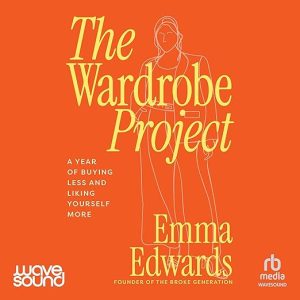
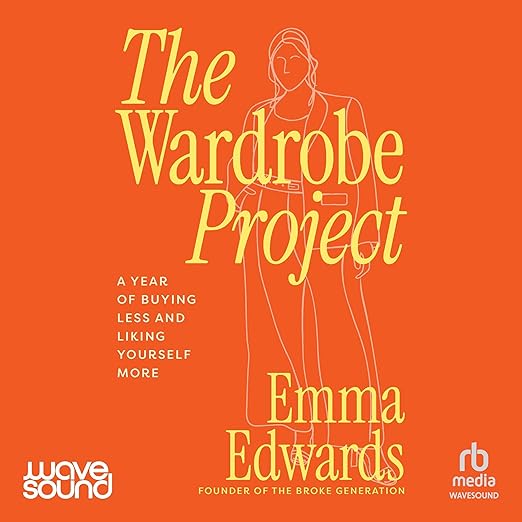
I was midway through a conversation with a friend about the psychological weight of getting dressed when I remembered I had this one queued up. Emma Edwards spent a full year buying no clothes whatsoever. Not secondhand, not rental, nothing. The Wardrobe Project is her account of that year, and it turns out to be less about fashion and more about identity, which is exactly what makes it interesting.
Edwards is the founder of The Broke Generation, a financial literacy platform, which positions her differently from most style writers. She approaches the wardrobe problem from inside behavioral economics rather than from inside the fashion industry, and that angle is what gives this book its particular texture. The question she’s really asking isn’t what should you wear but why do we keep buying things we already have equivalents of, and what does that behavior actually cost us.
One Year, Month by Month
The book is organized chronologically through Edwards’ no-buy year, which means you’re getting her real-time account of the psychological pressures and small victories rather than a retrospective cleaned-up version. The month-by-month structure creates genuine narrative tension. There’s a chapter on surviving a wedding with no new dress. There’s one on navigating professional environments where your appearance carries implicit stakes. There’s a particularly raw section on body image, where Edwards traces the connection between her desire to buy clothes and her relationship to her own body at different points in the year.
That body image thread is more substantive than you might expect from a book nominally about wardrobe management. One reviewer noted the book’s insight that style is separate from shopping and that style can be achieved without a complete body transformation. That’s the kind of reframe that sounds simple and is actually quite difficult to internalize, and Edwards earns it rather than just asserting it.
The Financial Behavior Lens
What sets The Wardrobe Project apart from other no-buy or capsule-wardrobe narratives is Edwards’ explicit attention to the consumption psychology beneath the spending patterns. She describes the hamster wheel of perpetual acquisition, the way new purchases deliver a brief resolution to the underlying dissatisfaction before the cycle resets. This is the same behavioral loop that behavioral economists document in other consumption contexts, applied specifically to fashion spending, and Edwards writes about it with the authority of someone who researches this professionally and has also lived it personally.
The practical techniques for resisting impulse buying, both in physical stores and online, are well-developed and specific rather than generic. These sections read as genuinely tested strategies rather than aspirational advice. Listeners dealing with the financial pressure side of the equation will find more traction here than in a purely aesthetic style guide.
Why Self-Narration Was the Right Choice
Edwards’ narration is one of the clearest examples I’ve encountered of self-narration being not just acceptable but necessary. The diary-like personal accounts of each month require her voice specifically. A professional narrator reading these passages would create an odd fiction of intimacy that Edwards’ own dry Australian humor and occasional self-deprecation make genuine. When she describes the absurd social pressure of events like Christmas shopping season from inside a no-buy year, the timing and tone are hers and they work.
Reviewers have consistently described her as funny, thoughtful, and thought-provoking. The audio format captures something of the quality you’d want in a long conversation with someone who has done something unusual and is honest about what it cost her.
Pairing and Listening Guidance
This pairs naturally with Sally Mackinnon’s Styled if you want to combine the consumption-behavior reframe with a practical wardrobe system. It also sits in productive tension with economic analyses of fast fashion like those found in Aja Barber’s Consumed. Edwards’ focus is personal and behavioral; the larger structural critique is mostly outside her frame, which is a legitimate choice though worth noting.
Listen if you’ve ever felt confused by your own relationship to clothes spending, if financial behavior and psychological patterns interest you as much as the aesthetic questions, or if you want personal-essay-style nonfiction with genuine practical application. Skip if you want a style guide organized around visual archetypes or trend-based wardrobe building.
Frequently Asked Questions
Is The Wardrobe Project primarily a self-help book, a memoir, or a style guide?
It’s genuinely all three, which is part of what makes it distinctive. The structure is memoir-like, organized through a no-buy year. The content covers personal finance behavior, body image, and style philosophy. Listeners who want a single-genre experience may find the hybridity either enriching or unfocused depending on their expectations.
Does Emma Edwards advocate for permanent no-buy approaches, or is the year an experiment with more nuanced conclusions?
The conclusions are nuanced. Edwards doesn’t prescribe permanent abstinence from clothing purchases. The year functions as a reset that allows her to understand her actual consumption patterns and identify what genuinely serves her wardrobe versus what serves a behavioral loop. The practical strategies she develops are intended to transfer beyond the experiment.
How does the book address the intersection of body image and clothing consumption?
More substantively than most wardrobe books. Edwards traces month-by-month how her relationship to her own body affected her desire to acquire new clothes, and documents the slow disentanglement of those two things over the year. This is one of the more valuable sections and distinguishes the book from purely logistical wardrobe guides.
Is Emma Edwards’ background as a financial behavior specialist evident in how the audiobook is structured?
Yes, clearly. The behavioral economics lens shapes both the analysis and the practical advice. She frames shopping compulsion in terms of identity outsourcing and consumption loops rather than purely moral failure, which is a more useful frame for most readers trying to change their actual behavior.