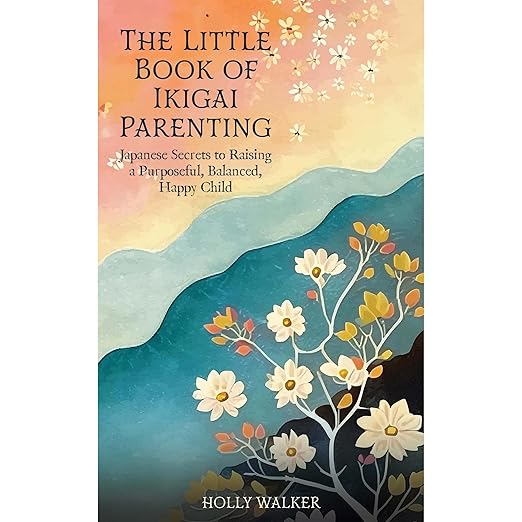
Quick Take
- Narration: Virtual Voice narrates, which creates a clinical distance that works against the book’s warmth-centered philosophy, the flat synthetic delivery is noticeable across the 3-hour runtime.
- Themes: Ikigai philosophy applied to family life, raising purposeful children, mindfulness and resilience in parenting
- Mood: Encouraging but impersonal in audio form
- Verdict: The ideas here are genuinely useful, but the Virtual Voice narration undercuts the very warmth and connection the book advocates for, consider the print version if the format matters to you.
I picked this one up on a Sunday evening after a particularly fractured weekend of parenting, the kind where screens had won too many battles and I’d snapped at my daughter over something trivial. The premise of applying ikigai, the Japanese concept of finding one’s reason for being, to child-rearing struck me as worth investigating. At just over three hours, it seemed manageable as a late-evening listen. What I got was a book with genuine ideas and a narration that made those ideas harder to inhabit than they should have been.
Holly Walker’s core argument is accessible and, in its essentials, sound: that Western parenting has become so oriented around achievement metrics and structured stimulation that it has lost sight of the deeper question of purpose. Ikigai, as Walker frames it, is not about grand life missions but about the quieter cultivation of passion, resilience, gratitude, and presence, virtues that children absorb more through environment and modeling than through explicit instruction. The book proceeds through practical applications: how to foster intrinsic motivation, how to build emotional regulation, how to create family rhythms that prioritize connection over productivity.
The Ikigai Framework in a Parenting Context
Where Walker is strongest is in the translation of a cultural concept that can feel abstract or exotic in its Japanese context into the texture of everyday family life in an English-speaking household. She doesn’t mythologize Japan or pretend that ikigai is a magic framework inaccessible to Western families. Her approach is pragmatic: take the useful ideas, the emphasis on small daily joys, on community and belonging, on perseverance not as a virtue to demand but as a capacity to cultivate through supported failure, and build them into your existing routines. The sections on fostering resilience and instilling a sense of community are the book’s most substantive, offering specific examples that avoid the vagueness that plagues much parenting advice.
One reviewer described the book as “the perfect example” of its genre, finding no shortcomings at all. Another praised the way it translates ikigai’s mental toughness applications into parenting contexts. These are genuine strengths. The book earns its enthusiasm from readers who engage with the ideas in print or e-book form.
Why the Virtual Voice Narration Is a Real Problem Here
The difficulty with this specific audiobook comes from the narration. Virtual Voice is Amazon’s AI text-to-speech technology, and while it has improved considerably, it remains ill-suited for content where warmth and personal connection are load-bearing. A book about raising children who feel a deep sense of belonging and emotional attunement, read in a measured synthetic voice that cannot modulate for the occasional humor or the gentle urgency of a parent’s concern, loses something essential in the transfer. The irony is not subtle: a book arguing for presence and human connection delivered through the most impersonal available medium.
At three hours and twenty-one minutes, the runtime is short enough that the narration doesn’t become actively exhausting, but it does create a persistent sense of distance that the material doesn’t deserve. This is a case where the print or Kindle version likely serves the reader better than the audio.
What You Carry Away Despite the Format
Listeners willing to push through the delivery will find substantive parenting guidance that takes the ikigai philosophy seriously without turning it into a rigidly Japanese framework. The five core focuses Walker identifies, inspiring passions, cultivating resilience, fostering mindfulness, embracing simplicity, instilling community, are not novel in isolation, but the ikigai lens gives them a coherence and cultural grounding that helps them stick. The book is densely practical within its short runtime, which several readers noted approvingly.
Whether this is the right audio purchase depends on how much the narration affects your ability to absorb material. Some listeners find Virtual Voice acceptable for instructional content; others find it a consistent barrier. For a book centered on warmth, connection, and the quiet cultivation of meaning in family life, I’d lean toward the version you can hold in your hands.
Frequently Asked Questions
Do I need to know anything about Japanese culture or the ikigai concept before listening to this book?
No prior knowledge is required. Walker explains the ikigai framework clearly in the early chapters and then applies it throughout without assuming cultural familiarity. The book is designed for a general English-speaking audience and doesn’t require any background in Japanese philosophy or practice.
Is the Virtual Voice narration on this audiobook tolerable for a 3-hour listen?
It’s manageable given the short runtime, but noticeably synthetic. Listeners who find AI text-to-speech disruptive should be aware that this is not a human narrator performance. For a book about warmth and connection in parenting, the format mismatch is more pronounced than it would be for, say, a technical manual.
Is this book suitable for parents of young children only, or does it apply to raising teenagers as well?
Walker’s framework applies across age ranges. While some examples skew toward younger children, the core ikigai principles, cultivating purpose, resilience, mindfulness, and belonging, are as relevant to parenting teenagers as to parenting toddlers. The section on instilling community and social responsibility is particularly applicable to older children.
How does this compare to other mindfulness-based parenting books like those by Daniel Siegel or Shefali Tsabary?
Walker’s book is shorter and more introductory than Siegel’s The Whole-Brain Child or Tsabary’s The Conscious Parent. Where those books draw on neuroscience and developmental psychology, Walker’s approach is more culturally philosophical. The ikigai frame offers a distinct organizing principle that complements the neuroscience-heavy approaches without replicating them.