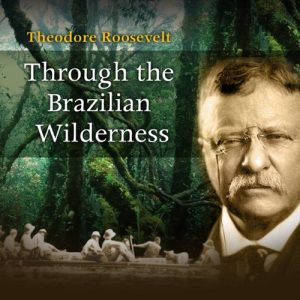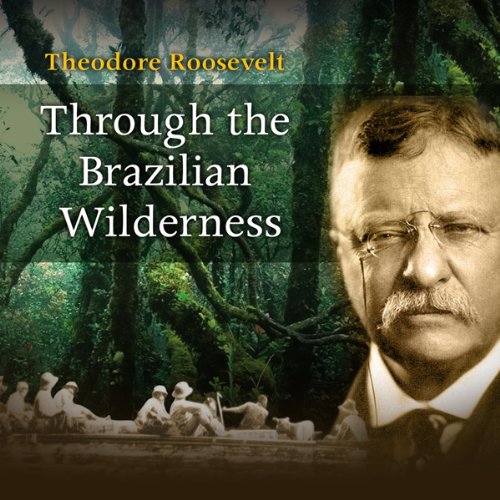
Theodore Roosevelt's Through the Brazilian Wilderness, narrated by Andre Stojka, stands as one of the more remarkable first-person accounts in American exploration literature, and this audiobook marks what the production notes describe as the first audio recording of the complete text. At eleven hours and twenty-seven minutes, it covers Roosevelt's 1913 expedition through Brazil with Brazilian explorer Candido Rondon: the animal specimen collection for the American Museum of Natural History, the descent of the River of Doubt, the piranha-filled rivers, the near-impenetrable forests, a murder among desperate men, and the illness that nearly killed a former president who refused to slow down. Roosevelt was fifty-five years old during this expedition and in rapidly declining health by its end.
Roosevelt the writer is a different creature from Roosevelt the politician or Roosevelt the hunter, and this account is worth hearing for the prose alone. He writes with a naturalist's precision about species he encounters, with a soldier's economy about the dangers they face, and with the particular understatement of a man who has decided that describing near-death experiences in elevated rhetoric would be undignified. When he writes about the River of Doubt, now officially renamed the Rio Roosevelt, the understated quality of his account is itself a historical artifact: this was a man who had been a governor, a war hero, and a president, who nearly died of a leg infection in a Brazilian jungle and wrote about it as though cataloging an interesting difficulty. Reviewers describe the writing as understated and lively, which is exactly right. The scientific observations are thorough rather than showy. The descriptions of indigenous tribes encountered along the way reflect both the genuine curiosity and the colonial assumptions of a 1913 American expedition, and listeners will need to hold both of those things simultaneously. One reviewer who came to the book after reading Candice Millard's River of Doubt, which covers the same expedition from a biographer's external perspective, found Roosevelt's first-person narration a valuable companion text that fills in the experiential register that a historian writing ninety years after the fact cannot fully replicate. That comparison, primary source against secondary biography, is the most illuminating framework for understanding what this audio edition uniquely offers.
Stojka's narration fits the material with notable precision. He does not inject drama that Roosevelt deliberately withheld from the prose, and he reads the extensive naturalist passages with the same care he brings to the survival sequences. The pace is steady rather than propulsive, which is consistent with Roosevelt's own voice as a writer and with the rhythm of an expedition narrative that covers months of difficult terrain rather than a single climactic event.
Why Through the Brazilian Wilderness Works as an Audiobook
This is primary source material, which gives it a different category status from most travel writing available in audio. Roosevelt did not write this as entertainment. He wrote it as a report, and the density of observation, detailed ornithological and botanical notes alongside the human drama of a murder on the river and increasingly desperate men, reflects that purpose. The naturalist sections are not padding. They are evidence of what the expedition was scientifically attempting, and they give the survival narrative a context that strips away any adventure-story romanticism. For listeners interested in early twentieth-century exploration, American political history, the natural history of the Amazon basin, or the specific question of what distinguishes a primary source document from its retrospective retellings, this audio is a document you cannot replace with something else. The synopsis notes this is the first audio recording of the text, which makes this edition genuinely significant for Roosevelt scholars and audio-format enthusiasts alike.
Before You Commit to Through the Brazilian Wilderness
The expedition's stakes become clearest in the River of Doubt segment, which occupies the latter portion of the narrative. Roosevelt contracted a leg infection during this phase that left him permanently weakened and that many historians believe shortened his life significantly. He does not dramatize this in his own account, which is precisely why reading it alongside the Millard biography gives a fuller picture: Roosevelt's understatement and Millard's reconstruction of what he actually went through are in productive tension with each other. Pay attention to Roosevelt's treatment of Candido Rondon, his Brazilian co-leader. Rondon comes through as a figure of considerable skill and restraint, and Roosevelt's observations about him are among the most respectful he offers to anyone in the book. The cultural and racial assumptions of the era surface regularly, and they are most legible in the passages about indigenous communities encountered along the route. A careful listener will notice exactly where the expedition's self-understanding diverges from contemporary ethical frameworks, which is itself historically instructive.
Should You Listen to Through the Brazilian Wilderness?
History readers with a specific interest in the Roosevelt era, Amazon exploration, or primary-source travel accounts will get the most from this audiobook. It is also a strong choice for listeners who have already read Millard's River of Doubt and want Roosevelt's own version of events as a counterpoint. Skip it if you want adventure narrative with the pacing and dramatic shaping of contemporary nonfiction: Roosevelt is meticulous rather than propulsive, and the scientific sections require patience. This is a historical document in audio form, not a thriller, and Stojka's measured delivery reinforces that distinction rather than trying to bridge it. The reward is in the texture of the voice behind the text.
Frequently Asked Questions
Should I read Candice Millard's River of Doubt before or after this audiobook?
Either order works, but multiple reviewers recommend pairing the two. Millard's external biography fills in the dramatic and medical details that Roosevelt deliberately understated, while Roosevelt's own account provides the experiential texture a historian writing ninety years later cannot replicate. Reading Millard first gives you context; reading her after gives you correction and expansion.
Is this audiobook accessible to listeners without background knowledge of early twentieth-century US history?
The expedition narrative is self-contained enough to work without political context. Knowledge of who Roosevelt was helps calibrate the significance of a former president nearly dying in a Brazilian river, but Stojka's narration does not assume prior familiarity with the historical period.
Does this audiobook address the colonial attitudes present in Roosevelt's original text?
Roosevelt's first-person account reflects the assumptions of a 1913 American expedition leader, including toward indigenous communities. The audio does not editorialize these passages; listeners bring their own critical lens. Pairing it with contemporary historical scholarship, including Millard's book, provides useful context for understanding how the expedition has been reappraised.