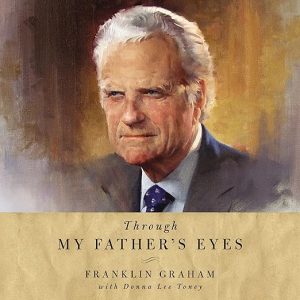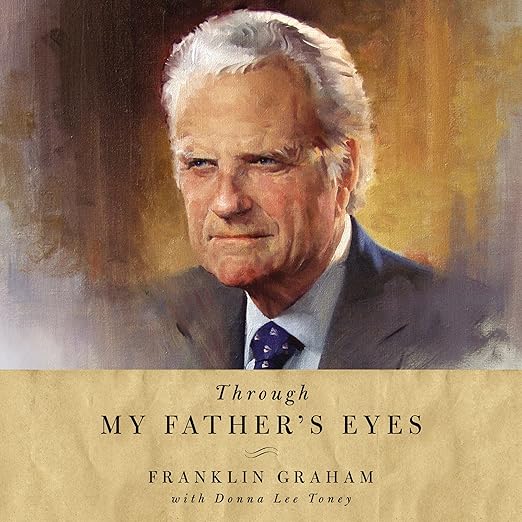
Billy Graham preached to stadiums and counseled presidents for most of Franklin Graham's childhood, so what was left over for the boy who just wanted a father? This audiobook, Through My Father's Eyes, spends ten hours and forty-one minutes answering that question, narrated by Matt Baugher, as Franklin Graham describes the man America called its pastor from the considerably smaller vantage point of a son. As the synopsis puts it, many people have written about Billy Graham the evangelist; this is billed as the first book about Billy Graham the father, told by the person best positioned to actually know that side of him.
A Son's Eyes Replace the Outside Biographer
The book's organizing idea is a genuinely useful one: Billy Graham pursued his ministry, in the synopsis's words, 'amid a similarly significant calling to be a loving husband and father,' and Franklin Graham's project here is to show both callings operating at once rather than treating fatherhood as a footnote to the public ministry. That framing lets the book cover familiar territory, Graham's global influence and his 'stated purpose... to help people find a personal relationship with God' through faith, while still finding fresh material in the domestic details only a son would actually have access to.
The book closes on a direct scriptural note, Franklin Graham quoting what he believes his father will hear from God, 'Well done, good and faithful servant,' drawn from Matthew 25:21. That closing image frames the entire memoir as much as a statement of faith as a biography, positioning Billy Graham's legacy as something ongoing and spiritual rather than simply a historical record to be assessed and filed away.
The synopsis notes this reached the USA Today Bestseller List, a commercial signal that the appetite for a personal account of Billy Graham extended well beyond his core devoted following. Franklin Graham's own framing adds another layer worth noting: the synopsis describes him as a son who 'walked in his father's steps while also becoming his own man, leading ministries around the world,' all of it built on the foundational lessons his father taught him, which positions the book as much a study in inherited calling as a straightforward tribute.
The title itself signals the book's angle precisely: this is not an outside biographer looking at Billy Graham, it is explicitly framed as seeing him through a specific, singular set of eyes, his son's. That reversal, from public record to private vantage point, is the entire premise of the book, and it explains why the synopsis spends as much time on Franklin's own development, becoming his own man while still walking in his father's footsteps, as it does on Billy Graham's public ministry.
Access Beats Comprehensiveness as This Book's Real Edge
The core value proposition here is genuinely unique access. Reviewers consistently point to the insider detail as the book's strength, with one writing about the 'insights into how his father taught, mentored, guided and loved him over the years,' and another describing decades of general awareness of Billy Graham finally deepened by a specific, personal account of 'how dedicated he was to our Heavenly Father.' That kind of intimate, son's-eye detail is not something a conventional biography, however well researched, can replicate.
The audience response also points to something worth naming directly: this book clearly resonates most with listeners who already have a long relationship with Billy Graham's public ministry. One reviewer bought it as a birthday gift for a 98-year-old uncle described as 'a huge fan of both Franklin and Billy Graham,' and another, a 65-year-old lifelong Christian, wrote about having 'known of Billy Graham my whole life' before this book deepened that awareness considerably.
Franklin Graham has spent decades running his own ministry organizations, and that lived experience of inheriting a version of his father's calling gives him a genuinely unusual vantage point most biographers lack: he is not just observing Billy Graham's balancing act between public ministry and private fatherhood, he has spent his own adult life attempting a version of the same balance himself. That doubled perspective, son and fellow minister at once, is part of what reviewers respond to when they describe the book's insights as more than sentimental reminiscence.
Because so much has already been written about Billy Graham's public ministry, this book's real advantage is specificity of access rather than comprehensiveness; it does not attempt to replace a full biography so much as add the one perspective no outside biographer could ever fully capture. Readers who have already worked through the standard Billy Graham biographies will find this a genuinely different kind of book rather than a redundant retelling of familiar ground.
Baugher's Narration Is Competent, Never Quite Intimate
Matt Baugher's narration is competent and clear, but it is also fairly unremarkable measured against material this personal. He handles the material capably without adding much interpretive depth or emotional shading beyond a steady, professional read, and given how intimate this account is, a son remembering his father, some listeners may well find themselves wishing Franklin Graham had narrated his own book rather than handing it to a reader with no personal stake in the material.
This is, by design, an admiring account written by a devoted son rather than a journalistically distant biography. Listeners should go in expecting a loving tribute that frames Billy Graham's life and legacy sympathetically throughout, not a critical assessment that weighs controversies or complications with any real skepticism. That is not a flaw so much as the book's stated premise, but it is worth knowing before you start.
At ten hours and forty-one minutes, this runs longer than a typical single-subject memoir, giving Franklin Graham room to move chronologically through his father's decades of ministry rather than compressing the account into a handful of highlight anecdotes. That extended runtime lets specific formative family moments breathe rather than being rushed past in service of a tighter, more commercial running time, which fits a book more interested in accumulated texture than a quick highlight reel.
A Serviceable Reading That Adds Only Clarity
Longtime Billy Graham followers, evangelical Christian listeners, and readers who gravitate toward faith-based family memoirs will find exactly what they are looking for here, as will anyone simply curious what a famous public minister's private home life actually looked like from the inside.
Skip this one if you want a critical or journalistically neutral biography weighing Billy Graham's full public legacy and any controversies alongside his ministry; this is a son's tribute by design, not that kind of assessment. Listeners for whom narration quality is a dealbreaker should also know Baugher's reading, while perfectly serviceable, does not add much beyond competent clarity.
Quick Take
- Performance: Matt Baugher reads competently and clearly but without much distinctive interpretive shading, a solid if unremarkable match for material this personal.
- What it covers: faith and fatherhood, ministry legacy, a son's tribute to a public figure
- Feel: Tender, reverent, and reflective
- Our call: A genuinely intimate portrait for longtime Billy Graham followers, though the narration itself stays safely in the background rather than elevating the material.