Quick Take
- Narration: Count Arthur Strong reading his own memoir is the entire comedic project, the malapropisms, digressions, and unreliable self-portrait are performed from the inside by a character comedian in complete command of his register.
- Themes: Self-delusion as art form, showbiz mythology as survival strategy, the unreliable narrator as memoir format
- Mood: Gloriously, consistently mad in exactly the right proportion
- Verdict: For fans of Count Arthur Strong’s radio and stage work this is essential and deeply funny; newcomers should understand they are entering a fully constructed character’s world where the comedy lives inside the gap between conviction and reality.
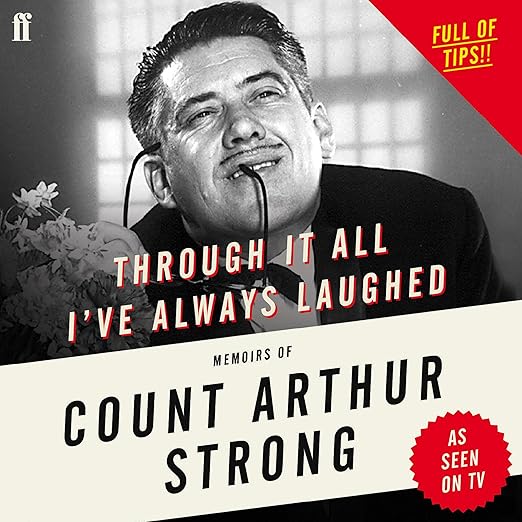
I put this on during a rainy Saturday afternoon without any particular expectations, and within twenty minutes I was laughing in the specific way that only really committed character comedy produces: the kind where you are laughing at the gap between what the character thinks is happening and what you can see is actually happening. Count Arthur Strong’s memoir is narrated by Count Arthur Strong, which tells you everything you need to know about its reliability as autobiography and everything you need to know about why it works as comedy.
The conceit is established immediately. Arthur Strong is a show business legend, former entertainer, authority on Ancient Egypt having been stationed there during his national service, and the author of what he believes may become a six-volume collection of memoirs. He has friends in the showbiz world: people like Barry Cryer, the white haired one with glasses off I’m Sorry I Haven’t Got A Clue and Jokers Wild. These descriptions are characteristic of the Arthur Strong method: always slightly off, always confident, always producing a version of the world that is internally consistent and entirely at odds with conventional reality. The book even ends its synopsis with an offer to book him directly for events, bypassing his representation, for cash. Of course it does.
The Memoir That Operates Outside Memoir Conventions
What Through It All I’ve Always Laughed performs is the genre of memoir from the inside of a character who has no critical distance on himself whatsoever. Arthur’s journey from the only son of a contortionist in wartime Doncaster to the dizzy heights of fame is narrated with complete conviction, and the comedy lives in the gap between that conviction and evidence. The specific details, the contortionist father, the national service in Egypt, the showbiz connections, are never quite verifiable and never quite obviously fabricated. They exist in the mode of Arthur’s version of events, which is to say they are precisely as reliable as Arthur is, which is not at all.
Reviewer Ken’s description captures it well: so consistently mad, just the right amount of mad though, and funny that you will quickly be hooked. The qualification matters. There is a precision to the madness that distinguishes Arthur Strong from broad comedy. The malapropisms and non-sequiturs are not random; they follow an internal logic that rewards close attention. You start to hear the patterns, the specific ways Arthur’s version of events diverges from plausibility, and the comedy deepens rather than diminishing on extended exposure.
Why Self-Narration Is the Only Option Here
Steve Delaney’s performance as Count Arthur Strong is the entire foundation of the character’s existence across stage, radio, and television, and this audiobook is no different. The voice work here, the specific music of Arthur’s speech, the timing of the digressions, the moments of unexpected lucidity that make the general confusion funnier, is not something that could be transferred to another performer without losing the architecture entirely. Reviewer Barry Randolph put it simply: I laughed out loud at several parts and did not cry at any of it. The not-crying-at-any-of-it is itself a kind of joke, one that makes more sense after you have spent some time with the character.
At 4 hours and 52 minutes, the book is appropriately sized for a comedy character memoir rather than a grand literary project. It does not attempt to sustain a conventional narrative arc or deliver emotional revelation in the standard memoir mode. It is precisely what it is: the world according to Arthur, delivered by Arthur, for listeners willing to spend an afternoon in his company.
The Question of Prior Familiarity
Reviewer Ken specifically notes this works even if you have never heard of the character, suggesting the internal logic of the comedy is accessible without prior knowledge. I would offer a slight modification: it works, but it works better with prior exposure to the BBC Radio 4 show or live performances that established who Arthur Strong is. The memoir is denser with its own in-jokes and callbacks for longtime fans, and the specific relationship between Arthur’s self-perception and the audience’s knowledge of his actual cultural standing is funnier when you know the full picture. For new listeners, the comedy still lands; for established fans, it is additionally and substantially rewarding.
Frequently Asked Questions
Is this a memoir in the traditional sense, or is it fully in character as Count Arthur Strong?
It is entirely in character. Count Arthur Strong is a persona created by comedian Steve Delaney, and the memoir is narrated by the character rather than by Delaney writing about himself. The comedy depends on treating the character’s self-description as sincere autobiography, which means it functions as extended character comedy rather than personal memoir.
Should I listen to the Count Arthur Strong radio show before starting this book?
It helps. Reviewer Ken says it works without prior knowledge, and that is true for the basic comedy, but the specific texture of Arthur’s world and the pleasure of recognizing his particular patterns of thought are richer with some familiarity. The BBC Radio 4 show is an accessible starting point.
Does the book have a plot, or is it more of a series of episodes and digressions?
More the latter. The memoir follows a loose chronological framework from Arthur’s childhood in wartime Doncaster through his claimed career in show business, but the structural energy comes from the digressions and the character’s relationship to his own account rather than from a narrative arc with conventional momentum.
Why does a comedy character memoir appear under performing arts rather than straight humor?
Count Arthur Strong’s work spans radio, stage, and television, and Steve Delaney’s performance career is the genuine subject even when the comedy operates through the fictional character’s perspective. The performing arts tag reflects both the character’s claimed identity as an entertainer and Delaney’s actual background as a live and radio comedian.