Quick Take
- Narration: Jeremy Kroeker narrates his own memoir with the disarming self-deprecation and honesty that makes the book work; his voice is warm without being performative.
- Themes: faith under examination, motorcycle travel as spiritual quest, uncertainty as a valid place to rest
- Mood: Wry, searching, and surprisingly tender
- Verdict: A travel memoir that earns its philosophical detours because the author is genuinely funny and genuinely lost at the same time.
I came to this one with moderate expectations. Motorcycle memoirs occupy a well-worn shelf. The man-on-a-bike-finds-himself narrative has produced some extraordinary books and a great deal of repetitive ones. What I did not anticipate was how thoroughly Jeremy Kroeker’s combination of Mennonite background, theological doubt, and self-aware humor would make Through Dust and Darkness feel like its own thing.
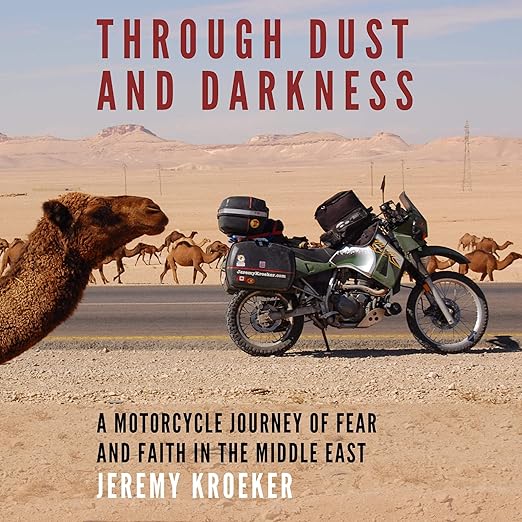
Kroeker rides from Europe into Iran in the fall of 2007, an act born out of a drunken resolution he made while trying to keep his unraveling faith at arm’s length. The book covers that physical journey and the internal one that runs alongside it, and it is candid enough about both that you believe he is telling you what actually happened rather than a cleaned-up version of it.
Our Take on Through Dust and Darkness
The memoir’s strongest quality is Kroeker’s refusal to arrive at a tidy conclusion. His faith does not return fully restored, and it does not shatter completely either. He ends up somewhere more honest than either: in a state of deliberate uncertainty that he has chosen to accept rather than resolve. Reviewer Liz Jansen, who identified herself as someone who came to motorcycling at the same time she was leaving a religious tradition, noted the resonance of that trajectory. The book will speak clearly to anyone who has tried to hold onto something they are no longer sure they believe, which is most people at some point.
The Iran section is where the travel writing becomes genuinely compelling. Kroeker is not writing a political travelogue, and he is not particularly interested in grand statements about the theocratic state he is visiting. He is interested in the people he meets, the small moments of connection across what should be impossible cultural distance, and what it feels like to find yourself inside the holiest Muslim shrine in the country on a forbidden visit. The moment he describes there, invisible hands reaching into his chest and ripping out a sincere prayer, reads as genuinely strange and genuinely felt, neither manufactured sentiment nor religious conversion narrative.
Why Listen to Through Dust and Darkness
Author-narrated memoirs live or die by whether the author’s voice on the page translates to the spoken format, and Kroeker’s does. He narrates with the rhythm of someone telling a story at a dinner table, confident enough to let the humor land without signaling it in advance. Reviewer Rus K. highlighted the gift for humor and humility present throughout, and that pairing is real. The book is funny in ways that feel natural rather than inserted, and the humility keeps it from sliding into the self-congratulatory register that travel writing about spiritual awakening can easily reach.
At just over seven hours, the pacing is comfortable. The early chapters establish the Mennonite background efficiently, and by the time the motorcycle is crossing into Iran the foundation is solid enough that the stranger moments of the journey carry weight. Reviewer Friðrik suggested Kroeker should explore Buddhism next, which captures something true about the book’s energy: it reads as the beginning of a longer inquiry rather than a finished one.
What to Watch For in Through Dust and Darkness
Listeners who are not especially interested in questions of religious faith should know that those questions are central rather than incidental. This is not a book where the motorcycle journey is the main event and the theology is ornamental. The two are genuinely intertwined, and the book will be less satisfying if you want to skip the internal journey and stay on the road.
Also worth noting: the book is a decade and a half old now, published originally in 2013 though re-released in audio form in 2021. The Iran of 2007 that Kroeker describes is a specific historical moment. Readers looking for current political analysis will not find it here, and that is probably fine. The book is not trying to explain Iran. It is trying to explain a person, which ages better.
Who Should Listen to Through Dust and Darkness
This memoir is well-suited for listeners who love travel writing that takes the interior journey as seriously as the exterior one, and who have some tolerance for theological questions even if they do not share Kroeker’s particular background. It also works beautifully for motorcycle enthusiasts who are tired of books that treat bikes as pure adventure props. Anyone drawn to writers like Pico Iyer or the more reflective end of Robert Pirsig will find something here. Listeners who want clear destinations, literal or spiritual, may find the open-ended conclusion unsatisfying.
Frequently Asked Questions
Do I need to be religious or interested in faith to enjoy this book?
Not strictly, though faith and doubt are central themes rather than background color. Kroeker’s inquiry is honest enough that readers without religious backgrounds often report connecting with the universal experience of questioning something you were raised to believe. The travel writing and humor carry considerable weight on their own.
How significant is the Mennonite background to the narrative?
It is important context rather than the main subject. Kroeker uses his upbringing, which shares roots with the community Miriam Toews fictionalized in A Complicated Kindness, to establish what kind of faith he is questioning and why the Iran trip feels both logical and absurd as a response to that crisis. You do not need prior knowledge of Mennonite culture to follow the book.
Is this primarily a travel book or a memoir about faith?
Both simultaneously, and the two threads are genuinely inseparable. The physical journey through Europe and into Iran provides the structure, but the internal journey, Kroeker’s oscillation between belief and doubt, gives the book its stakes. Readers who expect one without the other may feel the balance is off.
Does Jeremy Kroeker narrate his own audiobook and does it work?
Yes, he narrates it himself. Multiple reviewers and the general tone of the reception suggest his narration is one of the audiobook’s genuine assets. He reads with the cadence of natural storytelling rather than performed dramatic reading, which suits the intimate, confessional nature of the material.