Quick Take
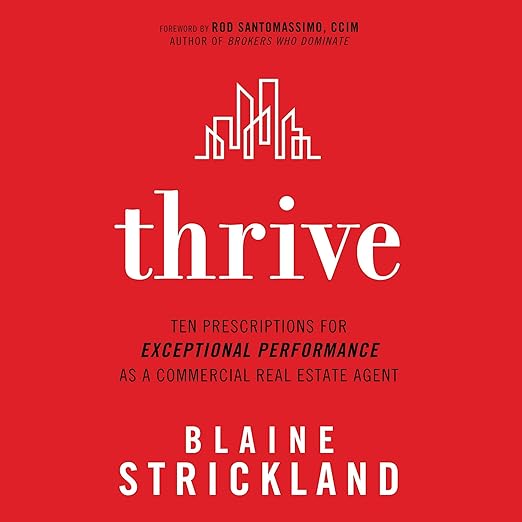
- Narration: H. Blaine Strickland narrates his own book, which gives the content an instructional authenticity, this is a practitioner speaking directly, not an actor performing expertise.
- Themes: Building a dominant market presence in commercial real estate, transitioning from solo agent to business operator, client relationship depth over transaction volume
- Mood: Direct and motivational, structured like a coaching session rather than a lecture
- Verdict: A concise, field-specific playbook for commercial real estate brokers that rewards both newcomers and experienced agents, narrow in focus but rich in applicable detail for its target audience.
I listened to Thrive during a run, which is probably not the intended listening context, Blaine Strickland’s book is dense with specific, actionable advice that works better when you can take notes. But even without a notebook, the structure was clear enough to track: this is a practitioner who knows exactly what problems commercial real estate agents face at specific career stages, and he addresses each one directly. The book is two hours and forty minutes of that clarity, which is shorter than most business audiobooks and more useful than most of them as a result.
Strickland comes to this as an expert dealmaker, coach, and CCIM instructor, a credential that carries specific weight in the commercial real estate world, and several of the reviewers identify themselves as having encountered him through CCIM coursework. That context matters: this is not a general business book that gestures toward real estate application. It is specifically calibrated for commercial real estate brokerage, and its prescriptions, becoming a dominant market force, building a team, running your operation as a business rather than a series of transactions, are directed at that specific professional context.
Our Take on Thrive
The book’s best quality is that it does not pretend to reinvent anything. Strickland presents proven strategies rather than novel theories, and his tone is that of a senior colleague sharing what actually works rather than a consultant selling a methodology. One reviewer who described themselves as having been in the business for many years, usually in small shops, noted that the book spelled out many things they had not done well as an agent, without making that recognition feel like an indictment. That is a difficult authorial tone to achieve, and Strickland manages it through the genuine humility of someone who has made mistakes and learned from them.
The prescriptions are specific enough to be immediately applicable. The VIP list of 125 contacts and calling schedule that one reviewer mentioned starting immediately after finishing the book is the kind of concrete output that distinguishes a genuinely useful business book from one that provides inspiration without traction. Multiple reviewers describe returning to specific chapters at different career stages, which suggests the book functions as a reference tool as much as a linear read.
Why Listen to Thrive
Strickland narrating his own work is the right choice here. The intimacy of a practitioner speaking in their own voice about their own experience carries authority that an actor’s rendition would lack. He is not a professional narrator and does not have the polish of one, but in a book structured around the idea of authentic, relationship-based business practice, the slight informality of self-narration is a feature rather than a flaw.
The runtime is a genuine asset. At two hours and forty minutes, Thrive can be completed in a single workout session or a long commute, and its density means the time is not wasted on filler. Business audiobooks frequently run six to ten hours because authors feel they need to earn the price point with volume. Strickland has the confidence to say what needs to be said and stop.
What to Watch For in Thrive
The book is extremely specifically targeted, if you are not in commercial real estate brokerage, or not considering entering it, most of the prescriptions will not translate. Unlike broader business books that extract from their primary domain to broader application, Thrive stays entirely within its lane. This is the right choice for its intended audience and a significant limitation for anyone outside it.
Some readers may find the motivational framing somewhat familiar, the emphasis on mindset, on outperforming peers, on building durable income, echoes the general business coaching literature in ways that are less distinctive than the CRE-specific content. The value proposition is strongest in the operational specifics rather than the inspirational passages.
Who Should Listen to Thrive
This is unambiguously for commercial real estate agents and brokers at any career stage, the book explicitly addresses both those who are new to the field and those who have been practicing for years and want to grow beyond the solo agent model. Adjacent audiences in residential real estate may find some of the principles applicable but will need to translate the CRE-specific context themselves. General business readers looking for broadly applicable frameworks should look elsewhere. And if you are a CCIM student or recent designee, this is the natural companion text to your coursework.
Frequently Asked Questions
Is Thrive useful for residential real estate agents as well as commercial real estate brokers?
Strickland is specific about commercial real estate brokerage throughout, and the examples and prescriptions are calibrated to that context. Residential agents will find some transferable principles, the VIP contact system, the team-building framework, but will need to do their own translation work. The book is most valuable to its intended CRE audience.
At 2 hours and 40 minutes, is Thrive long enough to cover its subject in depth?
For its scope, yes. Strickland is covering specific operational prescriptions for CRE agents rather than building a comprehensive theory of business. The brevity reflects a deliberate choice to say what needs to be said without filler, which reviewers consistently identify as a strength rather than a limitation.
Does Strickland’s self-narration affect the audiobook quality?
He is not a professional narrator but he is not a liability either. The informality of self-narration suits a book built around the idea of direct practitioner-to-practitioner guidance. Listeners expecting polished audiobook production should know what to expect; listeners who respond well to authentic voice will find it appropriate.
Is Thrive worth returning to at different career stages, or is it a one-time read?
Multiple reviewers describe returning to specific chapters as their careers have developed. The book is structured around career-stage challenges, dominance, team-building, business operation, which means different sections become most relevant at different points. One reviewer described it as a reference guide they have returned to multiple times over several years.