Quick Take
- Narration: Julian Elfer brings a dry, observational quality to Michael Booth’s travelogue voice, well matched to prose that balances historical gravity with self-deprecating humor.
- Themes: Historical grievance in East Asia, geopolitical tension between Japan, China, and Korea, travel as a tool for understanding enmity
- Mood: Curious and occasionally sobering, always readable
- Verdict: An unusually honest and entertaining guide to why Northeast Asia remains one of the world’s most politically complicated regions, written for people who want understanding rather than just information.
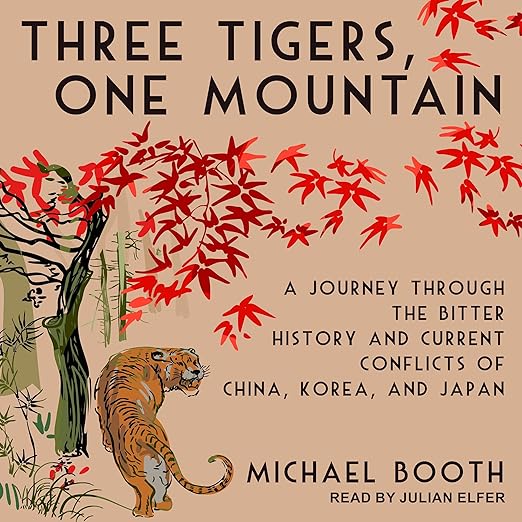
I picked up Three Tigers, One Mountain during a period when I was trying to understand the background to several concurrent news stories about relations between Japan, South Korea, and China, stories I kept encountering without the historical context to evaluate them properly. Michael Booth’s travelogue arrived at the right moment. He is not a specialist in East Asian politics or history in the academic sense, which turns out to be one of the book’s assets: he is a curious, well-read traveler who has spent significant time in all three countries and is willing to ask the questions that specialists sometimes assume are already settled.
The book’s organizing conceit comes from an ancient Chinese proverb: two tigers cannot share the same mountain. Booth extends the image to three tigers, China, Japan, and Korea, and uses it to frame his central question: how deep, really, is the enmity between these nations, and what stands in the way of genuine reconciliation? The answer he discovers is complicated, and he doesn’t pretend otherwise. The burden of history and the memory of past atrocities, as the synopsis puts it, continues to overshadow present relationships no matter where he travels, and Booth is honest about the ways that burden is unevenly acknowledged and unevenly carried.
Our Take on Three Tigers, One Mountain
One reviewer noted, fairly, that the book is somewhat Japan-centric, that Booth had greater access to and spent more time in Japan than in either China or Korea, and that the historical analysis reflects that imbalance. The bitter history the subtitle promises is indeed largely a history of Japan’s imperialist era and its contested legacy, which means China and Korea appear primarily as aggrieved parties responding to Japanese conduct rather than as fully realized societies with their own internal contradictions. That is a genuine limitation, and listeners expecting equal treatment of all three nations should know it upfront.
Within those limits, the book is exceptionally good. Booth writes for what one reviewer called normal human beings who want to understand why Northeast Asian politics are so complicated, and he has calibrated his prose accordingly. The historical material is accurate and fairly presented without being weighted down by the kind of academic hedging that makes comparable books unreadable for non-specialists. And the humor, which appears regularly in his observations about his own confusion, his encounters with Japanese bureaucracy, the peculiarities of geopolitical kitsch in Seoul, keeps what could be an oppressively heavy subject from becoming so.
Why Listen to Three Tigers, One Mountain
Julian Elfer’s narration suits Booth’s prose style well. Booth writes in first person with a dry, self-aware voice that depends on good timing, and Elfer delivers the comedic asides without making them feel inserted. The travelogue format means the pacing shifts between long historical passages and present-tense observations from the road, and Elfer handles those transitions smoothly.
At just under eleven hours, the book is long enough to develop its arguments about each country with real depth, but it never feels like it is punishing the listener for wanting to understand. The structure follows Booth’s physical journey, which gives the book a narrative momentum that straight history or political analysis would lack. By the time you reach his attempts at reconciliation in the final chapters, or at least his attempts to imagine what reconciliation might require, you’ve traveled alongside him through enough of the underlying history to feel the weight of what he’s asking.
What to Watch For in Three Tigers, One Mountain
The book was published in 2020, which means some of the geopolitical dynamics it describes have evolved since. China’s economic and military posture has shifted considerably, and the political situations in both South Korea and Japan have moved through several administrations with different orientations toward historical accountability. Booth’s analysis of the structural conditions creating tension is largely durable, but his specific political assessments of individual leaders and moments should be read as historical rather than current.
The North Korea material is relatively thin, which Booth acknowledges is a function of access. He addresses the North-South division primarily as a factor complicating South Korean identity and international relations rather than as a subject in its own right.
Who Should Listen to Three Tigers, One Mountain
Readers with existing interest in Japan, China, or Korea who want a readable account of the historical grievances that complicate regional relations will find this invaluable. Travelers planning time in any of these countries will gain context that no guidebook provides. Skip it if you are looking for a balanced treatment of all three nations, Japan gets the most sustained attention, or if you need analysis more current than 2020.
Frequently Asked Questions
Do you need prior knowledge of East Asian history to follow Three Tigers, One Mountain?
No. Booth provides the historical context as he goes and writes explicitly for readers who don’t already know the background. The book is designed as a discovery of this history rather than an extension of existing knowledge.
Is the book more focused on Japan than on China and Korea?
Yes, and one reviewer raised this directly. Booth had greater access to Japan and spends more time there. The historical analysis centers heavily on Japan’s imperialist era and its contested legacy, with China and Korea appearing primarily in relation to that history.
How does Julian Elfer’s narration handle the balance between historical seriousness and Booth’s dry humor?
Elfer manages the tonal shifts well. Booth’s self-deprecating observations are delivered without over-playing them, and the historical passages are read with the appropriate weight. The narration feels like a single voice that understands both registers.
Is the 2020 publication date a problem given how much has changed in the region since then?
Somewhat. The structural analysis of historical grievance remains valid, but specific political dynamics and individual leader assessments have dated. Think of the political content as historical record rather than current affairs.