Quick Take
- Narration: LJ Ganser reads with consistent energy and clarity, keeping twelve-plus hours from feeling encyclopedic even when the content is genuinely comprehensive.
- Themes: the history of archaeological practice, discovery and its ethics, the transformation of science over centuries
- Mood: Curious and enthusiastic, with the feel of an extremely good introductory course
- Verdict: The best single-volume introduction to the history and practice of archaeology currently available in audio format, warm and knowledgeable from an author who has dug the sites he describes.
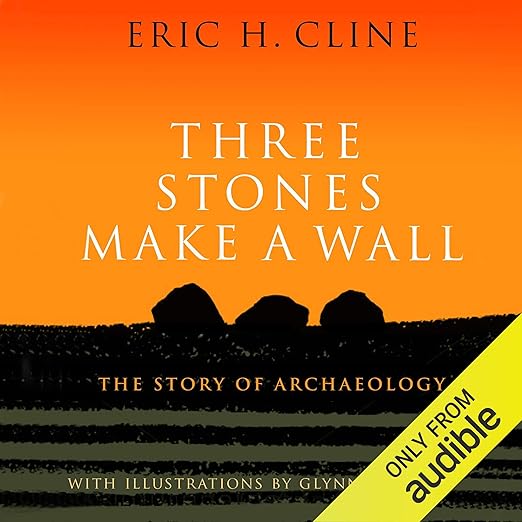
I was not expecting to spend most of a long train journey entirely absorbed in an archaeology audiobook. I had picked up Three Stones Make a Wall partly because I had read Eric Cline’s 1177 B.C. and found his ability to make ancient catastrophe feel immediate, and partly because twelve hours felt like a reasonable match for a long journey with some walking around time at the other end. I finished it two days later, having deliberately rationed the final sections to make them last.
Cline is a working archaeologist with more than thirty seasons of excavation experience, and that credibility saturates this book without ever tipping into the kind of insider jargon that keeps casual readers at arm’s length. This is a book written by someone who has stood on sites at Megiddo and Masada and tried to explain to an interested general public not just what was found there but how you go about finding anything at all. The pedagogy is generous without being condescending, a quality that distinguishes the best popular science writing from the merely competent.
From Amateur Treasure Hunters to Forensic Science
The organizing arc of the book is the transformation of archaeology from a gentleman’s pursuit, often little more than licensed looting in the nineteenth century, into the multidisciplinary science it is today. Cline handles this with both honesty and affection. He does not romanticize the Victorian-era excavators who tore through sites without adequate documentation, but he also gives them their due as people working within the assumptions of their time. Heinrich Schliemann’s excavations at Troy are treated with appropriate ambivalence: the discoveries were real but the methodology destroyed layers of context that can never be recovered. Mary Leakey’s work in East Africa, by contrast, represents the careful, patient science that transformed our understanding of human origins, and Cline uses her as one of several figures through whom the profession’s better instincts are illustrated.
What holds all of this together is Cline’s willingness to answer the questions actual curious people ask. How do you know where to dig? How is an excavation actually run? How do you date what you find? Who has legal and moral claim over objects removed from their countries of origin? These are not abstract questions in the book but organizing principles for whole sections, which gives the survey structure and momentum rather than letting it sprawl.
Sites That Become Characters
Pompeii, Petra, Troy, the Terracotta Warriors, Mycenae, Masada: Cline takes the listener to each of these through a combination of discovery narrative and present-day scientific understanding. The Tutankhamun opening, with Howard Carter peering through the small opening he had cut in the tomb door and saying he saw wonderful things, is one of those historical moments that carries its full weight no matter how many times you encounter it. Cline uses it to open the book and then circles back to it to illustrate larger points about documentation, publication, and the politics of repatriation. The reviewer who described reading this as wanting to love archaeology and being given the tools to do so was not overstating the case.
There is something infectious about Cline’s genuine enthusiasm for the moment when the environment in which an artifact is found turns out to be just as significant as the artifact itself. That is the kind of insight that changes how you think about these discoveries and why it matters that they are excavated carefully rather than quickly.
Cline also takes seriously the contemporary ethical debates that shape how archaeological work is conducted and reported. Questions about the treatment of human remains, particularly in indigenous contexts, have shifted significantly over the decades that the book spans, and Cline tracks those shifts without reducing them to simple before-and-after progress narratives. The chapter on who gets to keep what is found is one of the more intellectually honest sections in a book that is consistently more willing to acknowledge complexity than the genre typically demands.
The Audiobook’s One Real Limitation
Several reviewers of the print edition noted the absence of photographs as a genuine complaint, particularly given that Cline describes specific images, paintings, and artifacts in the text. The audiobook has the same limitation in heightened form: references to visual material in the accompanying line drawings have nothing to anchor to in the audio experience. This is not a fatal problem, and the descriptive prose is usually strong enough to build a mental image, but listeners curious about specific sites will want to keep a browser tab open for images while listening. The writing compensates as much as writing can compensate for the absence of visual archaeology, and Cline’s descriptions are sufficiently precise to be useful.
LJ Ganser navigates the full twelve hours and forty-four minutes without flagging, keeping a tone that feels engaged throughout. He has a quality of sounding interested in the material rather than simply reading it, which matters considerably over a long listen in a genre where deadpan recitation is a real risk.
Ideal Listeners and Those Who Should Look Elsewhere
Anyone with curiosity about ancient civilizations who wants a structured, intelligent entry point into how we actually know what we know about them should listen to this. It works for complete newcomers to the field and for people with some existing interest who want their knowledge systematized into a coherent picture. Specialists will find the level of detail lighter than they need, but this was written for a general educated audience and succeeds brilliantly at that goal. As a foundation, it is exceptionally well constructed, and Cline’s own bibliography and the suggestions embedded in the text point clearly toward more specialized reading when you are ready for it.
Frequently Asked Questions
Do I need any prior knowledge of archaeology or ancient history to enjoy this audiobook?
None at all. Cline wrote this explicitly for interested general readers, and the book builds its own context as it goes. Listeners who already have some familiarity with ancient sites or civilizations will find the material easy to follow and will appreciate the depth; those coming in cold will find it equally accessible.
Does the audiobook suffer from the lack of photographs that reviewers complained about in the print edition?
Yes, somewhat. Cline frequently references specific images, paintings, and artifacts, and the audiobook cannot show them. The descriptive prose is strong enough to compensate in most cases, but listeners with a particular interest in the visual dimension of specific sites will benefit from keeping an image search open while listening.
How does Three Stones Make a Wall compare to Cline’s 1177 B.C. for someone who has already read that book?
The two books complement each other well but cover different ground. 1177 B.C. is a focused narrative about a specific historical collapse event, while Three Stones Make a Wall is a survey of archaeological history and method across many civilizations and time periods. Readers who enjoyed Cline’s writing in the earlier book will find the same accessible, enthusiastic style here applied to a much broader canvas.
Does the book address the ethics of artifact ownership and repatriation?
Yes, and with more nuance than you might expect from a popular introduction. Cline dedicates serious attention to the question of who has rightful claim over objects excavated from their countries of origin, covering everything from the Elgin Marbles to contemporary repatriation cases. He does not offer simple answers but frames the debates clearly and fairly.