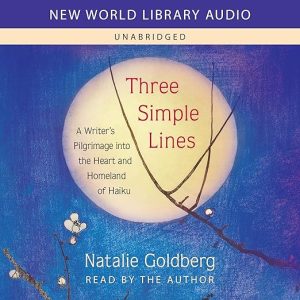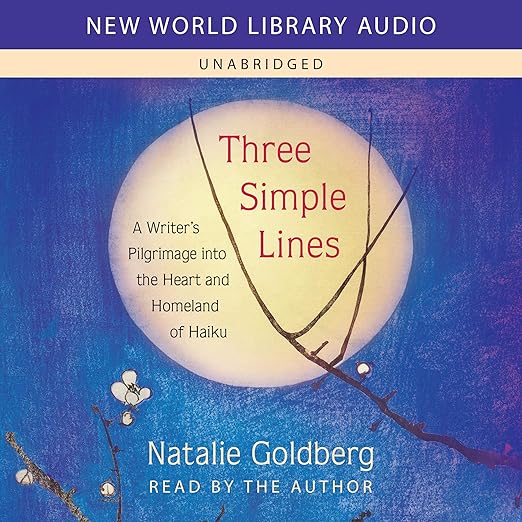
Natalie Goldberg's Three Simple Lines begins with the form's fundamental paradox: three lines that seem like the simplest possible literary container are, as Allen Ginsberg described them, capable of making the mind leap into a small sensation of space which is nothing less than God. The audiobook, narrated by Goldberg herself, is the right version of this material. She has been one of the most influential writing teachers in America since Writing Down the Bones appeared in 1986, and the decades of teaching practice she brings to haiku's compressed architecture produce a guide that treats the form with both scholarly seriousness and personal devotion. Four hours and twenty-three minutes is exactly the right runtime for a book about attending closely to small things.
The haiku tradition Goldberg explores reaches back to the 17th century and the masters she focuses on most intently: Basho, Issa, and the too-often-overlooked woman master Chiyo-ni. Her treatment of Chiyo-ni in particular carries an advocacy dimension, arguing that this important figure has been underrepresented in Western discussions of the tradition's canonical voices. Goldberg is not writing a survey of Japanese literature for academic purposes; she is writing about what haiku has done to her attention over decades of practice and what it might do to yours if you let it.
Goldberg's Pauses Are Themselves the Lesson
The book's structure interweaves literary history and criticism with travel memoir, Goldberg's own trips to Japan providing the grounding scenes that alternate with analysis of the masters' formal innovations. Her encounters with food, family, frogs, and ponds appear alongside discussion of Basho and Issa in a structure that is itself haiku in spirit: specific, concrete details doing the work that abstract statement cannot. One longtime Goldberg reader describes this as their favorite of all her books, which is a significant claim given a catalog that includes Writing Down the Bones, Wild Mind, and Thunder and Lightning. The structural reason for that response is audible in the audio format in a way that reading the same sentences might not make as clear.
The self-narration produces a quality specific to writers who read their own work well, and Goldberg is one of them. When she reads a Basho haiku and then pauses before moving to what it means, the pause itself is instruction. She is not explaining that you should sit with the image; she is demonstrating sitting with it. This is teaching through form rather than through assertion, and it is the reason the audiobook is the best version of this particular book. A third-party narrator, however skilled, would have to decide how long to pause. Goldberg knows.
How Haiku's Noticing Reshaped Her Prose
Listeners who have worked through Writing Down the Bones or Wild Mind will recognize the quality of attention Goldberg brings to any subject she writes about, but Three Simple Lines is distinct within her catalog. The subject matter has reshaped the writing. Haiku teaches a particular noticing, an acute awareness of the immediate and often ordinary, that Goldberg has absorbed and brought back to her prose, and the audiobook captures that influence in the timing and specificity of how she reads herself.
For listeners interested in haiku as a writing practice rather than just a literary form, the audiobook is more useful than the text version because Goldberg's reading models the attention the form requires rather than simply describing it. When she discusses Basho's frog poem, the quality of attention she brings to the analysis is itself a demonstration of how to receive the poem. That modeling is present in audio and largely lost in silent reading. The four-hour runtime means the audiobook can be listened to in a single extended session, and there is a case for doing it that way: the accumulating quality of attention the book cultivates builds toward something different from what chapter-by-chapter reading produces.
Appreciation Over Syllable-Count Technical Instruction
The book is not a how-to guide for writing haiku in the technical sense. Goldberg provides insight into reading and appreciating the form, and the Japan travel sections give the historical analysis a present-tense vitality it would not have in a purely academic treatment. But listeners who want a technical manual for producing haiku that follow the formal conventions of syllable count, seasonal reference (the kigo tradition), and the kireji cutting word will need to supplement with a more prescriptive text. Goldberg's teaching method has always been through invitation and example rather than through rule-setting, and that approach is consistent throughout Three Simple Lines.
The short runtime is both an asset and a limitation. Goldberg covers a substantial amount of historical and biographical ground across Basho, Issa, and Chiyo-ni within the four hours, but she moves through some of the historical material quickly in order to preserve space for the personal and experiential sections that are the book's real heart. Listeners who want deeper scholarly coverage of any individual master may need to supplement the audiobook with more specialist texts.
Close Readers Will Get the Most From This
This audiobook rewards listeners who already have a practice of close reading or close listening, or who want to develop one. Goldberg's existing audience from Writing Down the Bones is the obvious first readership, but the book is accessible to anyone interested in Japanese literary history, contemplative writing practices, or what happens when a Western writer goes to Japan to understand a form she has loved for years.
Listeners who want a comprehensive academic survey of haiku history or a technical guide to writing the form will find the audiobook more personal and impressionistic than they were expecting. But for the experience of being guided through an attention practice by one of the better guides currently working in that tradition, Three Simple Lines in Goldberg's own voice is the right choice.