Key Details
- Read by: Barnaby Edwards brings Churchill's essayistic voice to life with measured authority, sustaining the varied tones across subjects as different as parliamentary elections, submarine warfare, and his love of oil painting.
- At its heart: Political reflection, creative autobiography, the statesman as observer of modern life
- Vibe: Witty, expansive, and occasionally prophetic
- Short version: Barnaby Edwards's narration makes this ten-hour collection feel exactly like the dinner conversation at Chartwell it was always meant to be.
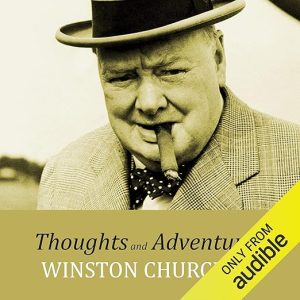
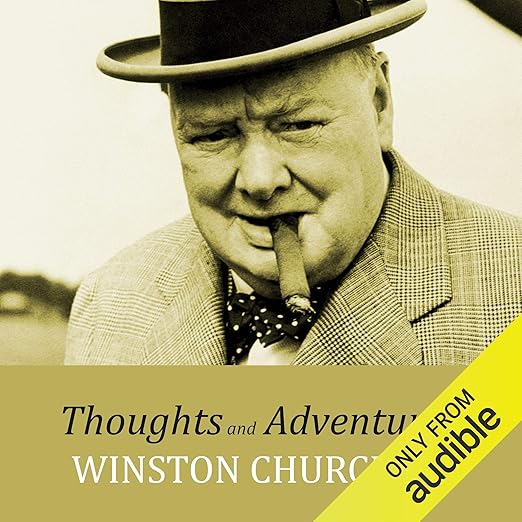
Barnaby Edwards's narration of Winston Churchill's Thoughts and Adventures is one of the most satisfying combinations of voice and text in British historical nonfiction audio. This is the fourth volume in the Winston S. Churchill Essays and Other Works series, gathering the essays Churchill dictated late at night in the 1920s, pieces he called his pot-boilers, sold to newspapers and magazines to fund the Chartwell lifestyle he refused to abandon despite never having the inherited wealth that lifestyle usually required. The audiobook runs ten hours and thirty-five minutes across a collection whose range and variety are the first surprise for new readers and the primary pleasure for those returning to it.
Churchill in the 1920s was in what he himself would later call the wilderness years, politically sidelined after the catastrophic professional humiliation of Gallipoli and watching from a distance as the Conservative Party rebuilt itself without him at its center. These essays were written during that period, and knowing that context, the confident authority with which Churchill pronounces on everything from the future of aviation to the character of general elections reads as both genuinely impressive and as the particular bravado of a man who had no intention of staying in the wilderness. He writes about submarines, spies, Cartesian philosophy, the value of cartoons, flying, elections, and the problem of what it would mean to live your life again with full foreknowledge. The essay that closes the collection, on painting, is among the most personal things he ever published.
The painting essay, also known as a standalone piece called Painting as a Pastime, describes Churchill's discovery of oils as a form of psychological recovery after Gallipoli. It has circulated widely on its own, and hearing it here as the conclusion to a collection that begins with Churchill asking whether he would live his life again gives it a weight that reading it alone does not. The framing device of the collection, such as it is, turns out to be Churchill making a case for his own continued engagement with a world he is currently observing rather than shaping. The essays are the proof of that engagement. Whatever his political situation at the time of writing, Churchill was still synthesizing, still finding patterns, still pronouncing with the conviction of a man who expected to be right.
Edwards Modulates Across Spies, Flight, and Submarines
Barnaby Edwards is one of the more reliable narrators working in British historical nonfiction audio, and his performance here reflects a careful reading of the material. Churchill's prose has its own rhythm, a preference for short declarative sentences broken by long Latinate constructions, and Edwards navigates that cadence without either flattening it into neutrality or heightening it into parody. The essay on spies, the account of the Siege of Sydney Street in which Churchill as Home Secretary turned up in person, and the piece on flying all have different energy from the political reflections, and Edwards modulates accordingly. The essay on submarines carries the technical fascination of someone who actually understood the mechanics, and Edwards reads it with the appropriate register of informed enthusiasm rather than performed wonder.
At ten and a half hours, the collection never outstays its welcome because the essays are individually self-contained. Unlike a narrative history that demands sustained attention to a single thread, this can be listened to in sections without loss of continuity, which makes it an ideal long-commute or evening-read audiobook for listeners who have difficulty sustaining attention across extended narratives. One reviewer noted the essays are models of clarity, and the audio format validates that assessment consistently, since Churchill's structure is always audibly logical even when his subject matter is deliberately eccentric or playful.
Primary Source, Not Balanced Historical Analysis
The historical context matters in specific places. Several essays engage directly with interwar debates that require some background to follow, particularly those touching on the Irish question, the General Strike, and the future of the League of Nations. Churchill's political positions are presented without apology or counterbalance, which is appropriate for a collection of his own essays but means the audiobook should be understood as primary source material rather than balanced historical analysis. His attitudes toward empire, which appear occasionally, reflect the assumptions of a mid-1920s British statesman with complete confidence in Britain's imperial role. The essays on future technology, particularly the piece on what aviation will mean for warfare and civilization, are remarkable for their specific accuracy in several predictions and their confident blind spots in others, which makes them worth particular attention as evidence of how a genuinely intelligent observer navigates uncertainty about the future.
Hearing Churchill Directly Instead of Through Biographers
Churchill admirers who have read the major biographies and want to encounter his thinking in his own voice rather than through a biographer's interpretation will find this collection indispensable. History readers interested in the interwar period more generally will find firsthand perspective on the political texture of the 1920s from someone who was simultaneously a major actor in recent events and a frustrated observer of current ones. Listeners who want political biography in narrative form, with a continuous story and a building argument, should look elsewhere in the Churchill Essays series. This collection rewards the kind of attention you give to a long conversation with someone who has seen a great deal and has strong views about all of it, which is precisely what the Chartwell dinner analogy in the collection's own framing promises and which Edwards's narration delivers consistently across the full runtime.
Before You Listen
Is this audiobook part of a series, and does the listening order matter?
It is the fourth volume in the Winston S. Churchill Essays and Other Works series. Each volume collects different essays and can be listened to independently. The chronological order of the series reflects Churchill's life stages but is not required for comprehension of individual volumes.
How does Barnaby Edwards handle the different tones across Churchill's essays in this audiobook?
Edwards modulates significantly across the collection, distinguishing the dry political analysis from the more personal pieces like the painting essay and the adventure accounts. He avoids imposing a uniform Churchillian gravitas that would flatten the genuine variety of register Churchill employed across such different subjects.