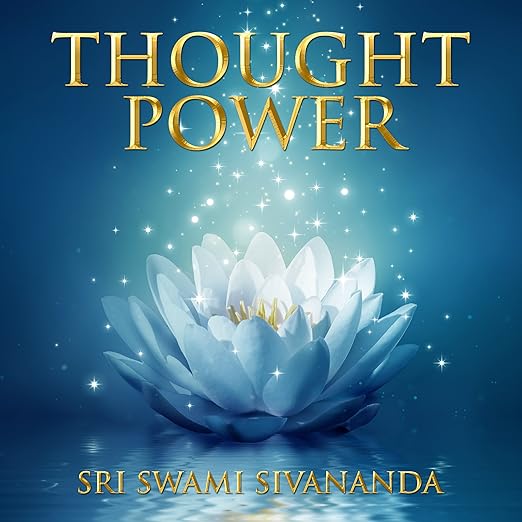
Quick Take
- Narration: Greg Young delivers the formal, meditative prose of Sri Swami Sivananda with appropriate gravity. Measured and deliberate, which suits the text’s devotional register.
- Themes: The transformative power of thought, spiritual discipline, the relationship between mind and character
- Mood: Contemplative, elevated, and demanding patient attention
- Verdict: A foundational yogic text that rewards serious students of Vedantic philosophy. Those seeking a casual introduction to mindfulness will find it dense and demanding.
There is a category of book that does not submit to the kind of listening you do while doing something else. Thought Power by Sri Swami Sivananda is emphatically in that category. I tried it first during a morning walk and found that the prose, formal, elevated, and structured around a philosophy that demands active engagement, kept sliding past me without landing. I came back to it on a quiet evening with no other task competing for my attention, and the experience was substantially different. Sivananda’s work rewards the kind of listening that the format of audiobooks does not always encourage, and understanding that before you press play will shape whether you find this four hours illuminating or impenetrable.
Sivananda was one of the most prolific writers in the Vedantic tradition, a physician who became a monk and founded the Divine Life Society in 1936. Thought Power is not an introduction to yoga or a popular wellness text. It is a philosophical and spiritual examination of how thought functions as the fundamental substance of a person’s character, destiny, and spiritual development. The claims it makes are large. The synopsis describes it as carrying life-transforming value and suggests that no one who listens with genuine attention will remain unchanged, and while that language reads as hyperbolic, the tradition from which Sivananda writes has a four-thousand-year argument behind it.
What Sivananda Is Actually Arguing
The central thesis of Thought Power is that thought is not merely a passive reflection of reality but an active force that shapes the thinker, the thinker’s relationships, and ultimately the thinker’s spiritual trajectory. This is not a novel claim. You can find it in Stoic philosophy, in New Thought American tradition, in cognitive behavioral therapy’s more popular formulations. But Sivananda approaches it from within the framework of Vedantic philosophy and yogic practice, which gives it a specific texture and vocabulary that differs from the Western self-help versions of the same idea.
One reviewer with a long background in metaphysics described Sivananda’s books as worth their weight in precious gems, while a more measured review noted it is good for beginners but may seem repetitive to readers who have worked extensively with yogic texts. Both assessments are accurate. The book’s organization is cumulative rather than linear: Sivananda circles the central idea from multiple angles, addressing the relationship between thought and health, thought and character, thought and the divine, in overlapping ways that may feel redundant if you are reading for new information but feel reinforcing if you are reading for practice.
Greg Young’s Narration and the Problem of Sacred Text
Greg Young is a narrator with a substantial catalog across audiobooks, and his delivery of Sivananda’s prose is appropriately measured and formal. The text is not conversational. It is addressed to the reader as a student addressed by a teacher, and Young does not attempt to modernize or domesticate the register. This is the right call. Sivananda’s authority in the text is partly a function of its distance from casual speech, and a narrator who tried to make this sound like a podcast conversation would be doing violence to the material.
At four hours, this is a compact listen for the depth it contains. The brevity is not a deficiency. Sivananda is dense but not verbose, and he does not pad his arguments. Listeners who are genuinely engaging with the material rather than listening passively may find that four hours requires multiple sessions to process fully. There is no shame in treating this like a course rather than a one-time experience. The meditative repetition built into the text actually rewards this approach, as returning to passages with fresh attention reveals dimensions that a single pass might not surface.
The Vocabulary of Transformation and Who It Is Written For
Sivananda writes about rendering our lives into grand stories of the epic unfolding of the divine truth we enshrine, the divine light we bear, and the divine perfection we hold in our inner being. This is not the language of contemporary wellness culture. It is the language of a classical spiritual tradition, and readers who are looking for that tradition will find this text genuinely nourishing. Readers who are looking for practical techniques and accessible language will find it inaccessible and abstract in ways that popular mindfulness publishing carefully avoids.
The reviewer who called it a must have in every yogi’s library is giving the most accurate targeting information available. Thought Power is for people already situated in a yogic or Vedantic practice who want their philosophical foundation to deepen, or for people drawn to contemplative traditions who want a rigorous, traditional treatment rather than a modern adaptation. Approached on its own terms, with appropriate preparation and patience, this audiobook offers something that a great deal of contemporary spiritual publishing cannot: a direct connection to a lineage of thought rather than a product designed for a contemporary audience.
How to Approach This Listen and What to Expect From It
The practical guidance for anyone considering Thought Power as an audiobook is straightforward: set aside the time properly. Do not listen while driving, not because the content is dense in a way that demands constant processing, but because Sivananda’s prose operates at a frequency that requires quiet to receive. The best listening context is one where you can pause, sit with a passage, and return. The four-hour runtime is genuinely short for the philosophical scope the book is attempting, and listeners who race through it will receive a fraction of what the text offers.
For listeners who make that commitment, the rewards are real. Multiple reviewers describe having their lives transformed, their minds opened, their relationship to thought itself altered. Those are large claims, but they come from readers who engaged with the material on its own terms rather than measuring it against contemporary self-help standards. That is the instruction this audiobook most needs: come to it as a student, not as a consumer, and it will meet you accordingly.
Frequently Asked Questions
Is Thought Power an appropriate starting point for someone new to yoga and Eastern philosophy, or does it require prior familiarity with Vedantic concepts?
Reviewers describe it as suitable for beginners in the sense that it does not assume advanced practice, but the philosophical framework and formal register are demanding for readers with no exposure to yogic or Vedantic traditions. A complete beginner may find the vocabulary and concepts unfamiliar enough to be a barrier. Some background in yoga philosophy would help considerably.
How does Thought Power differ from modern mindfulness and positive-thinking books that cover similar ground about the power of thought?
Sivananda writes from within the Vedantic philosophical tradition, which means the framework, vocabulary, and ultimate aims are significantly different from Western self-help or mindfulness traditions. The goal is not productivity or wellbeing in the contemporary sense but spiritual transformation and the development of what he calls divine perfection. The differences are theological and teleological, not merely stylistic.
Reviewers with extensive yogic reading find it repetitive. Is that a fair criticism or a misreading of how the book is structured?
It is a structural feature of the text rather than a flaw. Sivananda circles the central arguments from multiple angles, which is consistent with a teaching approach that values reinforcement and contemplation over linear progression. Readers expecting systematic argument may experience this as redundancy. Readers approaching it as a devotional or meditative text will find the repetition functional and intentional.
Greg Young has narrated across many genres. Does his narration of a Vedantic sacred text present any challenges with terminology or pronunciation?
The book is written in English and does not require extensive Sanskrit terminology beyond what would be familiar to readers with any exposure to yoga culture. Young’s delivery is measured and respectful of the formal register without stumbling over terminology. Listeners with deep knowledge of the tradition may notice occasional variations, but nothing that disrupts comprehension of the text.