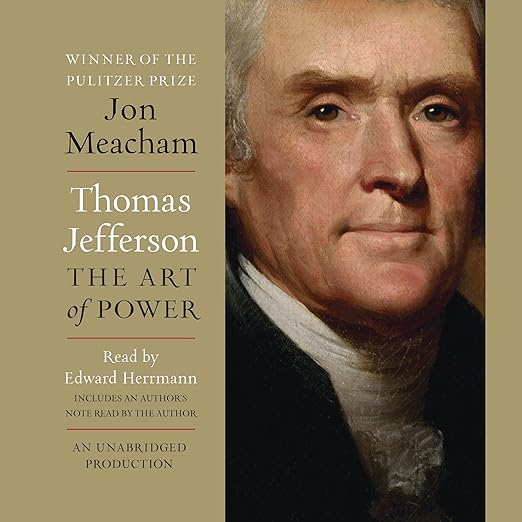
Jon Meacham, who won his Pulitzer Prize for a different presidential biography, brings that same instinct for finding the private man inside the public monument to Thomas Jefferson: The Art of Power, and Edward Herrmann's narration across nearly nineteen hours of audiobook makes that private Jefferson, appetite, contradictions, and all, genuinely audible rather than merely described on the page.
Meacham's Ongoing Project on Power Itself
Meacham built this biography on archives across the United States, England, and France, plus unpublished transcripts of Jefferson's presidential papers, and the resulting portrait balances the political operator against the private man: his passions for women, family, science, architecture, gardening, and Monticello sit alongside his skill at moving allies and marshaling ideas through fierce partisan opposition. The book's real subject, as the title promises, is power itself, how Jefferson acquired it, used it, and occasionally lost his grip on it.
Rather than a cradle to grave chronological march, Meacham keeps returning to Jefferson's specific talent for political survival, learning from mistakes and enduring where contemporaries faltered, a throughline the synopsis frames explicitly as resonant with any era of ferocious partisanship and economic uncertainty. That focus gives an otherwise familiar subject, a founding father already covered in dozens of biographies, a genuinely distinct angle to organize around.
Meacham's broader bibliography backs up his credentials for this specific project. His earlier biography American Lion, covering Andrew Jackson's presidency, won the Pulitzer Prize, and he has returned repeatedly to the question of how individual character shapes the exercise of power across American history, including later books on Franklin Roosevelt and Winston Churchill's wartime partnership and on civil rights leader John Lewis. Thomas Jefferson: The Art of Power fits squarely inside that ongoing project rather than standing apart from it.
Herrmann Won an Emmy for His FDR
Edward Herrmann brings a long, well regarded career in audiobook narration to this project, along with a personal connection to American presidential history worth noting: he won an Emmy for his on screen portrayal of Franklin Roosevelt decades earlier. That familiarity with the register of American political biography carries over clearly here, a measured, authoritative delivery suited to sweeping historical material without tipping into dry recitation.
One reviewer, who describes having read Jefferson biographies ranging from nineteenth century hagiography to the dullest textbooks to modern criticism, singles this one out as genuinely exceptional, a strong claim from someone who does not praise the genre lightly. That kind of comparative endorsement, from a reader with real range across the existing Jefferson literature, carries more weight than a general five star review would on its own.
Herrmann's career extended well beyond audiobooks and his Emmy winning FDR portrayal. Television audiences also know him as Richard Gilmore on Gilmore Girls, a role that showcased the same combination of warmth and old fashioned authority he brings to Jefferson here, and that range across drama, comedy adjacent family television, and serious narrated history is part of what makes his reading feel neither stiffly academic nor artificially theatrical.
Punchy, Brief Chapters Across Nineteen Hours
One reviewer notes the chapters run punchy and relatively brief, some as short as five or six pages, and that structural choice translates into a genuinely brisk, propulsive audiobook for a subject that could easily feel like homework at this length. Even so, nearly nineteen hours remains a serious commitment, and listeners should plan for a real investment of time rather than a quick survey.
The synopsis is upfront that Meacham engages directly with Jefferson's appetite, sensuality, and personal contradictions rather than presenting a purely heroic monument, but the book's central lens stays on political mastery specifically, the art of power promised in the title, rather than functioning as a full, sustained reckoning with Jefferson as a slaveholder. Listeners specifically seeking that reckoning as the book's primary focus should know it is present but not the organizing argument.
Reviewer Steven Peterson references Joseph Ellis's American Sphinx as a comparison point, which is useful context: this biography sits inside a genuinely crowded field of major single volume Jefferson accounts, and per another reviewer's own wide reading across that field, it distinguishes itself from both older hagiography and more recent, more critical treatments rather than simply adding another entry to the pile.
Structurally, Meacham organizes the book less as an even march through eighty years of life and more as a series of extended set pieces built around key episodes: drafting the Declaration, the presidency itself, and Jefferson's long retirement at Monticello shaping his legacy in real time. Listeners should expect the pacing to slow and speed up around these anchor points rather than moving at a uniform clip from birth to death.
Jefferson's key relationships with his political contemporaries get real attention too: his uneasy partnership and eventual distance from Washington, his bitter rivalry with Alexander Hamilton over the shape of the federal government, and his famous rupture and late life reconciliation with John Adams, conducted almost entirely through letters. Meacham uses these relationships to show Jefferson's political instincts in action rather than simply asserting his brilliance, exactly the kind of texture that makes an eighteen hour biography feel earned rather than padded.
Moving From Lincoln Through Washington to Here
Recommend this to Founding Fathers history enthusiasts, existing fans of Meacham's other presidential biographies, and listeners working through a personal project of reading or listening to presidents in rough chronological order, a pattern one reviewer specifically describes after moving from Lincoln through Washington and Grant before arriving here. Fans of Edward Herrmann's narration work more broadly will also find him well matched to the material.
Skip it if you want a book centered specifically and primarily on Jefferson's relationship to slavery as its main argument, since that subject is present but not the book's organizing lens, or if you prefer a shorter, single sitting biography over an eighteen hour commitment covering an entire, complicated political life.
- Narration: Edward Herrmann brings a long audiobook career and a personal on screen history with American presidential figures, delivering measured, authoritative narration suited to sweeping biography.
- Themes: political survival and partisan warfare, private appetite versus public monument, power as Jefferson's defining skill.
- Mood: Absorbing and brisk despite its length, thanks to short, punchy chapters.
- Verdict: A strong pick for history buffs even in a crowded field of Jefferson biographies, elevated by Herrmann's authoritative narration.