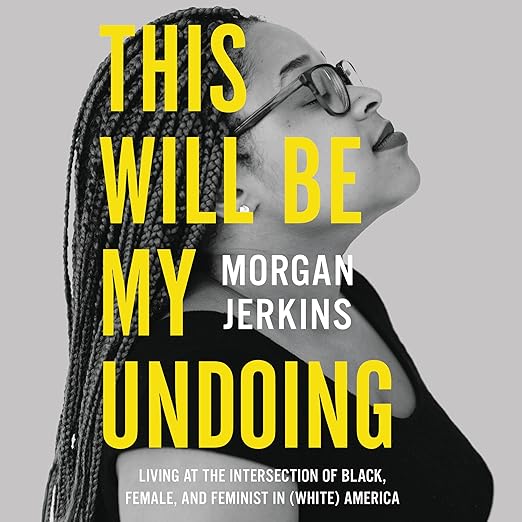
Morgan Jerkins narrates This Will Be My Undoing herself, and that choice is not incidental to how the audiobook works. This is an essay collection about what it feels like to occupy a particular body in a particular culture, and Jerkins's voice carrying those essays does something that a hired narrator could not. The difference between reading about black female embodiment and hearing a young black woman articulate it in her own voice is a difference in kind rather than degree. The essays cover Sailor Moon, Rachel Dolezal, therapy stigma, the paradox of black female sexuality in American culture, disability and the "Black Girl Magic" movement, being a black visitor in Russia - and they cohere because they are all dispatches from the same consciousness navigating the same fundamental conditions.
Jerkins is in her twenties when she writes these essays, and she is candid about what that means: she is working out ideas in real time, which gives the collection its energy and its occasional unfinished quality. The central inquiry driving all of it is one she states directly: what does it mean to exist as a black woman in America when the mainstream culture systematically misreads, objectifies, and marginalizes that existence? The comparison points the publisher identifies - Roxane Gay's Bad Feminist, Rebecca Solnit's Men Explain Things to Me, Chimamanda Ngozi Adichie's We Should All Be Feminists - are accurate in spirit. Jerkins's focus is narrower and more personal than any of them, but she writes with the same combination of critical intelligence and firsthand authority that makes that lineage feel earned rather than aspirational.
The essay form here is not the detached critical essay of academic journals but the linked personal essay that moves between autobiography and cultural analysis within a single piece. Jerkins becomes, as she describes it, both narrator and subject - a doubled position that is the source of the collection's particular power. She is analyzing forces that have acted on her specifically, which gives her access to evidence that purely theoretical feminism cannot provide, and she is writing with enough critical distance to make the analysis useful beyond autobiography.
Jerkins Narrates With the Control of Dual Ownership
One reviewer described identifying with Jerkins "in so many places" despite expecting to find little common ground - noting moments of tears and recognition across the essays, including the passage on Michelle Obama and what she meant to black women specifically. Another reviewer had followed Jerkins's work closely from before publication and described having "half of the book highlighted" during an intensely engaged first reading. The self-narration delivers these moments with the control that comes from knowing the material completely - Jerkins wrote it, lived it, and reads it with the authority of that dual ownership. The linked essay structure suits audio particularly well; each piece functions as a complete unit while connecting to the larger argument, which means you can direct full attention at a single essay without losing the thread of the collection.
One reviewer who followed Jerkins from their shared time at Princeton described the book as something they had been anticipating and telling people about for months before publication. That kind of sustained word-of-mouth investment speaks to what Jerkins is doing in these essays: providing language for experiences that her readers recognize but have not seen articulated quite this precisely before.
Offering Testimony Instead of a Debate
The essay form means the experience is different from memoir's sustained narrative or cultural criticism's maintained theoretical distance. Jerkins moves between modes - personal anecdote, cultural analysis, historical context, direct address - sometimes within a single paragraph, and that movement is a strength when it works and a source of tonal disruption when it transitions too quickly. The collection rewards listeners who give each essay its own attention rather than treating the runtime as a continuous argument to be followed sequentially. The political positions throughout are clear and unapologetic, and listeners approaching from outside the experiential frame Jerkins is writing within should bring genuine openness rather than intellectual distance. These essays are not proposing a debate; they are offering testimony, and they function best received in that spirit. Some of the earlier essays are more uneven than the later ones, which is characteristic of debut collections and does not diminish what Jerkins is achieving overall.
A Double Position, Deliberate and Generative
Readers of contemporary feminist essay collections who want a voice that is specific and personal rather than broadly theoretical will find Jerkins distinctive and precise in ways that most cultural criticism is not. Listeners interested in the analysis of blackness in American culture - particularly in relation to pop culture, body politics, and feminist movements that have historically failed black women - will find the range of subjects and the depth of engagement unusual for a debut. Those interested in comparing how different writers handle self-narration of essay collections will find Jerkins's reading a compelling case for why some books belong in the author's own voice and no other. Approach with genuine engagement if you are coming from outside the experiential frame. Jerkins is both narrator and subject, that double position is deliberate and generative, and the discomfort it sometimes produces for readers who encounter the work from a distance is exactly the discomfort the essays are designed to create.