
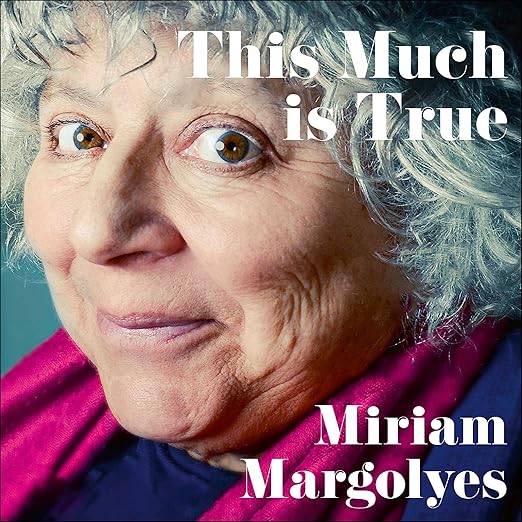
- Performance: Miriam Margolyes narrating her own life story is the entire production. Her voice carries decades of stage and screen craft, moving between comedy and genuine vulnerability with complete authority.
- What it covers: LGBTQ+ identity across generations, the intersection of Jewish heritage and British cultural life, celebrity as lived experience rather than persona
- Feel: Outspoken and warm, with the specific energy of someone who has decided to tell the whole truth at eighty
- Our call: Margolyes in her own voice is an unrepeatable audio experience; this memoir rewards the full fifteen hours.
When She Drops Her Voice to Confide
Who else but Miriam Margolyes could make you feel, over fifteen hours of audiobook listening, that you have been sitting across from her at a kitchen table, slightly scandalized and entirely delighted? That is the precise quality of this memoir, and the fact that Margolyes narrates it herself is not incidental: it is the entire point. Her voice, instantly recognizable from decades of screen and stage work, carries a volume and texture that print simply cannot replicate. When she drops her voice to confide something genuinely personal, you feel the shift in register. When she erupts into laughter at her own story, it is infectious without being performed.
This Much Is True was published when Margolyes was eighty, which gives it a particular quality: the retrospective confidence of someone who no longer has anything to prove or protect. She moves through her Cambridge education, her career, her LGBTQ+ identity, her Jewish heritage, and her complicated feelings about all of it with a directness that occasionally makes you catch your breath. Stephen Fry's endorsement that 'no one on earth is quite so wonderful' may be hyperbolic, but it gestures at something real about her particular brand of outspoken warmth.
Bob Monkhouse, the Best Male Kiss She's Had
The central pleasure of this audiobook is Margolyes herself. Her career spans Lady Whiteadder in Blackadder, Professor Sprout in Harry Potter, the Cadbury Caramel Rabbit, and dozens of roles across six decades of British and international screen work. But the memoir is far richer and stranger than a career retrospective. She describes being conceived during an air raid, explains how that gave her curly hair (her theory, not science), and details the pranks that made her the 'naughtiest girl Oxford High School ever had.' She was the first woman to say a particular expletive on British television, on University Challenge, and she recounts the aftermath with characteristic lack of remorse.
The name-dropping is genuinely extraordinary. Martin Scorsese and Barbra Streisand sit alongside Isaiah Berlin and Bob Monkhouse in a cast list that spans continents and decades. Margolyes does not deploy these names for status; she deploys them because they are the actual population of her life. Her encounter with the Queen, being told off with regal efficiency, is a highlight. Her account of Bob Monkhouse as 'the best male kiss she's ever had' is exactly the kind of left-field detail that makes this memoir work as audio.
One reviewer noted that Margolyes is 'a lot quirkier than even her biggest fans realize.' That understatement is accurate. She is funnier and more serious minded than the grand dame persona sometimes suggests, and the combination of sustained humor and genuine emotional depth across fifteen hours never feels forced. Her obsession with her Jewish identity, noted by at least one listener as occasionally overwhelming, is actually one of the memoir's more consistent threads: she does not separate her cultural inheritance from her professional or personal self, and that refusal to compartmentalize is part of what makes her voice so particular.
A Potty Mouth That the Book Won't Soften
Margolyes has a 'potty mouth,' as one reviewer from County Durham put it with evident discomfort. She swears freely, and the memoir does not soften this for an audience that might prefer politer language. That authenticity is inseparable from what makes her narration compelling, but listeners who find casual profanity jarring should know it is present throughout.
The structure is episodic rather than strictly chronological. Margolyes moves associatively through her life, which suits audio listening but can make the overall arc feel loose. Some stories arrive with tremendous precision and emotional weight; others feel like extended anecdotes that she is enjoying telling perhaps slightly more than the listener needs. At fifteen hours, moments crop up where a tighter editorial hand would have served the material.
Demonstrating Resilience Instead of Performing It
One reviewer mentioned the absence of any discussion of her role as Aunt Prudence in 'Miss Fisher's Murder Mysteries,' which apparently disappointed at least one fan. The memoir cannot include everything, but it does give extensive coverage to the roles and encounters that mattered most to Margolyes herself, which is ultimately the more interesting choice.
A word about the memoir's treatment of mortality is warranted. Margolyes wrote this at eighty, and the book carries the specific quality of someone taking stock from a vantage point most people do not reach. Her willingness to discuss the deaths of people she loved, her parents, colleagues, friends lost across six decades of a very full life, gives the humor its weight. She is not performing resilience; she is demonstrating it, which is a different and more interesting thing. The audiobook's longest passages are often the most unexpected ones, digressions that reveal more than the official life story ever could.
A Different Voice Would Lose the Energy
Fans of Miriam Margolyes will find this exactly what they hoped for and somewhat more than they expected. The self-narration is essential; a different voice reading this material would lose the specific vocal energy that makes the stories land. Listeners who enjoy British memoir in the register of outspoken celebrity autobiography, interested in LGBTQ+ life histories across decades when that required real courage, will also find much to engage with. Anyone curious about British cultural life from the 1960s onward, told by someone who was genuinely in the middle of it, will discover a rich and often surprising account.
Those who prefer tightly structured memoir with a clear narrative through-line may find the episodic quality frustrating. And listeners sensitive to profanity, strong opinions delivered without apology, or frank discussion of sexuality should know that all of these are present throughout. For everyone else, this is an audiobook that earns its runtime.
Before You Listen
Does Miriam Margolyes narrating her own audiobook significantly change the experience?
Completely. The memoir was written for her voice, and her delivery, complete with comic timing, confidential asides, and genuine emotional shifts, is the primary reason to choose this audiobook over reading the print version. Another narrator would produce an entirely different, considerably lesser experience.
Is this audiobook structured chronologically or does it jump around?
It moves associatively rather than strictly chronologically. Margolyes organizes by theme and impulse as much as by timeline, which works well for audio but means some listeners may find the structure loose. The episodic rhythm suits long listening sessions rather than short dips.
At fifteen hours, does the audiobook sustain its quality throughout?
Mostly yes, with occasional stretches where the editorial hand could have been tighter. The strongest passages are the personal and emotional ones rather than the career chronology. Listeners who come for Margolyes's voice and personality rather than completeness of career coverage will find the runtime consistently rewarding.







