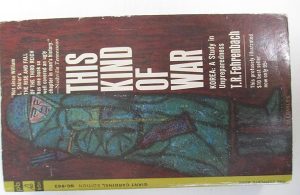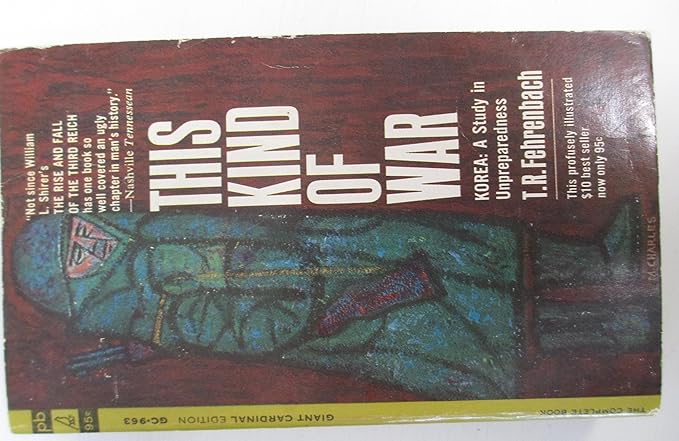
I came to This Kind of War through a recommendation from someone who described it as the book that explains every American military failure since 1953. That framing stuck with me through all 24 hours of the audiobook, and I think it is more accurate than it sounds like it should be. T. R. Fehrenbach published this in 1963, updated it for a 50th anniversary edition that added maps, photographs, and battlefield diagrams, and what you find inside is one of those rare military histories that cares more about truth than about comfort.
The Korean War is sometimes called the forgotten war, occupying the space between the moral clarity of World War II and the cultural convulsion of Vietnam. Fehrenbach's title is a deliberate corrective to that forgetting. It is also an argument. This kind of war, meaning limited, ambiguous, fought by professional soldiers and conscripted civilians in brutal conditions for objectives that shifted almost monthly, is what war actually looks like. The romantic version of conflict as a crusade with defined ends belongs to a different history.
First, the Big Picture
What Fehrenbach accomplishes that most military historians do not is the dual perspective. He provides what the synopsis accurately describes as a clear panoramic overview alongside a sharply drawn you-were-there account of American troops in fierce combat. These are usually incompatible objectives: historians who maintain analytical distance tend to lose the individual, while writers who foreground personal experience tend to lose the strategic context. Fehrenbach holds both simultaneously through his sourcing, which includes official records and operations journals alongside the personal accounts of small-unit commanders and their soldiers.
The result is that you understand the battle for the Chosin Reservoir both as a strategic disaster shaped by MacArthur's overreach and as an experience of cold that froze weapons, killed the wounded overnight, and required men to make impossible calculations about who could be carried and who could not. Neither frame erases the other. The political and the personal are in constant dialogue throughout the book, which is what elevates it from military reference to something with genuine literary structure.
The book's thesis, which he states early and returns to throughout, is that the United States sent civilian soldiers to fight a professional war. The men who went to Korea were largely World War II veterans who had been discharged and returned to civilian life, draftees, and National Guard units that had been reduced to a fraction of their authorized strength. They were asked to fight an adversary that was, in certain respects, a professional force with ideological conviction, in terrain and climate for which American training had not prepared them, under rules of engagement that were themselves contested between the military and the civilian government.
This argument carries particular weight today, as Fehrenbach repeatedly notes that the lessons he is documenting were available to anyone willing to look at them honestly. The 50th anniversary edition's addition of maps and battlefield diagrams translates partially to the audio through Foley's narration, which occasionally references the visual elements listeners without access to a companion edition cannot see. This is a minor frustration in an otherwise excellent production.
Before You Commit to This Kind of War
Twenty-four hours is a serious commitment to any audiobook, and military history in particular can become a series of similar-sounding engagements without sufficient variation in the narration to sustain attention. Foley keeps this from happening. His voice has the professional restraint appropriate to Fehrenbach's own prose style, and he modulates pace effectively between the analytical passages, where the argument needs room to develop, and the combat sequences, where a more driven delivery is appropriate.
The absence of listener reviews for this entry should not be read as indifference. This Kind of War has a 4.6 rating from over 1,100 listeners, which for a 24-hour military history is strong. The audience is self-selecting in a way that tends to produce less social media noise: these are people who came specifically for this book and found what they came for.
Is This One for You?
Reading Fehrenbach in 2026 with the long arc of American military history since Korea available for comparison makes This Kind of War an uncomfortable book in the best sense. His critique of what happens when a democratic society sends men to fight limited wars with ambiguous objectives, inadequate preparation, and a political establishment that has not been honest with the public about what is being asked of them, is not a historical argument. It is a description of a pattern. Listeners who come for Korean War history will get an excellent account of it. Listeners who are willing to follow Fehrenbach's argument to its conclusions will find something more useful and more troubling than history.
The Short Version
- Read by: Kevin Foley handles the scope and density of a 24-hour military history with consistent professional clarity; his voice suits the book's tone of rigorous, unsentimental analysis.
- At its heart: The nature of limited war, infantry combat in Korea, American military doctrine under pressure
- Vibe: Unsparing and methodical, with an urgency that comes from historical lessons still unlearned
- Short version: The definitive account of the Korean War for listeners who want ground-level truth rather than strategic overview.
Common Questions
Is This Kind of War accessible to listeners without a military background?
Yes, though it rewards some familiarity with basic military organization and the political context of the early Cold War. Fehrenbach writes for an educated general audience rather than specialists, and his descriptions of combat are visceral enough to be understood without technical knowledge. Listeners who struggle with maps and unit designations may find the opening chapters require re-listening.
How does the 50th anniversary edition differ from the original?
The anniversary edition added maps, photographs, and battlefield diagrams, which Fehrenbach's original lacked. For the audiobook format, some of these visual additions are referenced in the narration but cannot be fully conveyed through audio alone. Listeners who want the visual supplements may benefit from pairing the audiobook with a print or digital copy.
What is Fehrenbach's central argument about why Korea went the way it did?
His primary argument is that the United States committed civilian soldiers, inadequately trained and drastically understrength, to fight a professional war under conditions and with objectives they had not been prepared for. He sees this as both a military failure and a political one, rooted in how American society understands the relationship between citizenship and military service.
Does This Kind of War address the political decisions that shaped the Korean War or focus primarily on the soldiers?
Both, and that dual focus is the book's structural distinction. Fehrenbach moves between the strategic and political level, including MacArthur's overreach and the Washington constraints on the military, and the ground level of small-unit infantry combat. Neither perspective is subordinated to the other throughout the book.